



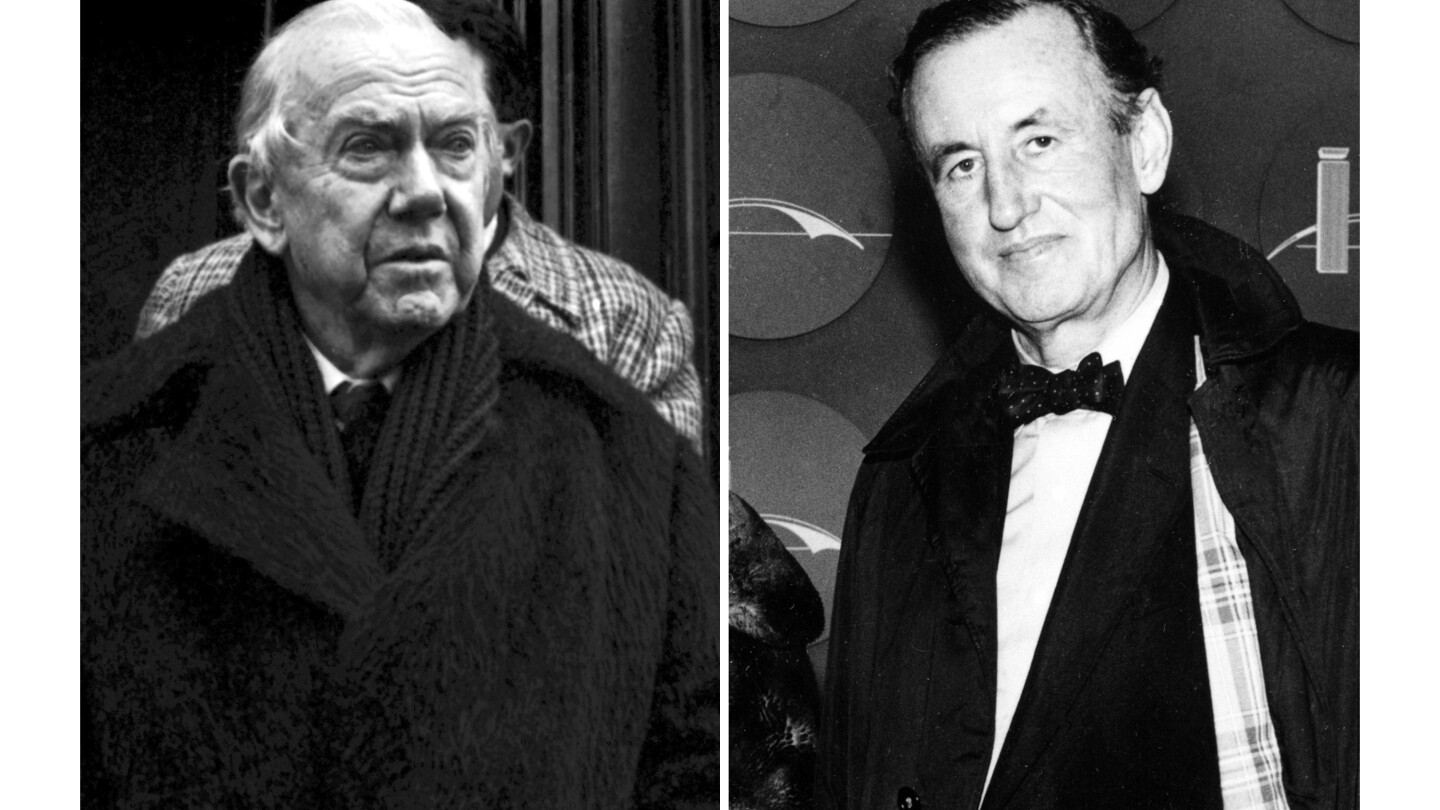
NEW YORK (AP) — “James Bond” creator Ian Fleming didn’t need to write about Cold War intrigue to consider the ways people scheme against each other. “The Shameful Dream,” a rare Fleming work published this week, is a short story about a Londoner named Bone, Caffery Bone.
Fleming’s protagonist is the literary editor of Our World, a periodical “designed to bring power and social advancement to Lord Ower,” its owner. Bone has been summoned to spend Saturday evening with Lord and Lady Ower, transported to them in a chauffeur-driven Rolls-Royce. Bone suspects, with a feeling of “inevitable doom,” that he is to meet the same fate of so many employed by Lord Ower — removed from his job and soon forgotten.
“For Lord Ower sacked everyone sooner or later, harshly if they belonged to no union or with a fat check if they did and were in a position to hit back,” Fleming writes. “If one worked for Lord Ower one was expendable and one just spent oneself until one had gone over the cliff edge and disappeared beneath the waves with a fat splash.”
“The Shameful Dream” appears in this week’s Strand Magazine along with another obscure work from a master of intrigue, Graham Greene’s “Reading at Night,” a brief ghost story in which the contents of a paperback anthology becomes frighteningly real. Greene scholars believe that the author of “Our Man in Havana,” “The End of the Affair” and other classics dashed off “Reading at Night” in the early 1960s when he found himself struggling to write a longer narrative.
Strand Magazine is a quarterly publication that has run little-known works by F. Scott Fitzgerald, Ernest Hemingway and many others. Managing editor Andrew F. Gulli noted that the current issue was Strand’s 75th and that he “thought it would be interesting for fans to read stories by these two midcentury literary icons side by side — writers whose approaches to the genre were markedly distinct: Greene, with his moral ambiguity and spiritual tension; and Fleming, with his glamorous take on espionage.”
Fleming, best known for such Bond thrillers as “Dr. No” and “From Russia with Love,” had a career in journalism spanning from the 1930s to the early 1960s, when he was well established as an author. For Reuters in the ‘30s, he wrote obituaries, covered auto racing in Austria and a Stalin show trial in the Soviet Union. After World War II, he served as foreign manager for the Kemsley newspaper group, a subsidiary of The Sunday Times. Fleming died of a heart attack in 1964, at age 56.
Mike VanBlaribum, president of the Ian Fleming Foundation, says that Fleming was clearly drawing upon his own background for “The Shameful Dream.” But biographers disagree over when Fleming wrote it. According to Nicholas Shakespeare’s “Ian Fleming: The Complete Man,” Fleming worked on the story in the early 1950s, based Lord Ower on his boss, Lord Kemsley, and based Bone upon himself. Lord Ower is sometimes referred to as “O,” anticipating the spy chief “M” of the Bond novels.
In “James Bond: The Man and His World,” author Henry Chancellor theorizes that Fleming wrote the story in 1961, and may have been inspired by a dispute with Daily Express owner Lord Beaverbrook over rights to a James Bond comic strip.
VanBlaribum speculates that Fleming wrote it in 1951, citing the author’s reference to a Sheerline saloon, a luxury car that the UK stopped producing in the mid-1950s.
“It is unlikely that Fleming would have used a decade-old car if the story were written in 1961,” he says. “In either event, ‘The Shameful Dream’ was never published. It has been stated that Lord Ower too closely resembled Lord Kemsley.”



Follow