



Starbucks has agreed pay more than $35m (£26m) to thousands of workers in New York City, to settle the city’s claims that the company denied them stable schedules and arbitrarily slashed their hours.
Over 15,000 hourly workers are set to receive $50 for each week they worked during from July 2021 through July 2024, city officials said.
Vilda Vera Mayuga, commissioner of the New York City Department of Consumer and Worker Protection, cited alleged violations of city law requiring predictable schedules for workers.
The settlement, announced on Monday, comes as the coffee chain faces pressure to improve working conditions nationwide.
Starbucks said in a statement that it is “committed to creating the best job in retail and to ensuring our practices follow all laws”. It added that it has recently outlined plans to invest $500m to improve coffeehouse staffing and training.
Officials in New York City started investigating Starbucks in 2022 – a probe that began with dozens of worker complaints and grew to encompass all Starbucks locations across the city.
The city’s worker protection department found “a pattern of systemic violations”, officials said in a statement. Starbucks broke the city’s Fair Workweek Law more than half a million times since 2021, they said, calling the agreement announced on Monday the largest worker protection settlement in the city’s history.
“All workers deserve to be treated with dignity, and we are proud to stand up for our neighbors when a multibillion-dollar company like Starbucks chooses to systematically violate their employees’ rights,” Mayuga said in a statement.
Under the terms of the agreement, Starbucks will also be forced to comply with the city’s worker protection laws moving forward, which require fast food employers to give employees regular schedules and opportunities to take on extra shifts.
The company noted that New York City’s worker protection laws are “complex”.
“We support the intent of the law and remain committed to compliance, but its complexity creates real-world challenges,” Starbucks said. Compensation to employees in New York City will be for legal compliance, not unpaid wages, the chain said.
New York City Mayor Eric Adams called it a “landmark settlement” that will “put tens of millions of dollars back into the pockets of hard-working New Yorkers and reinforce every New Yorker’s right to a reliable schedule, full hours, and basic dignity”.
Starbucks has in recent years faced consumer boycotts, a wave of new competitors and a customer backlash over high prices, as well as turmoil in its leadership ranks.
The chain, under chief executive Brian Niccol, has been working to bring back customers, promising faster service and a return its coffeehouse roots, with ceramic mugs and hand-written notes. In October, Starbucks reported 1% growth in sales at global stores open at least one year – its first quarterly increase in almost two years. But in the US, sales were flat.
Despite some recent progress in boosting sales, the company is still wrestling with a years-long labour fight that threatens to hamper its turnaround. It remains at odds with the Starbucks Workers United union over pay, staffing and hundreds of unresolved charges of unfair labour practice.
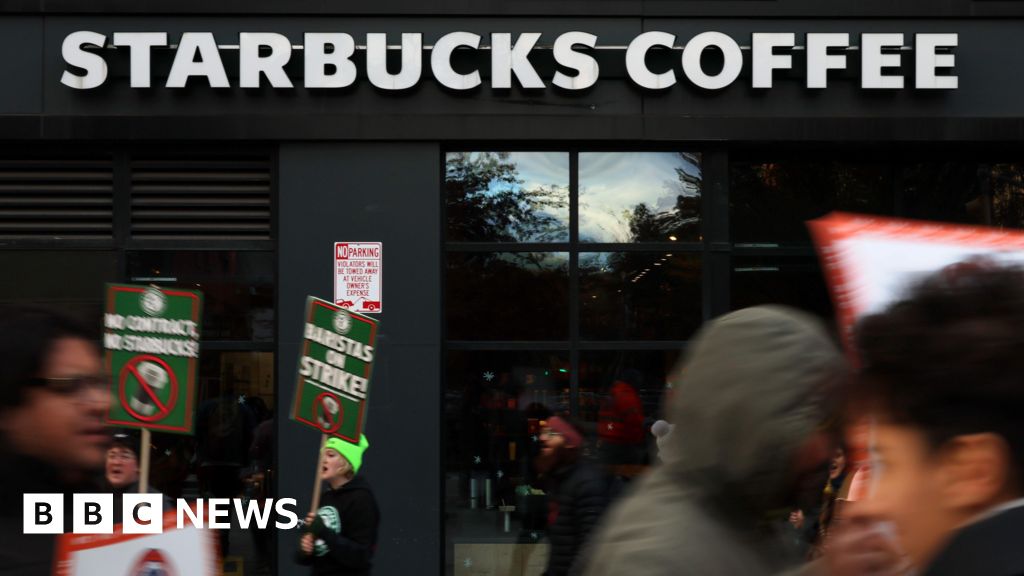
Last month, workers represented by Starbucks Workers United went on a strike in their latest bid to pressure the coffee chain for better pay and staffing after negotiations stalled.
“When this company cuts our hours, understaffs our stores and busts our union, it makes it harder for us to do our job and create that great experience for customers,” Kai Fritz, a union barista, said in a statement on Monday after New York City officials announced their agreement with the company.
“This settlement is a step in the right direction.”
The worker walkout is ongoing and has expanded to more than 120 stores across 85 cities, Starbucks Workers United said. The union has won elections at roughly 5% of the chain’s company-owned US locations since launching four years ago.
Thousands of workers remain on strike – in New York City and beyond – to demand a “fair union contract that memorializes job protections, better staffing, and higher pay”, Lynne Fox, Workers United’s international president, said in a statement.
“For too long, Starbucks has acted with impunity: manipulating schedules, disrespecting workers, and ignoring legal protections put into place by New Yorkers to protect working people from unfair business practices,” Ms Fox said.



Follow