



Heidi Kingstone is a journalist and author covering human rights issues, conflict and politics. Her most recent book is “Genocide: Personal Stories, Big Questions.”
Slavery is alive and thriving, and it’s wrapped inside shiny chocolate bars that promise to be “fair trade,” “child-labor free” and “sustainable.”
In West Africa, which produces more than 60 percent of the world’s cocoa, over 1.5 million children still work under hazardous conditions. Kids, some as young as five, use machetes to crack pods open in their hands, carry loads that weigh more than they do and spray toxic pesticides without protection.
Meanwhile, of the roughly 2 million metric tons of cocoa the Ivory Coast produces each year, between 20 percent and 30 percent is grown illegally in protected forests. And satellite data from Global Forest Watch shows an increase in deforestation across key cocoa-growing regions as farmers, desperate for income, push deeper into forest reserves.
The bitter truth is that despite decades of pledges, certification schemes and packaging glowing with virtue — of forests saved, farmers empowered and consciences soothed — most chocolate companies have failed to eradicate exploitation from their supply chains.
Today, many cocoa farmers in the Ivory Coast and Ghana still earn less than a dollar a day, well below the poverty line. According to a 2024 report by the International Cocoa Initiative, the average farmer earns only 40 percent of a living wage.
Put starkly, as the global chocolate market swells close to a $150 billion a year in 2025, the average farmer now receives less than 6 percent of the value of a single chocolate bar, whereas in the 1970s they received more than 50 percent.
Then there’s the use of child labor, which is essentially woven into the fabric of this economy, where we have been sold the illusion of progress. From the 2001 Harkin-Engel Protocol — a voluntary agreement to end child labor by the world’s chocolate giants — to today’s glossy environmental, social and governance (ESG) reports, every initiative has promised progress and delivered delay.
In 2007, the industry quietly redefined “public certification,” shifting it from a commitment to consumer labeling to a vague pledge to compile statistics on labor conditions. It missed the original 2010 deadline to eliminate child labor, as well as a new target to reduce it by 70 percent by 2020. And that year, a study by the University of Chicago’s National Opinion Research Center found that hazardous child labor in cocoa production increased from 2008 to 2019.
“We covered a story about a ship carrying trafficked children,” recalled journalist Humphrey Hawksley, who first exposed the issue in the BBC documentary called Slavery: A Global Investigation. “The chocolate companies refused to comment and spoke as one industry. That was their rule. Even now, none of them is slave-free,” he added.
As it stands, many of the more than 1.5 million West African children working in cocoa production are trafficked from neighboring Burkina Faso and Mali. Traffickers lure them with false promises or outright abduction, offering children as young as 10 either bicycles or small sums to travel to the Ivory Coast. There, they are sold to farmers for as little as $34 each.
And once on these farms, they are trapped. They work up to 14 hours a day, sleep in windowless sheds with no clean water or toilets, and most never see the inside of a classroom.
Last but not least, we come to deforestation: Since its independence, more than 90 percent of the Ivory Coast’s forests have disappeared due to cocoa farming. In 2024, deforestation accelerated despite corporate commitments to halt it by 2025, as declining soil fertility and stagnant prices pushed farmers farther into the forest to plant new cocoa trees.
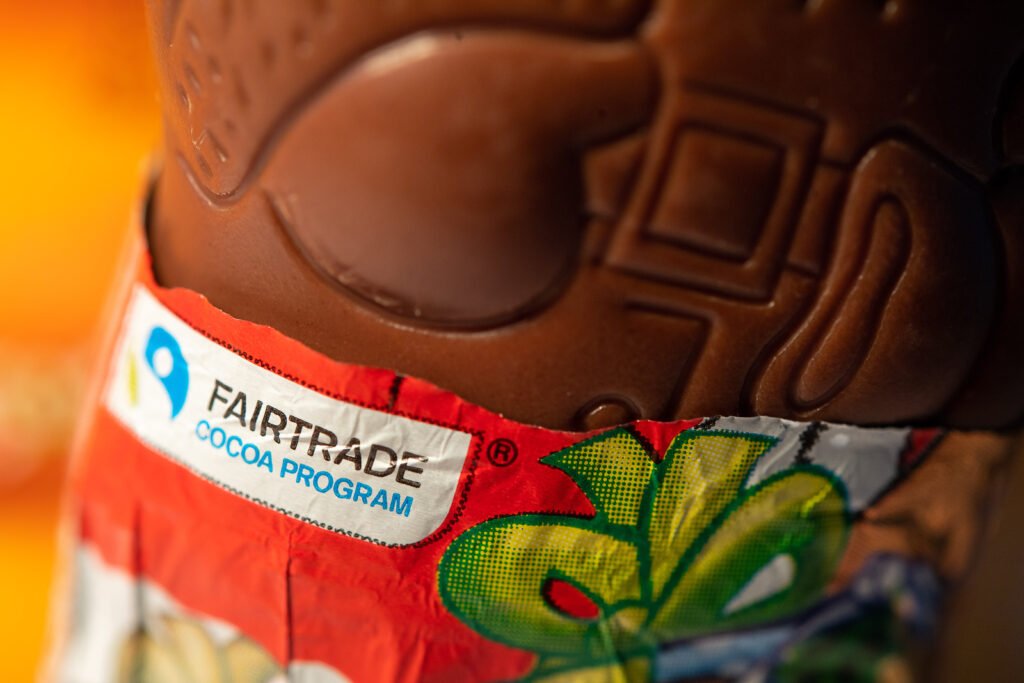
Certification labels like “Rainforest Alliance” and “Fairtrade” are supposed to prevent this. But as Reuters Correspondent for West and Central Africa Ange Aboa described them, such labels are “the biggest scam of the century!”
Complicit in all of this are the financiers and investors who profit. For example, Norway’s sovereign wealth fund is the world’s largest investor, and Norges Bank Investment Management (NBIM) is a shareholder in 9,000 corporations, including Nestlé, Mondelez, Hershey, Barry Callebaut and Lindt — all part of the direct chocolate cluster. NBIM also has shares in McDonald’s, Starbucks, Unilever, the Dunkin’ parent company and Tim Hortons — the indirect high-volume buyer cluster.
“The richest families in cocoa — the Marses, the Ferreros, the Cargills, the Jacobs — are billionaires thanks to the exploitation of the poorest children on earth,” said journalist and human rights campaigner Fernando Morales-de la Cruz, the founder of Cacao for Change. “And countries like Norway, which claim to be ethical, profit from slavery and child labor.”
The problem is, few are asking who picks the cocoa. And though the EU’s Corporate Sustainability Due Diligence Directive, which was adopted last year, requires large companies to address human rights and environmental abuses in their supply chains, critics say the directive’s weaknesses, loopholes, and delayed enforcement will blunt its impact.
However, all of this could still be fixed. Currently, a metric ton of cocoa sells for about $5,000 on world markets, but Morales-de la Cruz estimates that a fair farm-gate price would be around $7,500 per metric ton. To that end, he advocates for binding international trade standards that enforce living incomes and transparent pricing, modeled on the World Trade Organization’s compliance mechanisms. “Human rights should be as binding in trade as tariffs,” he insisted.
The solution isn’t to buy more “ethical” bars but to demand accountability and support legislation that makes exploitation unprofitable. “We can’t shop our way to justice,” he said.
So, as the trees in the Ivory Coast’s forests fall, the profits in Europe and North America continue to soar. And two decades after the industry vowed to end child labor, the cocoa supply chain remains one of the world’s most exploitative and least accountable.
Moreover, the European Parliament’s vote on the Omnibus simplification package last month laid bare the corporate control and moral blindness still present in EU policymaking, all behind talk of “cutting red tape.” “Yet Europe’s media and EU-funded NGOs stay silent, talking of competitiveness and green transitions, while ignoring the children who harvest its cocoa, coffee and cotton,” said Morales-de la Cruz.
“Europe cannot claim to defend human rights while profiting from exploitation.”
However, until the industry pays a fair price and governments enforce real accountability, every bar of chocolate remains an unpaid moral debt.



Follow