



The Labour Government has committed another attack on democracy after weeks of budget leaks, attempts to reverse Brexit and introducing digital ID.
Today, it announced that four mayoral elections set for May of next year will be postponed until 2028, by which time the voting system will have changed.
Voters in Essex, Hampshire and the Solent, Sussex and Brighton and Norfolk and Suffolk are being denied the opportunity to choose who runs their region.
The Government reasons that it needs more time to transition towards combined authorities under its devolution plans. Prime Minister responded this afternoon.
He said: “There are various arrangements being put in place to ensure all the election could take place at the right time, depending on the configurations of the council and other arrangements.”
Isn’t that wonderful? Elections have to take place at the right time. Do you think that means at the right time when he can win them? Has he become the Kim Jong Un of British politics?
Only hold elections when you’ve stuffed the ballot boxes in advance.
Anyway, when asked by lobby journalists to apologise on five separate occasions, Sir Keir’s spokesman refused to do so.
He then went on to confirm that No 10 cannot say that the 2028 target will be achieved, but it is minded to get there in brackets as long as it thinks Labour can do respectably.

The four areas have a combined electorate of more than seven million people, 10 per cent of the country. That is seven million people denied a democratic voice.
Cancelling elections is a bad practice that should only be carried out in a national crisis. Elections were delayed during the First and Second World Wars to avoid disrupting the war effort.
In 2001, local elections were delayed a month when foot and mouth disease broke out, and in 2020, during the Covid 19 pandemic, some local and mayoral elections were postponed by year.
But all of these delays were implemented with cross-party support. Delaying elections in the absence of a national crisis is quite improper, particularly if there isn’t cross-party support because it simply suggests a Government that is frightened of voters.
So what do these areas have in common? A rise in support for Reform.
Nigel Farage said earlier: “So you really could say to yourself, there is absolutely no reason why these elections should not go ahead.
POLITICS LATEST:
- Nigel Farage FUMES at ‘monstrous’ Labour plans to put off mayoral elections: ‘It’s outrageous!’
- ‘No, I’m done with you!’ Nigel Farage slams BBC as he REFUSES to take question from reporter
- MPs set date to debate immediate General Election after one million Britons sign snap poll petition
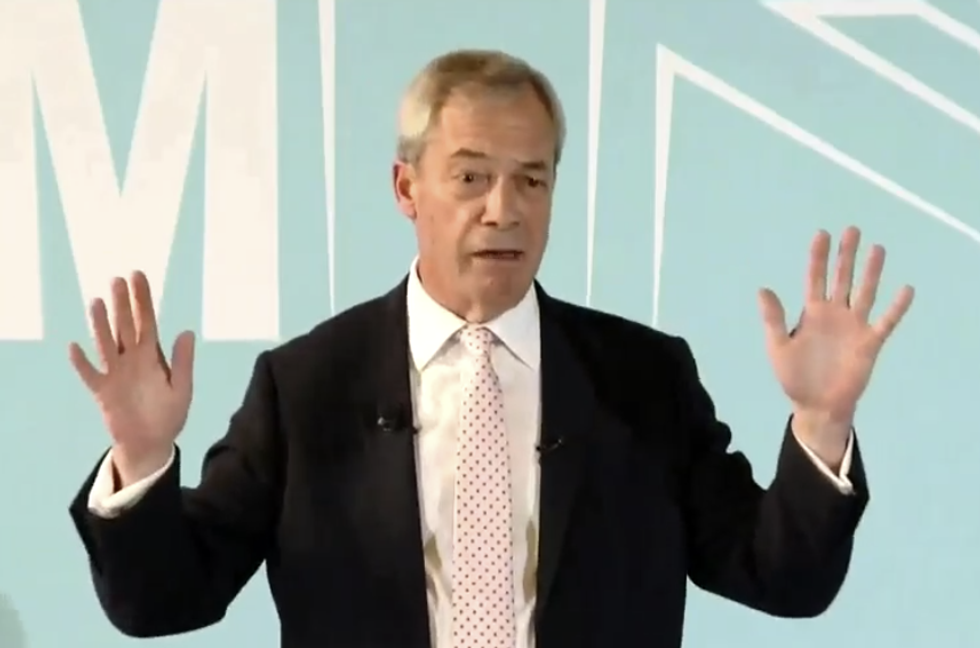
“But then there is, of course, one very big reason. Electoral Calculus put out their figures, just a couple of hours ago, that Reform would have won all four of these contests – would have won them quite comfortably.
“The Government are basically committing electoral fraud upon the electorate, who had every opportunity to put Reform mayors in place.”
Nigel Farage is accusing the Government of a politically motivated decision to cancel elections and the numbers agree.
Today, Electoral Calculus published its predictions for each area. In Essex, Labour is on 14 per cent and Reform over double on 29.
In Hampshire, Reform is on 31 per cent, again more than double, Labour on 14 per cent. Norfolk and Suffolk: 14 for Labour, 36 for Reform, and in Sussex and Brighton, 16 for Labour and 29 per cent for Reform.
The numbers show Reform victories and a Labour humiliation in all four of these areas.
Labour is running scared of Reform, so it’s not only the cancelling of the vote, but it’s also using this extra two years to change the voting system from first past the post to a proportional system, which would make it harder for Reform, but is better for Labour’s lefty friends because of course, it’s frightened of suffering an electoral collapse.
MPs don’t want to accept that the support they won in these areas, just a year and a half ago, has vanished like the dew in the dawn.
Ultimately, this is a strategy to protect the Prime Minister.
A sinister strategy so Labour MPs are not forced to realise quite how badly they’re doing and how badly their leader is doing.
When losses of this magnitude, as the data suggest, would happen, MPs have no choice but to question whether their party leader is up to the job. But there is a larger issue at play.
Labour doesn’t like democracy. Its motive for cancelling the elections is the same as that which drives the European reset.
They want to give power back to the bureaucrats of the European Union, back to the supranational organisation that we not only voted to leave, but that we voted to have no power left over our way of life.
Disdain for democracy is a fundamental characteristic of socialism. More government, less individual liberty, removal of the means to voice dissent. These council elections are merely the latest example.
Our Standards:
The GB News Editorial Charter



Follow