



Katy WatsonMaxwelton, Queensland
School is out for the year, but the summer holidays aren’t exactly a break for 15-year-old Breanna Easton – that is when she’s hard at work mustering cattle on the family’s station.
“It’s the freedom, the space you have to move,” Breanna says, listing all the things she loves about her life, 1,600km north-east of Brisbane in Australia’s sparsely-populated outback.
With grazier parents and grandparents, the industry runs in her blood. The vast hinterland is her own backyard.
And yet, like most teenagers, she’s also attached to her smartphone.
The all-terrain buggy she uses to herd cattle is fitted with an internet extender, enabling her to message friends on Snapchat while working. On days she gets a little bored, she likes to make funny TikTok videos with her siblings.
With nearly all her friends living at least 100km away, social media is a lifeline. But not anymore, now that Australia’s social media ban for children has taken effect.
“Taking away our socials is just taking away how we talk to each other,” Breanna says.
While she can still text her friends, it’s not the same as a quick “snap” or a “like” on a photo that allows her to play a part in their lives even when she is far away.
The ban has been in the making for a year now.
Throughout, supporters have argued it’s for the wellbeing of children who they say are spending too much time online and risk being exposed to uncontrollable pressures, bullying and predators.
Opponents say restricting children’s access to the internet runs the risk of pushing them to even less regulated corners of it – and they question the effectiveness of the age-verification tech the ban relies on.
The debate is far from settled but Australia’s experiment has now begun, and Breanna is among millions of children under the age of 16 who are no longer allowed to use social media.
And among them are children who are seen as both winning – saved from the potential dangers of social media – and losing out – no longer having the community and connections that may have been harder to forge offline.
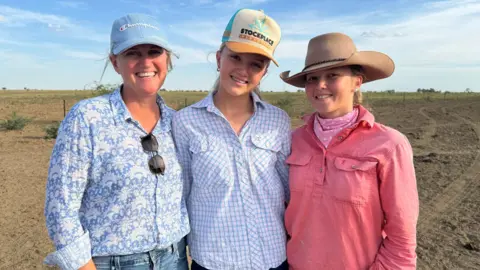
For Breanna’s mum Megan Easton, the ban is a mixed blessing. While she agrees kids need to be protected, she remembers her own childhood on a cattle station was far more isolating.
“We did feel very behind the other children at school because we had a somewhat sheltered life.”
Breanna, her older sister Olivia and younger brother Jacob all did remote classes for children in the outback who are unable to attend a physical school.
For senior grades though, boarding school is the only option for a good education. So from the age of 11 or 12, the siblings have lived six hours away from home during term-time.
“We might be incredibly geographically isolated but we’re not digitally illiterate and we have taken great measures in our family to make sure that we educate our children appropriately for the world ahead of them,” Ms Easton says. “I do think that it is a bit of government overstepping.”
One of her concerns is that delaying access to social media to 16 takes away power from parents to educate their children.
“Usually around 12 is when they start looking for their peers to be more influential than their parents,” she says. “Even though it’s young to get them on social media, we’ve staged their experiences with it and it’s a great opportunity for us to let them have a few mistakes and then talk them through the processes of self-correcting.”
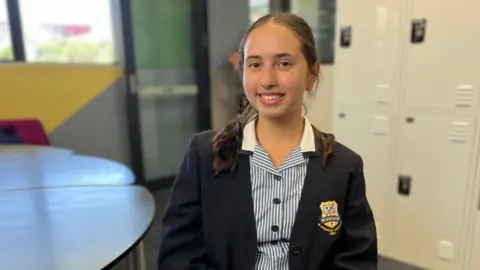
More than 2,000km away, teens in Sydney lead very different, far more connected lives. But they share similar worries.
“It’s a bit insulting that they think we can’t handle it,” says 14-year-old Jacinta Hickey who attends Rosebank College in Sydney’s inner west. “I’m definitely mature enough to distinguish right from wrong and to know what’s good and bad for me.”
Her teachers though couldn’t be happier. “I feel really passionate that as long as we can, we should preserve the innocence that comes through childhood,” says Iris Nastasi, the principal at Rosebank.
When smartphones started becoming popular in the early 2000s, she thought it would be an opportunity to teach children about technology. She embraced the change. Twenty years later, Ms Nastasi thinks very differently.
“It’s two in the morning, he or she does something that they wouldn’t normally do and the fallout happens here. Relationships are damaged and we have to look into it.”
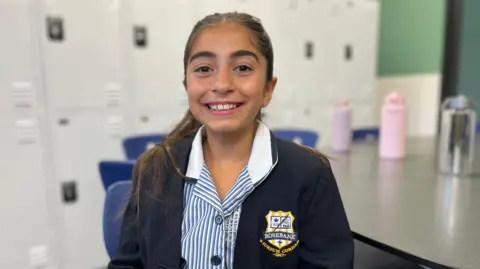
At 12, Lola Farrugia isn’t on social media yet – and with the new law, she now won’t be for another four years. But that doesn’t faze her. She’s happy enough with a flip phone.
“They’re my school friends so I see them at school, I see them in sport – they’re everywhere,” says Lola, who’s had coaching from her parents about the ills of social media.
“My mom explained to me that social media is junk food for the brain,” she says.
“If you have a pantry and you clear [it], you’re not craving anything, you know what I mean?”
Peter Malinauskas, the Premier of South Australia, is the man credited – or blamed, depending on your age – for clearing out the pantry.
After his wife read The Anxious Generation by Jonathan Haidt, an American psychologist who sets out the ills of the smartphone and how it is rewiring childhood, Malinauskas set out to introduce state-level legislation hoping it could win federal support too.
“She put the book down on her lap and turned to me and said you’ve really got to do something about this,” he told the BBC. “And then I stopped and thought about it and thought maybe we actually can.”
Not even Malinauskas expected the speed at which it happened though. The Anxious Generation was published in March 2024. By late November, a federal law banning social media for under-16s was passed.
There’s still a High Court challenge brought by two teens pending, possible battles with tech firms and a warning from US President Donald Trump about targeting American companies.
“Of course you think through the potential repercussions of any move like this,” Malinauskas says. “But when you are talking about protecting young people, all other considerations become secondary.”
But one of the biggest criticisms of the law is that a blanket restriction could do the opposite for minority groups.
According to a survey of nearly 1,000 young people carried out by Minus18, a group that supports under-18 LGBTQ+ communities, 96% of respondents said social media was important to access friends and support, and 82% believed a ban would leave them disconnected.
Brisbane schoolgirl Sadie Angus is one of them. She turned 13 just a few weeks ago and opening an Instagram account was a rite of passage for her. But it was a short-lived one – the law means she’s now being kicked off it and she’s frustrated.
“I can admit more things on there than I can in real life,” says Sadie who often prefers to keep her anonymity online.
“I use it as a safe space to share what I’ve had to go through and since nobody knows who I am, they can’t come to me in real life and talk about it and that feels kind of comforting.”
Sadie’s mother Kath felt it was an important step in her daughter – the youngest in their family – growing up and now that has been taken away from her.
“She’s being exposed to some really amazing role models through social media, particularly in the queer community which I think is really healthy for young adolescents,” Ms Angus says.
Other minority groups have also voiced concern over the ban.
“I am quite nervous about what this is going to mean for autistic young people,” says Sharon Fraser, the CEO of Reframing Autism.
“We communicate and socialise differently,” says Sharon who also has an autistic son. “Online can be a very beneficial place for autistic people and there are ways to connect online that are just not accessible to them in real life.”
For every young person who feels like they’re losing out, campaigner Emma Mason thinks there will be far more winners.
Nearly four years ago, her daughter Tilly killed herself. She was 15.
Emma blames the rise of social media for Tilly’s death. Face-to-face bullying started when Tilly was just eight. It moved to messaging and then to platforms including Tiktok, Snapchat and Instagram. But it got worse after a fake image of Tilly was spread by children at her school.
Emma recalls how hysterical Tilly was when she found out: “She was subject to something she had no control over, a harm that was instant, a harm that she could not stop. It was one of those moments in her life where she just lost it, she just thought I can’t do this anymore, I can’t keep fighting the demons.”
Ms Mason doesn’t want this to happen to other children, which is why she’s been standing alongside Prime Minister Anthony Albanese to support this law.
“These are agents of harm that are unregulated and I think our children have been the social experiment,” Emma says. “It’s a government’s job to protect the vulnerable of our society and to provide guardrails for how things need to go.”
She admits though, for those who are already teenagers, they might not be clear winners.
“I don’t know that we can save the children that have had access to it already,” she says. “But those children that are 13 and below that aren’t supposed to be on it now, they won’t have to grow up in a world where it’s acceptable that you just get on social media and you can say what you want, how you want, to whoever you want.”
Additional reporting by Simon Atkinson



Follow