



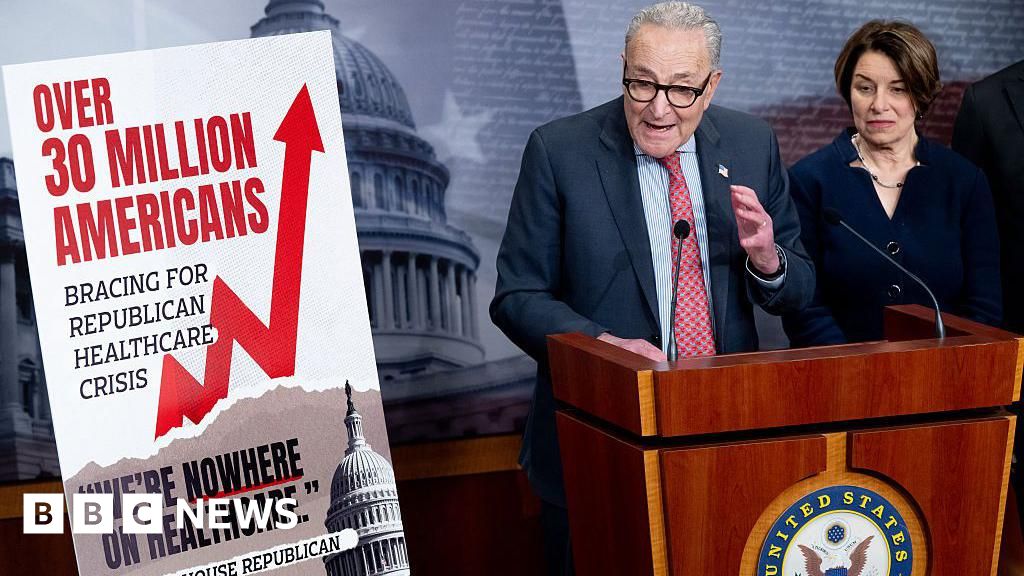
Healthcare subsidies for millions of Americans appear likely to expire after the Senate failed to pass competing bills, a politically fraught issue ahead of next year’s midterm elections.
Both Democratic and Republican plans fell short of the 60 votes needed to advance, meaning insurance premiums through the Affordable Care Act (ACA), also known as Obamacare, are on course to more than double at the end of the year.
Opinion polls show a vast majority of Americans favour a subsidy extension, with cost of living a major concern for voters.
The issue has caused a rift among Republicans, with healthcare poised to emerge as a hot issue in next year’s congressional elections.
More than 24 million people have health insurance through Obamacare.
The subsides set to expire on 1 January are additional tax credits that Democrats passed in 2021 during the Covid pandemic.
On Thursday, senators rejected both a Democratic bill to extend the subsidies for three years as well as a Republican proposal to create a new health savings account for Americans earning less than 700% of the federal poverty level.
The Republican-backed plan failed 51 votes to 48, and the Democrat one fell short by the same margin.
Four Republicans, Susan Collins of Maine, Josh Hawley of Missouri, and Dan Sullivan and Lisa Murkowski, both of Alaska, voted for the Democratic bill.
Speaking ahead of the votes, Senate minority leader Chuck Schumer, a New York Democrat, warned Republicans it was the last chance to act before the subsidies expire.
“Let’s avert a disaster,” he said. “The American people are watching.”
A congressional standoff over the expiring subsidies provoked the longest ever US government shutdown, lasting 43 days, this autumn.
Republicans have long argued Obamacare is rife with fraudulent claims and that it failed to deliver the affordable coverage promised in the bill’s title.
They say health savings accounts would benefit consumers directly rather than insurance companies.
While Trump did not publicly support that Republican plan, he said in an interview with Politico earlier this week that he wants “to give money to the people, not to the insurance companies”.
Before senators voted on Thursday, Senate majority leader John Thune, a South Dakota Republican, again spoke out against the extension of those subsidies.
He described them as an “attempt to disguise the real impact of Obamacare’s spiralling healthcare costs”.
While some Republicans on Capitol Hill have called for compromise or to extend the subsidies until an agreement with Democrats can be reached, there has so far been no high-level negotiations on the topic.
Speaking at the White House on Thursday, press secretary Karoline Leavitt laid the blame on Democrats and said the Covid-era health insurance subsidies had “completely distorted the health insurance market”.
She added that Trump and Republicans “are currently coming up with creative solutions and ideas” to lower healthcare costs, although she provided no details.
The issue is one that polls suggest has unified many voters, regardless of political affiliation.
One survey, released by KFF in November, found that 74% of Americans supported extending enhanced ACA credits.
Some Republicans have warned that a failure to fix the problem could cost them their legislative majorities in next November’s vote.
“If we fumble this healthcare bill, nothing else is going to matter,” Florida Republican congressman John Rutherford told Politico.



Follow