



King Charles X of France was crowned in a spectacular Ceremony at the Cathedral of Notre-Dame de Reims on this day in 1825, 200 years ago, 50 years after the Coronation of his ill-fated brother, King Louis XVI.
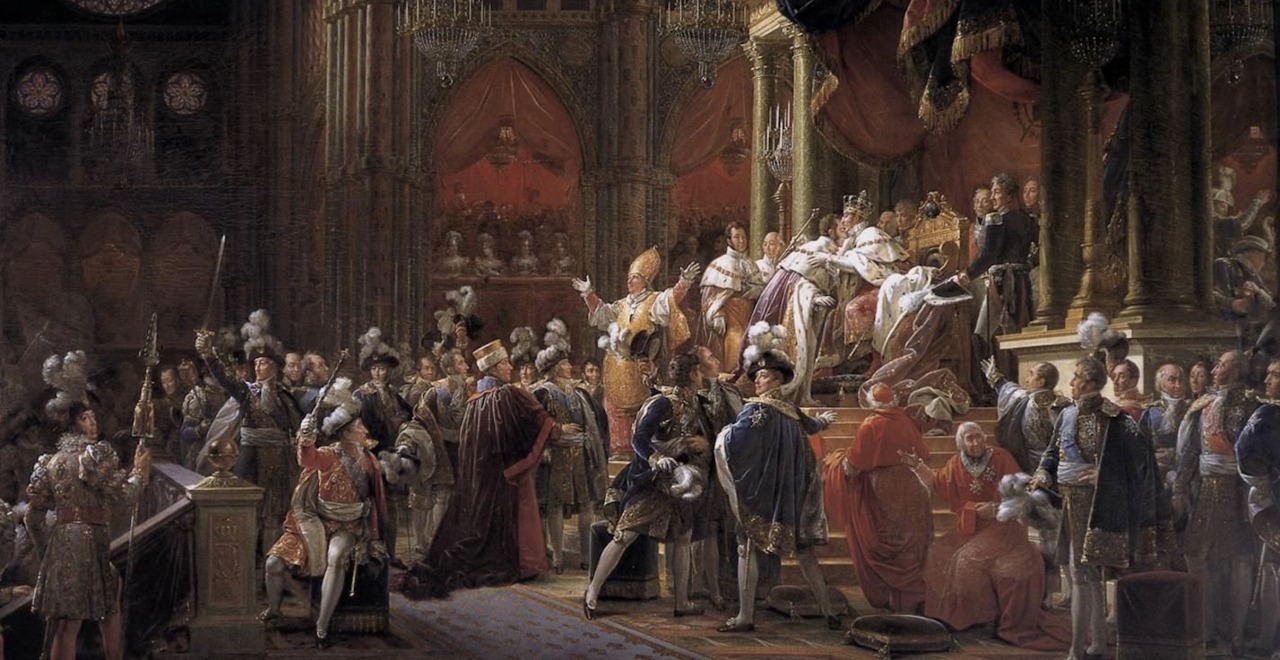
The Coronation of Charles X in Reims Cathedral, on May 29, 1825. The moment represented is that of the enthronement, when the Archbishop of Reims, Jean-Baptiste de Latil, having launched his ” Vivat Rex in aeternum “, the king, seated on his throne, embraces the dauphin, the Duke of Angoulême, and to the princes of the blood, the Duke of Orléans, future Louis-Philippe, and the Prince of Condé, standing at his side. Strongly inspired by David’s paintings on comparable subjects, this monumental and ambitious work was poorly received by critics. It was damaged during the revolutionary days of 1830.

Charles X was the last French sovereign to be crowned in Reims. Nostalgic for the absolute monarchy of divine right, the king wanted to erase any legacy of the revolutionary episode and fully resume the ceremonial of the Ancien Régime. Louis XVIII had renounced the coronation ceremony, in particular because he would not have been able to bear the fatigue. Charles X, for his part, revived the tradition and wanted a ceremony faithful to that of his ancestors. Preparations began in November 1824. A significant budget was devoted to the restoration of the buildings, to the sumptuous decoration of the cathedral of Reims and the archiepiscopal palace. For the occasion, the king had a mass specially composed by Luigi Cherubini and commissioned an opera from Gioacchino Rossini, Le Voyage à Reims . The carriage, designed by the architect Charles Percier, was an eight-horse sedan, the ornamentation of which had been contributed by the coachbuilder Duchêne, the sculptor Henri-Victor Roguier, the chaser Denière, and the painter Pierre-Claude-François Delorme.

On May 27, 1825, the royal procession set off from Compiègne, an essential stop on the road to the coronation. The ceremony had been slightly modified: Charles X had agreed to swear allegiance to the Constitutional Charter, “to reassure public opinion.” The rite took place before an audience dominated by scholars, artists, and poets such as Baron Gérard, Alphonse de Lamartine, and Victor Hugo. The latter composed the ode “The Coronation of Charles X,” which he published on June 18 in his collection Odes et Ballades , in which he presented himself as a champion of the alliance between the throne and the altar. On May 31, the king exercised his miracle-working powers by touching the scrofula of 130 sick people.


The impact of Charles X’s coronation on public opinion was extremely limited. In a society where anticlericalism was rife, the people saw it only as the resurrection of the Ancien Régime in one of its most archaic aspects and as an event charged with a religious significance they no longer understood. The coronation revealed the impossible harmony of two fundamentally contradictory principles: national sovereignty and the royal legitimacy of the Ancien Régime.















Follow