



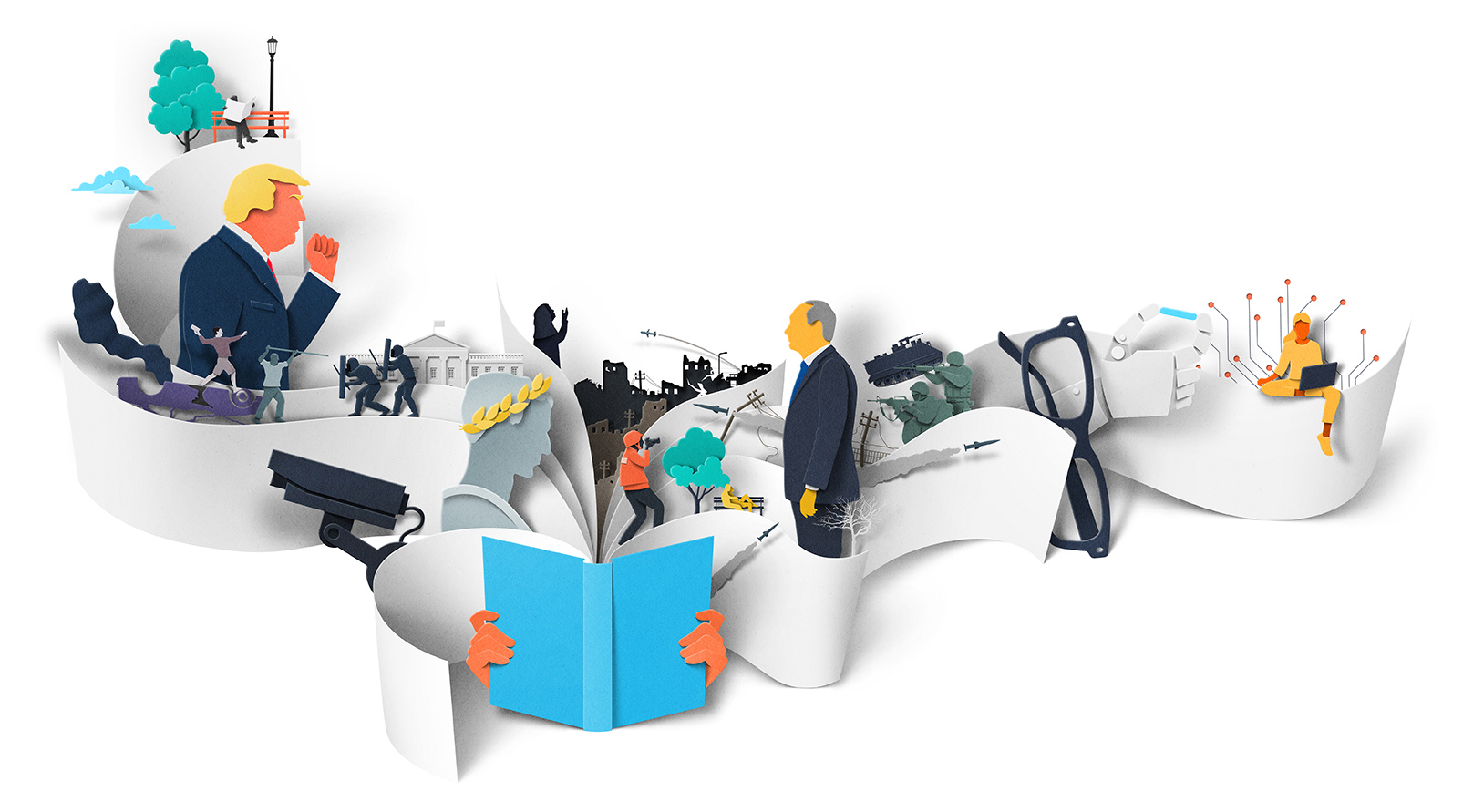
Trying to predict 2026 is impossible, but one thing’s certain: Politics never sits still. Elections reshuffle governments, wars redraw old lines, pandemics upend daily life and the democratic nervous system keeps twitching.
In moments like these, it helps to step back — and read. But what? With all the political analysis out there, choosing the right book can feel like one more campaign to navigate. That’s where we come in.
POLITICO’s editors and reporters on both sides of the Atlantic have built the perfect imaginary bookshelf: Titles that don’t just explain politics, but help you make sense of it.
Advertisement
Whether you’re a political biography devotee or a dystopian-fiction aficionado, there’s something here for you. From “Our Dear Friends in Moscow,” which peers inside Russia’s moral corrosion through the lives of those who chose obedience over freedom, to Suetonius’ timeless “Lives of the Twelve Caesars,” proving vanity, vice and ambition never go out of style.
Together, these books chart the forces reshaping Western democracies: anxiety, surveillance, ambition and the uneasy romance between principle and power. You might not find comfort here — but you will find clarity, and a little company, in the chaos.
“The Lives of the Twelve Caesars,” by Suetonius
The historian of ancient Rome’s early imperial era, who chronicled 12 successive Roman rulers from Julius Caesar to Domitian, would surely have been fascinated by our current crop of larger-than-life rulers — including Trump, Putin and Benjamin Netanyahu. Take away our technology and advances in medical science and we can read about our era in the most important work of Gaius Suetonius Tranquillus — his full, gloriously Latin name.
Here is caprice and malice, vanity and cruelty, whim and tyrannical ambition. The Victorians were so scandalized by the sex lives of the Roman emperors that editions of the collective biography were bowdlerized. Sad.
Of course, direct comparisons with our contemporary rulers would be untoward. Maybe. But what Suetonius does brilliantly is to plot the personal and political. That derives from his conviction, as English-language translator Tom Holland puts it, that “there is no foible so minor, so intimate that it cannot provide the measure of a man.”
— Jamie Dettmer, opinion editor and columnist
Advertisement
“1929,” by Andrew Ross Sorkin
Wildly overvalued companies, barely hidden economy weaknesses, great egos, buckets of hubris … if 2026 turns into the white-knuckle ride for global markets that some predict, we may as well understand what’s about to happen.
In “1929,” Andrew Ross Sorkin revisits the Wall Street crash that saw the collapse of overhyped stock values, just as ordinary folk pumped their savings into supposedly never-failing investments: A depressing tale of how quickly things can go wrong.
That catastrophe didn’t just destroy wealth; it reshaped politics. The Great Depression that followed saw the rise of populist politicians who went on to dominate Europe, leaving unspeakable scars all over the continent. Sorkin, New York Times journalist of “Too Big To Fail” fame, uses “1929” as a cautionary tale to warn against what happens when institutions and politicians fail the countries they are supposed to support.
He knows his onions, and his warning is clear: When markets wobble, democracies do too.
— Russell Hargrave, U.K.‘s energy and climate editor
“The Order of the Day” (original title: original title: “L’Ordre du jour”), by Éric Vuillard
Why wasn’t Hitler’s rise stopped? It’s the question that inevitably haunts readers of Éric Vuillard’s “The Order of the Day” — just as it makes us glance uneasily at our own times. In this brief book, Vuillard retraces the lead-up to World War II through four anecdotes — each one a missed chance to resist Hitler’s ascent.
We witness Hermann Göring’s secret meeting with German industrialists; the humiliating visit of Austrian Chancellor Kurt Schuschnigg to Hitler’s mountain retreat; a casual tennis chat between British Prime Minister Neville Chamberlain and German Ambassador Joachim von Ribbentrop as Nazi troops march into Austria; and the shambolic state of the German army during that very annexation.
Through these vignettes, Vuillard exposes the impotence of laws, diplomacy and polite conventions when faced with bluff, deceit and greed. His warning resonates chillingly today: “We never fall twice into the same abyss, but we always fall the same way — in a mixture of ridicule and dread.”
— Matthieu Verrier, editor
Advertisement
“On the Abolition of All Political Parties,” by Simone Weil
“Political parties are organizations that are publicly and officially designed for the purpose of killing in all souls the sense of truth and of justice.” So proclaimed Simone Weil in her bracing 1943 treatise, “On the Abolition of All Political Parties.”
Published after her death at the age of 34, the essay was a response to the infighting among exiled French politicians as Adolf Hitler’s armies rampaged the continent. Weil shared the instincts of the American founders in her abhorrence of political “factions,” the prerogatives of which can violate a man’s conscience and “submit his thinking to the authority of the party.”
Eighty years later, her thesis still holds true: “The force that impels thought is no longer the open, unconditional desire for truth, but merely a desire to conform with pre-established teachings.”
— James Kirchick, Axel Springer Global Reporter and author of “The End of Europe: Dictators, Demagogues and the Coming Dark Age,” and “Secret City: The Hidden History of Gay Washington.“
“Radical Shock: The Rise and Fall of the Competent” (original title: “Radical Choc: Ascesa e Caduta dei Competenti”), by Raffaele Alberto Ventura
One of the great innovations of the past century was the rise of vast bureaucratic machines composed of a new social class: the technocrats, or experts. It’s what Trump and other right-wing populists refer to as the “deep state.”
To understand where the technostructure is heading, in his 2020 book “Radical Shock: The Rise and Fall of the Competent,” Raffaele Alberto Ventura first looks back. He recalls how, in the late 1960s, economist John Kenneth Galbraith warned that the U.S. administrative apparatus had grown larger than many socialist countries. He also cites sociologist Max Weber, who argued that “real power” resides within the administration itself — not in parliamentary speeches or political declarations.
Today, predictably, experts are under attack. Ventura quotes Galbraith’s warning that “we are becoming the servants … of the machine we created to serve us.”
So, when German Chancellor Friedrich Merz criticizes the European Commission for excessive regulation, it might not be populist theater, but rather the start of a reckoning with the political legitimacy of experts in modern democracies.
— Jacopo Barigazzi, defense correspondent
Advertisement
“Our Dear Friends in Moscow: The Inside Story of a Broken Generation,” by Andrei Soldatov and Irina Borogan
Most books about Russia on Western shelves focus on Vladimir Putin as the sole architect of the country’s democratic decline. Russians themselves often appear as a faceless mass — either inherently submissive or hopelessly passive.
“Our Dear Friends in Moscow: The Inside Story of a Broken Generation” breaks that mold. Written by two leading experts on Russia’s security services, this book takes a more intimate route. Through the stories of former friends and colleagues, the authors trace how people who once shared their liberal convictions gradually turned into champions of Putin’s nationalist imperialism.
Few accounts combine such a close-up view of top-down repression with an understanding of personal choice. That makes this an essential read not only for grasping how Russia became what it is today — and what it may remain after Putin leaves the stage — but also for Europeans who care about safeguarding their countries’ democratic values, both individually and institutionally.
— Eva Hartog, foreign affairs reporter
Advertisement
detail: “instory_51”
}));
“Henry Kissinger: An Intimate Portrait of the Master of Realpolitik,” by Jérémie Gallon
Can we still learn from Henry Kissinger? French writer and former diplomat Jérémie Gallon definitely thinks so. His “Henry Kissinger: An Intimate Portrait of the Master of Realpolitik” takes a fresh approach to one of the most controversial figures in modern diplomacy.
Structured around unexpected themes — from Kissinger’s sense of humor to his sense of style — the book paints a nuanced picture that looks beyond moral judgment or mythmaking. Though it may not delight hardcore historians, Gallon doesn’t gloss over the darker chapters of Kissinger’s record and his involvement in controversial episodes of U.S. foreign policy, either.
He finds there is much to learn from this titan of U.S. diplomacy, especially in a time when diplomatic relations around the world are strained by wars, shifting alliances and the uneasy balance between ideals and realpolitik.
— Nicholas Vinocur, chief foreign affairs correspondent
“There Is Nothing For You Here,” by Fiona Hill
Long before Fiona Hill became a household name by testifying during Donald Trump’s first impeachment, she was the daughter of a former coal miner from a down-on-its-luck town in Northeast England. During the televised hearings, her working class accent riveted viewers in the U.K. and beyond, since very few people with Hill’s roots are able to escape the region’s multigenerational poverty, much less become a top adviser to a U.S. president.
Hill uses this semi-autobiographical book to describe this collapse of economic opportunity in the three countries she knows best — the U.K., the U.S. and Russia — how it has fueled illiberalism, and what can be done to reverse this erosion of opportunity and democracy.
“These left-behind people deserve better,” Hill writes. “As long as they feel there is no hope for them, there will be no hope for the rest of us. There will be nothing for us, anywhere.”
— Maura Reynolds, POLITICO Magazine deputy editor for ideas
Advertisement
detail: “instory_52”
}));
“I Was Jack Mortimer” (original title: “Ich war Jack Mortimer”), by Alexander Lernet-Holenia
In an age where our entire lives unfold within WhatsApp chats, and our browser histories or
artificial intelligence queries could become public without our consent, we rarely stop and think about the traces we leave behind.
In politics in particular, a leak can topple a government faster than an election. And technology has made transparency unavoidable and weaponized, driving some people (and leaders) into a state of constant doubt and hypervigilance: We begin to think like detectives about our own actions, imagining how everything might be used against us.
That paranoia — at once personal and political — is distilled in a lesser-known noir by Alexander Lernet-Holenia, set in the elegant decay of 1930s Vienna: “I Was Jack Mortimer.” A taxi driver picks up an impeccably dressed passenger, only to realize the man is dead.
His frantic attempt not to seem guilty becomes a monologue of self-incrimination: A parable for the digital panopticon we inhabit today, where the mere act of existing feels like evidence.
— Gerardo Fortuna, Brussels Playbook author
“Everybody Lies: Big Data, New Data, and What the Internet Can Tell Us About Who We Really Are: by Seth Stephens-Davidowitz
Aren’t we all just a bunch of liars? We hide uncomfortable truths from family and friends and keep quiet about unpopular opinions — to pollsters, too. There’s one place where we’re astonishingly honest, however, and that’s a Google search bar.
Search engines know everything from our darkest fears to our most embarrassing questions, and that vast amount of intel is what data scientist Seth Stephens-Davidowitz dug into to reveal the quiet trends people don’t want to say out loud.
Eight years have passed since “Everybody lies” first published — Trump was U.S. president, go figure! — yet it feels more relevant than ever. At a time when misinformation is rampant and the easiest way to reach a voter is through their phone, digital flair can equal real-life political wins. Stephens-Davidowitz’s book goes beyond a keyboard warrior’s anonymity and the echo chambers on social media to teach us something about who we are.
And remind us that the internet is the world’s most powerful database, for better or worse, if we care to look.
— Hanne Cokelaere, data journalist
Advertisement
detail: “instory_53”
}));
The “Robot” series, by Isaac Asimov
The advent of AI makes Isaac Asimov’s “Robot” series feel as relevant today as when he wrote it last century. The series — a mix of short stories and novels — explores how humanity manages the rise of the robots, the more advanced of which embodied AI.
Asimov’s robots were, in theory, governed by laws designed to prevent them from harming humans. Yet, there seemed to be a few loopholes in how those laws were applied. People could definitely get hurt.
In Asimov’s tales, humanity has already settled other planets, and people reacted differently to robots depending on where they were. Earthlings were suspicious of interacting with robots. Other planets were less so, to the point where some of the people lived happily with robots but could barely tolerate other humans.
Should AI be governed by similar laws? Is it even possible to contain it that way? And on a continent such as Europe, with so many different cultures and countries, will there be differences in how each integrates AI into their lives? Asimov probably would have enjoyed writing some sequels in today’s day and age.
— Nahal Toosi, senior foreign affairs correspondent
“Perfection” (original title: “Le Perfezioni”), by Vincenzo Latronico
Outside the walls of their sleek Berlin apartment, the world is changing. But for expat couple Anna and Tom, a day-to-day life of aspiration, remote work and precarious comfort goes on much the same.
Originally published in Italian, Vincenzo Latronico’s “Perfection” has attracted both praise and criticism for its portrait of a generation: Is it a fair social commentary or a self-absorbed attack on Europe’s young middle class? Either way, the novel paints the picture of an increasingly insubstantial existence where old ties and communities have broken down, and the social and political classes have offered nothing to replace them.
Without much by way of purpose, Latronico reveals the political vacuum at the heart of Europe’s urban elite: Anna and Tom don’t just struggle with how to contribute to a better world, he writes — “they couldn’t even imagine it.”
— Gabriel Gavin, reporter
Advertisement
detail: “instory_54”
}));
“The Empty House” (original title: “La Maison vide”), by Laurent Mauvignier
What if the European Union were a big, empty house, full of memories of the good old days and convictions that belong to another era? In “La Maison vide” — winner of France’s most prestigious literary prize, the Goncourt — Laurent Mauvignier reimagines the lives of his relatives in the family home in Touraine. He traces their story over the past century, through echoes of Émile Zola’s novels and fading photographs, uncovering uncomfortable truths and once-firm beliefs that now seem far less certain.
“La Maison vide” invites us to reflect on what we’ve inherited: What strengthens us and what might be best left behind. It’s an exercise our (more or less) beloved institutions, often accused of rigidity and nostalgia, should try themselves. Who knows, they might discover that “clunky bureaucratic machinery syndrome” doesn’t actually run in the family.
— Alexandre Léchenet, France energy and climate editor



Follow