



When Vladimir Putin invaded Ukraine, he promised Russians they would “do it again” — send their armed forces westward and sweep to victory like the Soviet Union did against Germany.
Today, the Russian president has kept half that boast. As of this week, the war Putin once hoped would be over in just three days has stretched out for longer than Moscow spent fighting the Nazis.
To make matters worse, even as Moscow bogs down in Ukraine, the global network of allies Putin spent two decades building seems to be falling apart, put to the test by an unexpectedly belligerent U.S. President Donald Trump.
What was supposed to be a quick operation in Ukraine has turned into a grinding war of attrition. The duration of the conflict has now surpassed the 1,418 days the Soviets spent fighting back the Nazi onslaught, ultimately pushing the Germans from Moscow all the way to Berlin.
During its almost-four-year campaign in Ukraine, Moscow has captured only a wedge of the country, at a cost of some 1.1 million Russian casualties and mounting disruption at home. This month some 600,000 Russians were left without electricity in the border region of Belgorod following a Ukrainian missile strike.
Meanwhile, internationally, there appears to be little Putin can do to stop his allies from being picked off one by one.
The Kremlin has been on the back foot in the Middle East since late 2024, when the collapse of Bashar al-Assad’s government in Syria deprived it of a reliable partner in the region.
Moscow was also seemingly unable to protect its closest friend in South America earlier this month when the United States captured Venezuela’s Nicolás Maduro, a leader who had dutifully made the trip to Moscow for Putin’s Victory Day Parade in May last year.
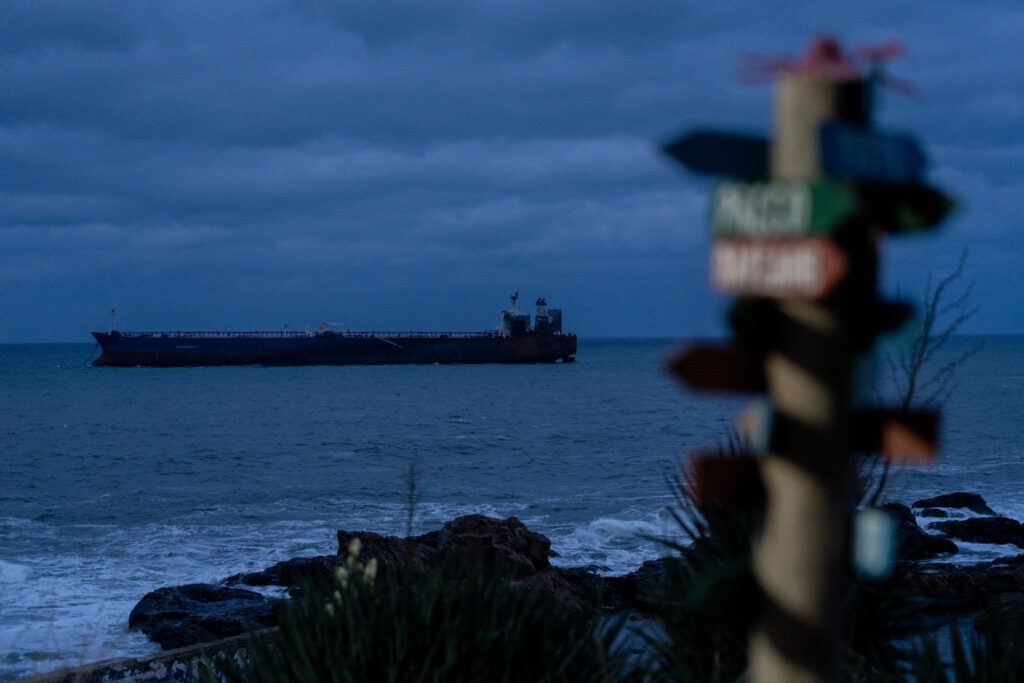
Embarrassingly, Moscow wasn’t even able to fend off the unprecedented U.S. seizure of an oil tanker flying a Russian flag.
Just a year ago, Putin signed a 20-year strategic partnership agreement with Tehran. Now the regime — which supplied Russia with killer Shahed drones for its fight in Ukraine — is in danger of being toppled by protesters whom Trump has indicated he could intervene militarily to defend.
Russians have taken notice.
“An entire era is coming to an end,” wrote a pro-war military blogger under the pen name Maxim Kalashnikov on Sunday, reflecting growing criticism of the Russian leadership.
Russian authorities, he argued, had spent too much time trying to create an image that the country was a great power rather than taking steps to ensure it became one. The promise that “‘we can do it again’ has failed,” Kalashnikov concluded.
Journalists friendly to the Iranian regime have reported that Moscow in recent weeks supplied Iran with Russian-made Spartak armored vehicles and attack helicopters, presumably to help fend off protesters, said Nikita Smagin, an expert on Russia-Iran relations and a contributor to the Carnegie Endowment for International Peace.
“But, of course, the Iranians have no illusions that if the situation were to become truly critical, Russia would simply step aside, as it did in the case of Bashar al-Assad,” he said, referring to the fall of the Syrian dictator’s regime in 2024 and his subsequent exile to Russia.
The reality is that the Moscow-inspired alliance was always largely fiction, said former Russian diplomat Boris Bondarev.
“Neither Venezuela nor Iran are part of any Russian empire,” he said. Following its invasion of Ukraine, “it was important [for Russia] to show that it was not alone, but that’s propaganda.”
Smagin pointed out that the partnership agreement between Iran and Russia specifically left out a mutual defense clause, describing their relationship as “stable” with an undertone of “serious mistrust.”
“The two countries aren’t really allies, they’re strategic partners out of necessity, because both sides have few other options,” he said.
The Kremlin’s mouthpieces have tried to put a positive spin on matters, arguing Washington’s own apparent lack of regard for international law shows Russia was right to invade Ukraine.
Other commentators have sought to downplay the relationship between Russia and its allies or have highlighted the differences between WWII and the war in Ukraine to justify the lack of progress. It’s not that the country’s military is weak, they argue: Russians are just less invested than they were back then.
“In the first case the entire country fought [the Nazis], now only 5 percent or so are interested,” a Telegram channel aptly named “Don’t Stop War” claimed.
Putin himself hasn’t yet commented on events in either Venezuela or Iran, true to his habit of leaving his underlings to talk about bad news, said Bondarev, the diplomat.
He noted, however, that the Kremlin likely sees U.S. actions in Venezuela and against the oil tanker as attempts to push Russia into a corner.
To show it doesn’t yield to pressure, Russia will be looking for ways to display its own dominance, primarily in Ukraine, said Bondarev, pointing to Moscow’s firing of an Oreshnik hypersonic missile into Ukraine last week.
Humiliated or not, Bondarev warned against expecting a “softening” of the Russian position. “Even if it is weak, the Kremlin will be looking to show that it’s strong.”



Follow