



Britain has access to a trade bloc that dwarfs the EU’s and yet it scarcely gets a mention from frontbenchers as Sir Keir Starmer continues to sign deals with Brussels.
The joint report from think tank Facts4EU and the Stand for Our Sovereignty campaign, in exclusive association with GB News, reveals that for the last year, the UK has been one of 12 members of the Trans-Pacific Partnership (CPTPP), one of the largest free trade areas in the world.
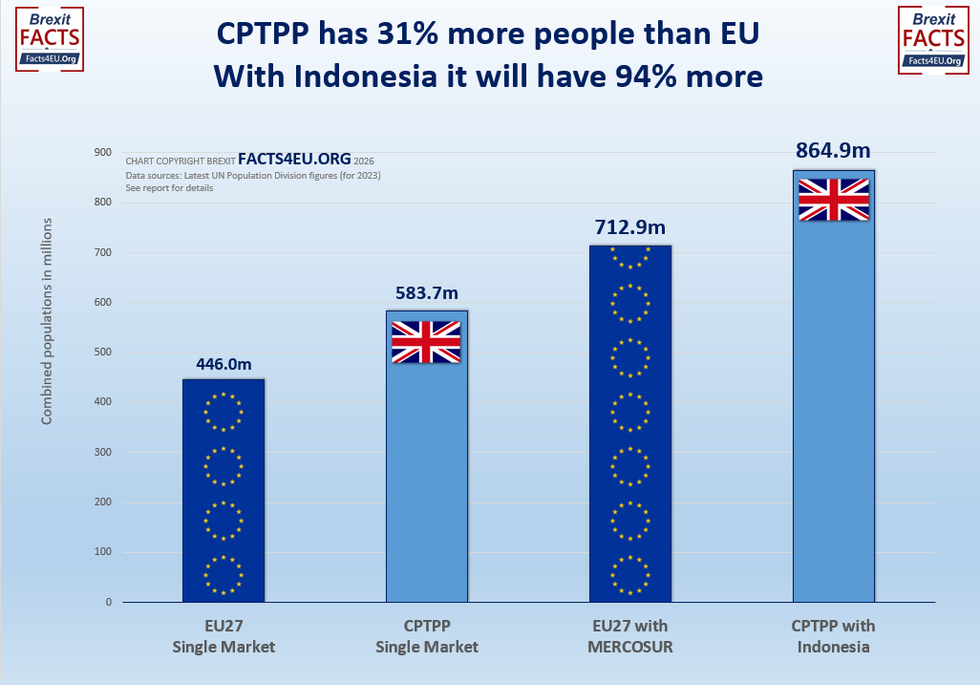
In doing so, it became part of a free trade area, 31 per cent larger than that of the EU’s Single Market.
While the UK has been part of the CPTPP since December 15 2024, it has barely been mentioned.
Former Prime Minister and Foreign Secretary Liz Truss told Facts4EU: “As Trade Secretary, I made our formal application to join CPTPP.
“I am delighted negotiations are completed, deepening UK access to some of the world’s fastest-growing economies.
“This is Global Britain in action and an important counterweight to those who seek to undermine our values.”
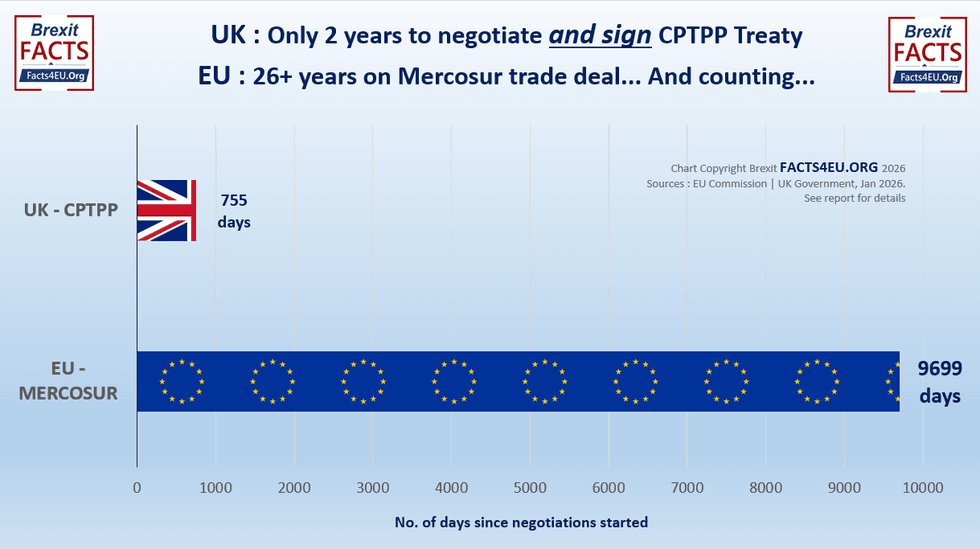
Another key comparison point is how quickly the UK was able to get a trade deal with the CPTPP over the line, versus the EU’s repeated, failed attempts with Mercosur, a partnership between Argentina, Brazil, Paraguay and Uruguay.
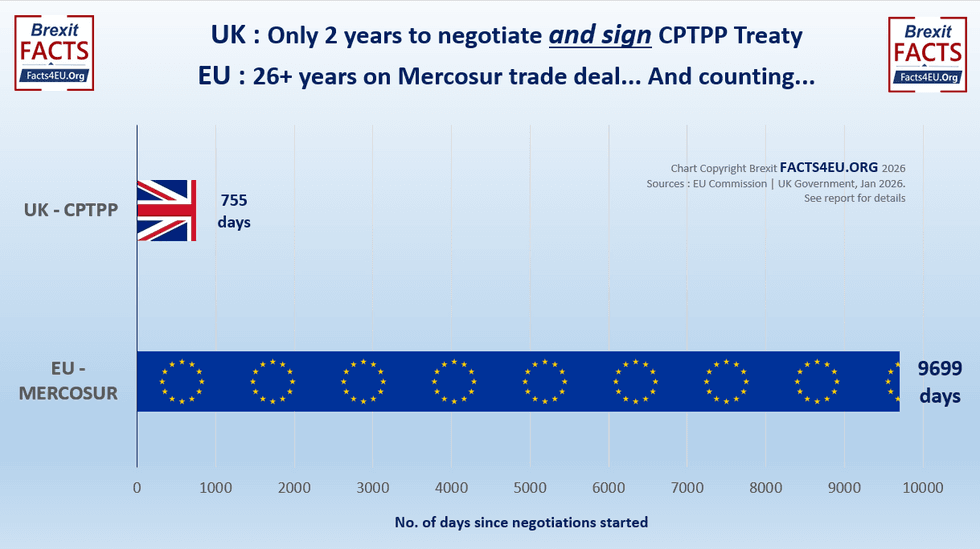
Currently, the EU is set to sign a deal with the four “Mercosur” South American countries on Saturday.
A Brussels spokesman said: “The deal with the Mercosur partners (Argentina, Brazil, Paraguay and Uruguay) will create the world’s biggest free trade zone, covering a market of over 700 million consumers.”
However, despite the fact the treaty will be signed this weekend, this does not mean that the deal between the EU and Mercosur will start.
In fact, it is uncertain currently what the timescales will be for the various elements to fall into place.
In addition, Indonesia, whose application to join the CPTPP was made easier when Australia sponsored it and the UK offered its assistance with the whole application process itself, is the last country to have gone through this process.
It is likely that Indonesia will be able to access the Trans-Pacific Partnership faster than the EU and Mercosur’s deal had all the necessary approvals.
In either event, once Indonesia joins the CPTPP, it will put the title out of reach for the EU, as the following chart shows.
LATEST DEVELOPMENTS
- Donald Trump suspends UK trade deal after frustration with Labour in major blow for Keir Starmer
- The UK-US trade deal could unleash the NHS – but a woke barrier stands in the way – Douglas Carswell
- Keir Starmer urged to complete £72BILLION trade deal bonanza to ‘turbocharge’ UK prosperity
Finally, just three weeks after the CPTPP nations first met to discuss the UK’s application, negotiations began and two years later on July 16 2023 the then Business and Trade Secretary (now Conservative Party Leader) Kemi Badenoch formally signed the accession treaty in New Zealand.
It then took a long time, as it always does, to get the necessary number of approvals from the other countries.
At the signing ceremony, Ms Badenoch said: “I’m delighted to be here in New Zealand to sign a deal that will be a big boost for British businesses and deliver billions of pounds in additional trade, as well as open up huge opportunities and unparalleled access to a market of over 500 million people.
“We are using our status as an independent trading nation to join an exciting, growing, forward-looking trade bloc, which will help grow the UK economy and build on the hundreds of thousands of jobs CPTPP-owned businesses already support up and down the country.”

It is essential to stress the CPTPP acts in a different way to the EU.
This is a free trade area which is what most countries want and does not require all the conditions which the EU impose on its members.
CPTPP members can pursue independent trade policies with non-CPTPP members, as the UK has already done and it does not require the UK to obey its laws, nor its foreign or defence policies.
It does not require an annual membership fee to subsidise the smaller and poorer member countries and does not have political institutions such as a parliament or an unelected Commission, as is the case with the EU.
It also does not separate Northern Ireland from the rest of the United Kingdom, as the EU has done.
Our Standards:
The GB News Editorial Charter



Follow