



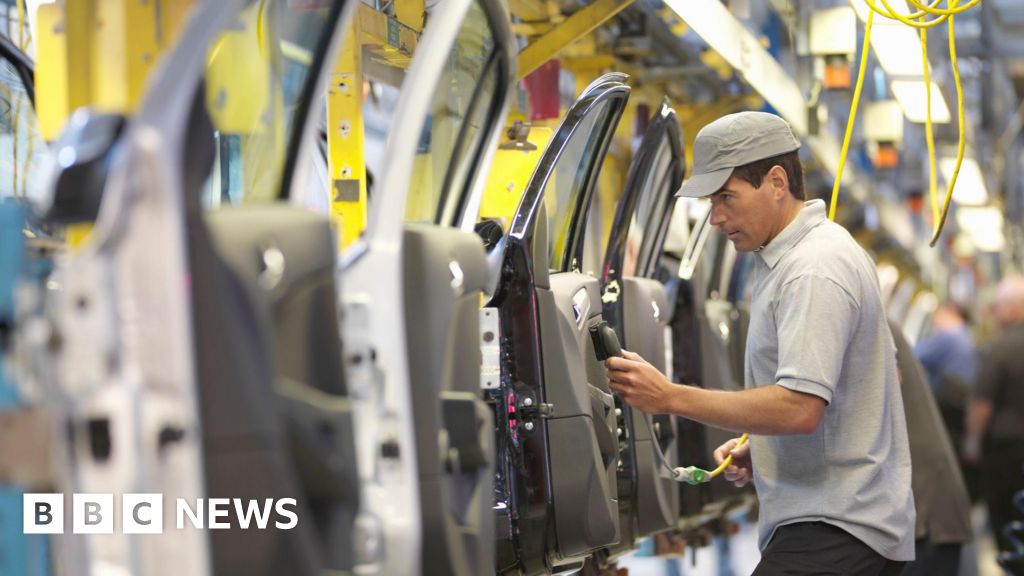
The UK economy grew by a faster-than-expected 0.3% in November after car production rebounded and the services sector got a boost.
Growth was driven by an increase in industrial output, the Office for National Statistics (ONS) said, helped by the return to production at Jaguar Land Rover’s facilities following the cyber-attack at the carmaker.
With the Budget on 26 November, there was also an increase in services driven by activities such as accounting and tax consultancy.
November’s growth figure was stronger than analysts’ expectations of a 0.1% increase.
Businesses across the construction, industrial production and services sector told the ONS in November they were waiting to see the outcome of the autumn Budget before making decisions.
The monthly GDP figures are more volatile than the rolling three-month data, which is considered to give a better underlying picture of growth.
In the three months to November the economy grew by 0.1% compared with the previous three months, the ONS said.
Yael Selfin, chief economist at KPMG UK, said the figures showed economic activity had accelerated despite uncertainty in the lead up to the Budget.
“Despite the relatively mooted consumer sentiment so far and consumer-facing services output declining in November, there are some tentative signs of a pick-up in household spending,” she said.
“With the worst of the uncertainty behind businesses, we expect growth momentum to continue over the coming months.”
Suren Thiru, economics director at the Institute of Chartered Accountants in England and Wales, said the “unexpectedly upbeat” November figures suggested that most sectors had “seemingly shrugged off pre-Budget uncertainty”.
“November’s uptick means it’s inevitable that the UK economy grew modestly across the final quarter of 2025 with easing uncertainty post-Budget likely to have supported growth in December, despite the ‘super flu’ disrupting activity in sectors like education,” he said
Construction output fell by 1.3% in November, and the ONS said the sector also registered “its largest three-monthly fall in nearly three years”.
Ruth Gregory, deputy chief economist at Capital Economics, said the fall in construction was probably due to “unseasonably wet weather” and was likely to rebound in December.
However, Gregory said the increase in services output did “little more than reverse the big declines in the past few months”.
“So we think November’s strength is more likely to be a rebound rather than a sign that the economy is fundamentally stronger than we thought,” she said.
Deutsche Bank’s chief UK economist Sanjay Raja said the economic data should “raise the bar” for a February interest rate cut from the Bank of England.
“With the economy now on a firmer footing than expected the impetus to accelerate rate cuts is likely lower,” he said.
Part of the rebound came from the continued pick up in Jaguar Land Rover (JLR) production, which drove the 25.5% increase in motor vehicle output in November.
JLR was forced to halt production at its plants across the UK for the whole of September, following a cyber-attack. Production began to resume in a staged manner from October.
A Treasury spokesperson said the government was making the economy “work for working people” by “reversing years of underinvestment” in infrastructure as well as putting through planning reform.
The spokesperson said the government was working to get bills and inflation down, but acknowledged there was still more to do to tackle the cost of living.
Shadow chancellor Mel Stride said the figures showed economic growth was “still flatlining”.
“The chancellor promised growth as her number one mission, but a failure to grip the benefits bills – and instead putting up taxes – is weighing heavily on business and the economy,” he said.



Follow