



BERLIN — Germany’s far-right Alternative for Germany (AfD) party has long sought close ties to the Trump administration in its quest for powerful international allies and an end to its political isolation at home.
But as public sentiment in Germany increasingly turns against U.S. President Donald Trump and his foreign interventionism — in particular his talk of taking control of Greenland and his seizure of Venezuelan President Nicolás Maduro — AfD leaders are recalibrating, putting distance between their party and a U.S. president they previously embraced.
“He has violated a fundamental election promise, namely not to interfere in other countries, and he has to explain that to his own voters,” Alice Weidel, one of the AfD’s national leaders, said earlier this week.
Standing alongside Weidel, Tino Chrupalla, the AfD’s other national leader, partly defended Trump for pursuing what he perceives to be American interests within the country’s “sphere of influence.” At the same time, he also condemned the approach Trump was taking.
“Wild West methods are to be rejected here, and the end does not always justify the means.”
By distancing themselves from Trump, the AfD leaders are following the path of Marine Le Pen’s far-right National Rally in France, whose leaders, due to the American president’s deep unpopularity there, have been far more critical of Trump and view his administration’s overtures to European nationalists as a liability. In response to Trump’s stances on Greenland and Venezuela, for instance, National Rally President Jordan Bardella recently accused the American leader of harboring “imperial ambitions.”
The AfD’s criticism this week, by contrast, was tepid; but even mild disapproval has been rare from the party’s leaders. From the moment Trump began his second term, the German far right has seen American ideological backing — including from billionaire tech mogul Elon Musk and U.S. Vice President JD Vance — as key to boosting the party’s domestic legitimacy and breaking the “firewall” that mainstream parties have historically imposed to keep the AfD from power.
But the political risks inherent in the AfD’s efforts to ally with Trump are also becoming clearer. Surveys show the vast majority of Germans strongly oppose what Trump has said about Greenland and what he has done in Venezuela. Only 12 percent of Germans view his performance positively, according to Germany’s benchmark ARD-DeutschlandTrend poll released last week, while only 15 percent see the U.S. as a trustworthy partner, a new low.
Trump’s unpopularity is forcing AfD leaders to attempt a awkward balancing act: Criticize the president, while not undermining the considerable efforts the party has made to forge links with Trump and his Republican party.
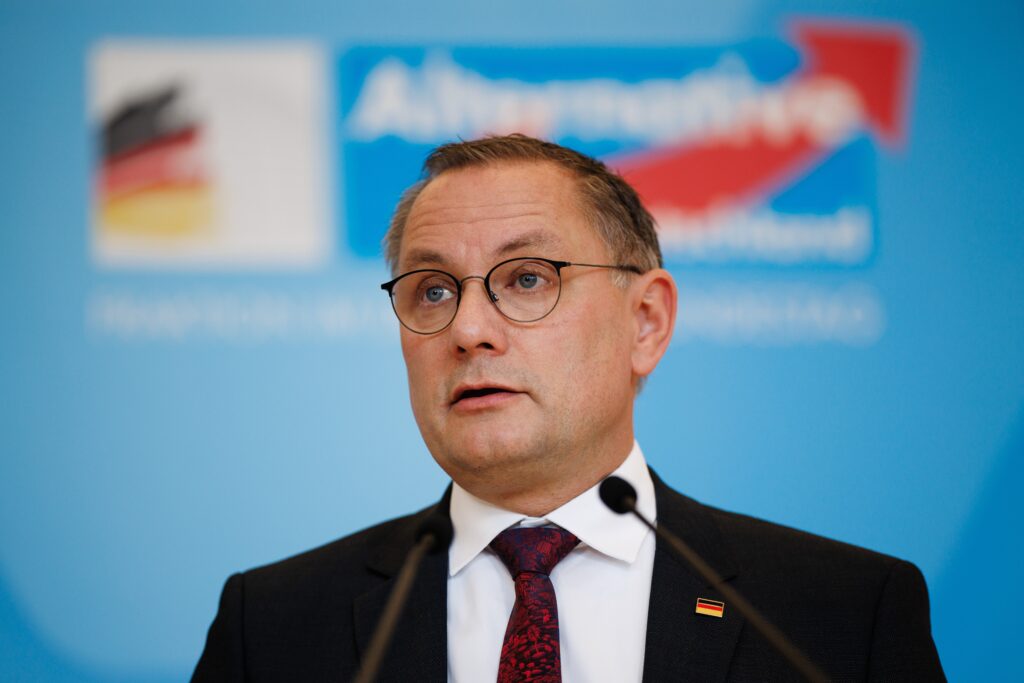
AfD leaders have leaned heavily on the Trump administration to help end their political ostracization at home. The strategy appears to have worked: When Germany’s domestic intelligence agency declared the AfD as extremist last year, U.S. Secretary of State Marco Rubio called the label “tyranny in disguise.” At last year’s Munich Security Conference, meanwhile, U.S. Vice President JD Vance urged mainstream politicians in Europe to dismantle the “firewalls” that have for decades shut out far-right parties.
AfD politicians were delighted on both occasions, which explains why their criticism of Trump this week was leavened by praise. In fact, Weidel and Chrupalla portrayed Trump’s pursuit of what he believes to be in the U.S. national interest as something of a model.
Germany’s government, Weidel suggested, could learn a lesson about how to put national self interest above other considerations.
Trump’s recent actions were based on “geostrategic reasons,” Weidel declared. “I would like to see the German federal government finally making policies for the German people, in the interest of Germany.”



Follow