




Nadine YousifSenior Canada reporter
 Getty Images
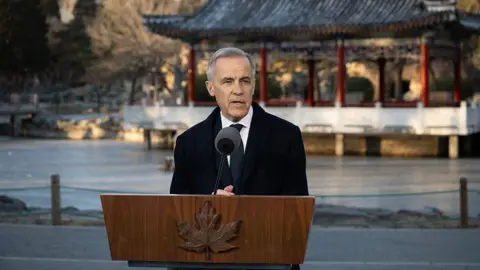
Prime Minister Mark Carney’s new approach to Canada’s foreign policy can perhaps be distilled in one line: “We take the world as it is, not as we wish it to be.”
That was his response when asked about the deal struck with China on Friday, despite concerns over its human rights record and nearly a year after he called China “the biggest security threat” facing Canada.
The deal will see Canada ease tariffs on Chinese electric vehicles that it imposed in tandem with the US in 2024. In exchange, China will lower retaliatory tariffs on key Canadian agricultural products.
Experts told the BBC the move represents a significant shift in Canada’s policy on China, one that is shaped by ongoing uncertainty with the US, its largest trade partner.
“The prime minister is saying, essentially, that Canada has agency too, and that it’s not going to just sit and wait for the United States,” said Eric Miller, a Washington DC based trade adviser and president of the Rideau Potomac Strategy Group.
Carney told reporters on Friday that “the world has changed” in recent years, and the progress made with China sets Canada up “well for the new world order”.
Canada’s relationship with China, he added, had become “more predictable” than its relationship with the US under the Trump administration.
He later wrote, in a social media post, that Canada was “recalibrating” its relationship with China, “strategically, pragmatically, and decisively”.
In Canada, as daylight broke on Friday, reaction to the deal was swift.
Some, like Saskatchewan Premier Scott Moe, hailed it as “very good news”. Farmers in Moe’s province have been hard hit by China’s retaliatory tariffs on Canadian canola oil, and the deal, he said, would bring much needed relief.
But Ontario Premier Doug Ford, whose province is home to Canada’s auto sector, was sharply critical of the deal. He said removing EV tariffs on China “would hurt our economy and lead to job losses”.
In a post on X, Ford said Carney’s government was “inviting a flood of cheap made-in-China electric vehicles without any real guarantees of equal or immediate investment in Canada’s economy”.
Some experts said the electric vehicle provisions in the trade deal would help China make inroads into the Canadian automobile market.
With the lower EV tariffs, approximately 10% of Canada’s electric vehicle sales are now expected to go to Chinese automakers, said Vivek Astvansh, a business professor at McGill University in Montreal.
The expected increase in Chinese EV sales could put pressure on US-based EV makers like Tesla which are seeking to expand their market share in Canada, he said.
“Carney has signalled to the Trump administration that it is warming up to China,” Astvansh added.
Reaction from the White House, meanwhile, has been mixed.
In an interview with CNBC on Friday morning, US trade representative Jamieson Greer called the deal “problematic” and said Canada may come to regret it.
President Donald Trump, however, hailed it as “a good thing”.
“If you can get a deal with China, you should do that,” he told reporters outside the White House.
Since taking office for a second time last year, Trump has imposed tariffs on Canadian sectors like metals and automotives, which has led to swirling economic uncertainty. He has also threatened to rip up a longstanding North American free trade agreement between Canada, the US and Mexico, calling it “irrelevant”.
That trade agreement, the USMCA, is now under a mandatory review. Canada and Mexico have both made clear they want it to remain in place.
But the decision to carve out a major new deal with China is a recognition by Carney that the future of North American free trade remains unclear, Miller of the Rideau Potomac Strategy Group told the BBC.
“There’s a reasonable chance that we could end up in 2026 without a meaningful, workable trade deal with the United States,” he said. “And Canada needs to be prepared.”
 Getty Images
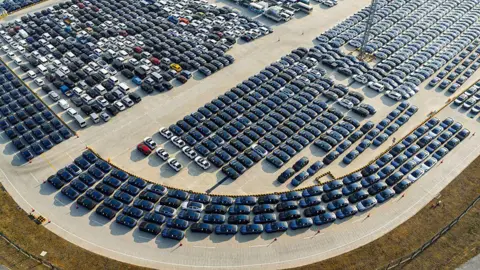
The deal with China drops Canada’s levies on Chinese EVs from 100% to 6.1% for the first 49,000 vehicles imported each year. That quota could rise, Carney said, reaching 70,000 in half a decade.
Canada and the US put levies on Chinese EVs in 2024, arguing that China was overproducing vehicles and undermining the ability of other countries to compete.
China is the world’s largest producer of EVs, accounting for 70% of global production.
In exchange, China will cut tariffs on Canadian canola seed to around 15% by 1 March, down from the current rate of 84%. Carney said Beijing had also committed to removing tariffs on Canadian canola meal, lobsters, crabs and peas “until at least the end of the year”.
China also committed to removing visa requirements for Canadian visitors, Carney said.
Beijing did not corroborate the details in a separate statement, but said “the two reached a preliminary joint agreement on addressing bilateral economic and trade issues”.
The introduction of Chinese EVs to Canada’s market will likely mean cheaper prices for Canadian consumers, said Gal Raz, an associate professor of Operations Management and Sustainability at Western University and an expert on the EV supply chain.
But Raz acknowledged that the deal Canada struck could hurt Canadian car manufacturers if it comes without further action from the Carney government to help the domestic sector.
He said it was the result of an “unfortunate” deterioration of the Canada-US trade relationship, which he noted has also hurt Canada’s automotive industry.
“The US has really put Canada in a corner,” he said.
Asked why Canada is giving China access to its automotive market, Carney said that China produces “some of the most affordable and energy-efficient vehicles in the world”. He said he expects the deal will spur Chinese investment into Canada’s auto industry, though he did not provide further details.
Trump himself has signalled openness to China building plants in the US if it means creating more jobs for Americans, despite his tough-on-China stance.
“If they want to come in and build a plant and hire you and hire your friends and your neighbours, that’s great, I love that,” Trump said at the Detroit Economic Club on Tuesday. “Let China come in, let Japan come in.”
The US president is notably headed to Beijing for his own meeting with President Xi Jinping in April. He has also invited Xi for a state visit to Washington.
For Carney, though, Friday’s deal may just be the first step in a “recalibration” of Canada’s trade relations.
With additional reporting from Daniel Bush in Washington



Follow