



The Labour Government is being urged to stop savers accessing their private pension savings from the age of 55 once they retire from the workplace under a shocking new proposal.
A prominent think tank with strong connections to senior Labour ministers has called on the government to increase the minimum age for accessing private pensions as a measure to discourage early retirement.
The Resolution Foundation argues that keeping older workers in employment is essential to tackling Britain’s growing joblessness problem. According to Office for National Statistics (ONS) data, unemployment has climbed to 5.1 per cent from a post-pandemic low of 3.6 per cent recorded in 2022.
The foundation identified workers aged over 50 and those under 25 as the primary drivers behind this surge in joblessness. Nye Cominetti, an economist at the Resolution Foundation, said: “Our pensions and tax rules currently incentivise very wealthy people to retire early. These generous tax breaks should be restricted.”
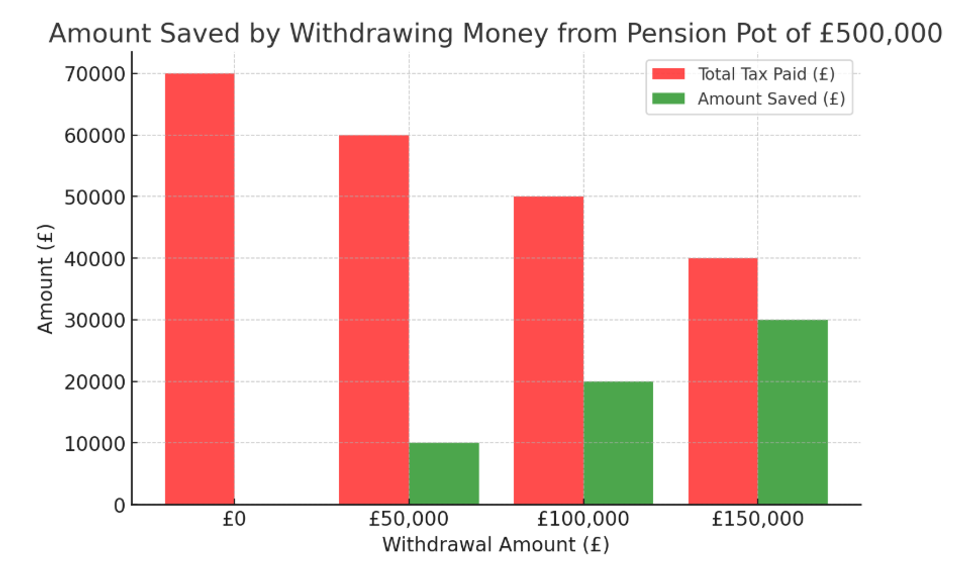
Currently, workers can begin drawing from their private pensions at 55, a full 11 years before they become eligible for the state pension, which rises from 66 to 67 this year. Under existing rules, individuals may withdraw up to a quarter of their pension pot tax-free, capped at £268,275.
The foundation stated: “To reduce the financial incentives for people to retire early, the Government should consider limiting access to private pension wealth before the state pension age.”
It suggested this could be achieved either by pushing back the age threshold for accessing tax-relieved pension savings or by cutting the tax-free allowance. The minimum access age is already scheduled to increase to 57 from April 2028, a change the think tank had previously advocated in a 2023 report.
While Britain’s employment rates for workers in their prime years compare favourably with high-performing EU nations such as Denmark, Germany, and Norway, the country lags behind when it comes to keeping over-50s in jobs.
Centre for Ageing Better analysis reveals that by age 55, one in four Britons has already left the workforce. This figure worsens significantly with age, with more than a third out of work by 60 and over half by 64.
By the time workers reach the state pension age of 66, just 30 per cent remain employed. Among those aged 50 to 65 who are not working, illness or disability accounts for 41 per cent, while 31 per cent have retired.
The remainder includes 12 per cent who are home-makers and 6 per cent actively seeking employment. Mr Cominetti added: “By doing so, the Government can boost both employment and the public finances.
“The UK does reasonably well on its overall employment rate compared to other rich countries, but trails the best-performing countries when it comes to the share of people over the age of 50 in work.
“The Government should offer a mix of carrots and stick to improve their job prospects.”
A Treasury spokesman said: “We want to help pensioners plan for a secure retirement.
“Our commitment to the triple lock is worth £470 a year to those receiving the new state pension, and we have launched a pensions commission to look at what more is required to ensure the pensions system is strong, fair and sustainable.”
Meanwhile, cost of living pressures have pushed more than 1.5 million state pensioners back into employment, with approximately 1.56 million over-65s now on payrolls, representing a 12 per cent increase from 2020-21.
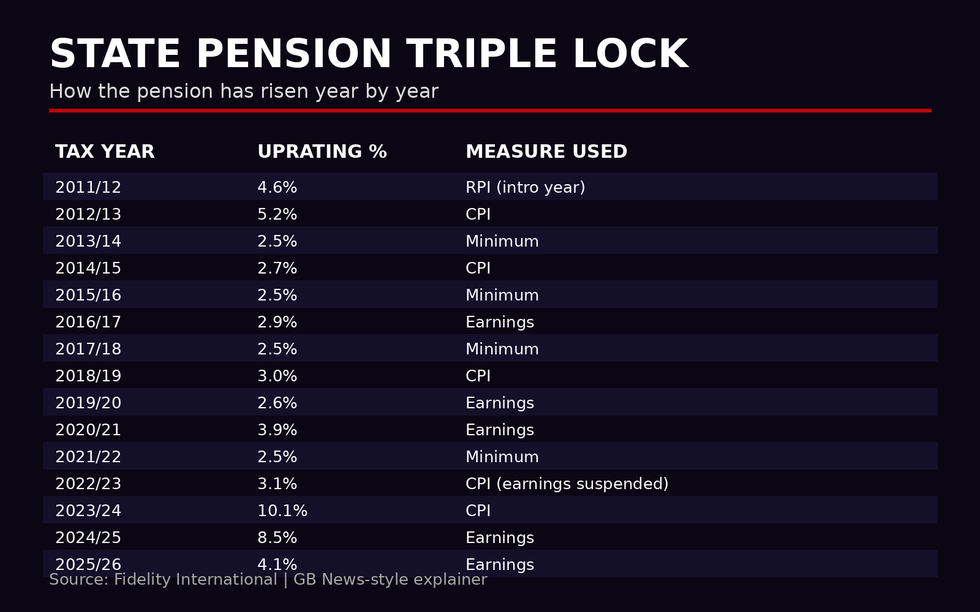
Under the triple lock, state pension payment rate are guaranteed to rise every year in line with either the rate of consumer price index (CPI) inflation, average wage growth, or 2.5 per cent; whichever is highest.
The state pension to increase by 4.8 per cent in April, boosting payments by £574.50 for those on the new state pension and £439.40 (basic state pension)Government commits to maintaining the triple lock
Mike Ambery, Retirement Savings Director at Standard Life, part of Phoenix Group said: “The Chancellor has confirmed that the state pension will rise by an inflation-busting 4.8 per cent in April, driven by the average earnings component of the triple lock.
“This will offer some short-term relief to those who continue to feel the squeeze of higher living costs, as the new state pension will be boosted by £574.50 per year and the basic state pension by £439.40.”
Our Standards: The GB News Editorial Charter



Follow