




SAN FRANCISCO (AP) — Google is leveraging its artificial intelligence technology to open a new peephole for its dominant search engine to tailor answers that draw upon people’s interests, habits, travel itineraries and photo libraries.
The new option rolling out Thursday will give millions of people the option of turning on a recently introduced tool called “Personal Intelligence” within the AI mode that has been available on Google’s search engine since last year. The technology will be first offered in the U.S. to Google AI Pro and Ultra subscribers, as well as an option within its experimental Labs division for anyone with a personal Google account.
If turned on, the new tool will plug Google’s AI Mode into Gmail and the Google Photos app so the technology can learn more about each user’s life and deliver more relevant answers tailored to personal tastes.
For instance, someone might ask for suggestions for a weekend getaway and get a quick recommendation based on past trips and experiences. Or, when in AI mode, the search engine might automatically know a person’s favorite restaurants or recognize preferred clothing styles by reviewing old pictures stored in Google Photos.
1 MIN READ

5 MIN READ

4 MIN READ
“Personal Intelligence transforms Search into an experience that feels uniquely yours by connecting the dots across your Google apps,” Robby Stein, a vice president in Google Search, wrote in a blog post. Stein also warned Personal Intelligence won’t always deliver the best answers, a pitfall that he said users can help correct by telling AI mode with words or a thumbs-down symbol.
Turning on the option will require users to trust Google’s search engine to protect the details that it is fed about their lives. But millions of people already have been doing that implicitly for decades while entering sometimes intimate queries into the search engine or sharing personal information within Gmail and the Photos app.
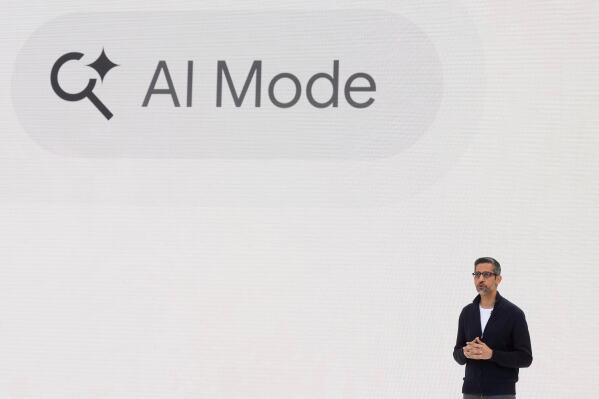
Alphabet CEO Sundar Pichai speaks at a Google I/O event in Mountain View, Calif., Tuesday, May 20, 2025. (AP Photo/Jeff Chiu, File)
Bringing Personal Intelligence to Google search is the latest sign of the company’s ambitions to make its arsenal of digital services even more powerful with a boost from the latest AI model, Gemini 3i, that came out in November.
Earlier this month, Google took its first steps toward turning Gmail into a personal assistant powered by AI and now it’s getting a chance to play a bigger role in a search engine that remains the foundation of its internet empire.
Gemini’s tentacles will even be extending into the iPhone, iPad and Mac after Apple decided last week to team up with Google to bring more AI tools to those products. The partnership will focus on a long-delayed effort to turn Apple’s often-bumbling digital assistant, Siri, into a more conversational and versatile aide.
Although Google’s search engine was condemned as an illegal monopoly in 2024 by a U.S. federal judge, it remains the internet’s main gateway while trying to fend off competitive threats from AI-powered answer engines offered by up-and-coming innovators such as ChatGPT and Perplexity.
The potentially revolutionary changes being wrought by AI helped persuade the judge who branded Google a monopoly to reject a proposal by the U.S. Justice Department that would have forced the company to sell its Chrome web browser to curb future abuses in the market.



Follow