




Fresh figures from HM Revenue and Customs (HMRC) reveal that pension tax relief now costs the Treasury around £59.1billion annually, according to data published this month.
This jump in people claiming a boost in their retirement savings comes amid “pure speculation” Chancellor Rachel Reeves will target the relief as part of a stealth tax raid in fiscal statements.
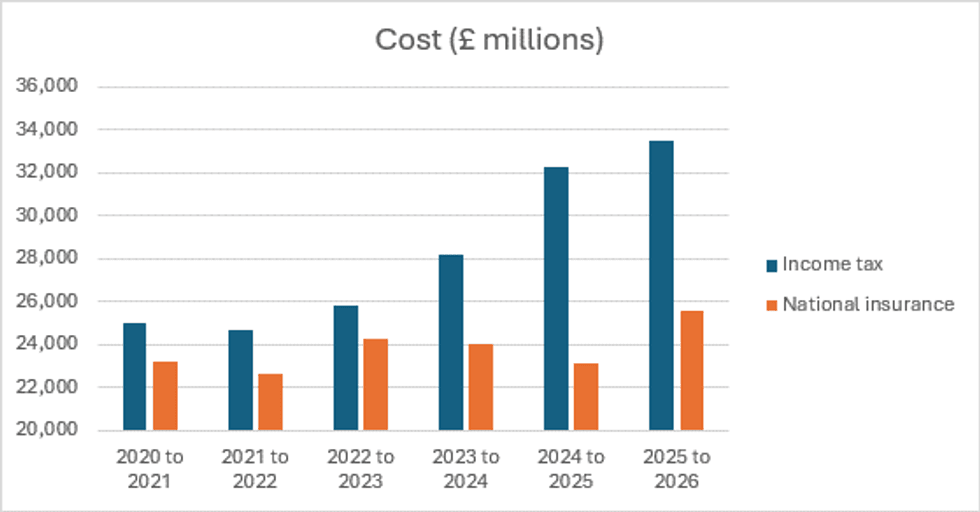
The statistics show the total expense has surged by close to £11billion over the past half-decade. Several factors have driven this substantial rise, including higher wages pushing up the value of pension contributions, expanded annual allowance limits, and the scrapping of the lifetime allowance.
Charlene Young, a senior pensions and savings expert at AJ Bell, noted: “The cost of retirement tax incentives is within touching distance of £60billion, once the tax collected on pension withdrawals has been deducted.”

Private residence relief shields homeowners from capital gains tax when selling their primary property. Mr Young explained that the income tax relief figure encompasses not just upfront tax breaks on contributions, but also the tax-free protection afforded to pension wrappers and the value of tax-free cash withdrawals.
Employers receive the largest portion of National Insurance contributions relief. The income tax relief component has experienced the most dramatic growth, climbing by more than a third over five years, which translates to £8.5billion in actual terms.
Ms Young observed: “It’s pulled away from National Insurance contribution relief which fell during the 2023/24 and 2024/25 years.
“This can be explained by the NI primary threshold increasing to bring it in line with the income tax personal allowance in July 2022, followed by cuts to employee NI rates in 2023 and 2024.”

The overall cost of pension tax incentives now represents approximately two per cent of Britain’s gross domestic product (GDP).
Ms Reeves’s November 2025 Budget left pension income tax relief and tax-free cash untouched, with ministers instead targeting National Insurance exemptions linked to salary sacrifice schemes.
However, Ms Young warned that pre-Budget speculation had already prompted many savers to make premature decisions, and similar behaviour could recur without clearer government messaging.
She added: “The Government sensibly did not touch pension income tax relief or tax-free cash at the Budget in November, instead choosing to go after the National Insurance exemptions available for firms and employees of salary sacrifice arrangements.
“But many people had already made decisions based on pure speculation, and there remains a huge risk that the same will happen again ahead of the next Budget unless the government provides certainty to savers on pension tax incentives.
“As the pensions landscape continues to move from the old world of pension promises and defined benefit schemes to an era of pension pots, it’s crucial that nothing undermines the confidence of people putting away their own money for the long term.”
“It is still within the chancellor’s gift to commit to stability for pension savers. As the pensions landscape continues to move from the old world of pension promises and defined benefit schemes to an era of pension pots, it’s crucial that nothing undermines the confidence of people putting away their own money for the long term.”
Ahead of the upcoming Self-Assessment deadline, Britons are being urged to apply for tax relief to ensure significant savings for later in life.
Lisa Picardo, the chief business officer UK at PensionBee, said: “It’s estimated that over five million taxpayers are yet to fill out their Self-Assessment form for the previous tax year, so getting your ducks in a row before January 31 is crucial.
“For many, completing a tax return could unlock unexpected pension benefits.
“If you’ve changed jobs, started self-employment or entered a higher tax bracket, filing ensures you don’t leave valuable tax relief unclaimed.
“Our tax relief calculator can help provide clarity on how much tax relief could be added to your pension pot, and help you understand whether or not you may need to file a Self-Assessment tax return to claim a portion of it.”
Our Standards: The GB News Editorial Charter



Follow