



BRUSSELS — Powerful political allies helped automakers force the EU to water down climate laws for cars — and now the aviation sector is borrowing those tactics.
Their big target is getting the EU to dilute its mandate forcing airlines to use increasing amounts of cleaner jet fuels, alternatives to kerosene that are also much more expensive and harder to source.
Aviation is emerging as the next crucial stress test for the EU’s climate agenda, as key leaders push to do whatever it takes to help struggling European businesses. With industry and allied governments pressing for relief from costly green rules, the fight will show how far Brussels is willing to go — and what it is willing to give up — in pursuit of its climate goals.
“I will make a bet today that what happened to the car regulation will happen to the SAF [Sustainable Aviation Fuels] regulation in Europe,” French energy giant TotalEnergies CEO Patrick Pouyanné predicted at the World Economic Forum in Davos earlier this month.
Carmakers provide a model on how to get the EU to backtrack. The bloc mandated that no CO2-emitting cars could be sold from 2035, essentially killing the combustion engine and replacing it with batteries (possibly with a minor role for hydrogen).
But many carmakers — allied with countries like Germany, Italy and automaking nations in Central Europe — pushed back, arguing that the 2035 mandate would destroy the car sector just as it is battling U.S. President Donald Trump’s tariffs, sluggish demand and a rising threat from Chinese competitors.

In the end, the European Commission gave way and watered down the 2035 mandate, which will now only aim to cut CO2 emissions by 90 percent.
Aviation demands
The aviation sector has a similar list of issues with the EU. It is taking aim at a host of other climate policies, such as including aviation in the bloc’s cap-and-trade Emissions Trading System and intervening on non-CO2 impacts of airplanes like contrails — the ice clouds produced by airplanes that have an effect on global warming.
Brussels introduced several regulations over the last 15 years to address the growing climate impact of air transport, which accounts for about 3 percent of global CO2 emissions. Those policies include the obligation to use sustainable aviation fuels, to put a price on carbon emissions and to take action on non-CO2 emissions.
Each of these green initiatives is now under attack.
The ReFuelEU regulation requires all airlines to use SAF for at least 2 percent of their fuel mix starting this year. That mandate rises to 6 percent from 2030, 20 percent from 2035 and 70 percent by 2050.
“Today, all airline companies are fighting even the 6 percent … which is easy to reach to be honest,” Pouyanné said, but then warned, “20 percent five years after makes zero sense.”
He is echoed by CEOs like Ryanair’s combative Michael O’Leary, who called the SAF mandate “nonsense.”
“It is all gradually dying a death, which is what it deserves to do,” O’Leary said last year. “We have just about met our 2 percent mandate. There is no possibility of meeting 6 percent by 2030; 10 percent, not a hope in hell. We’re not going to get to net zero by 2050.”
Brussels-based airline lobbies are not calling for the SAF mandate to be killed, rather they are demanding a book-and-claim system. Under such a scheme, airlines could claim carbon credits for a certain amount of SAF, even if they don’t use it in their own aircraft. They would buy it at an airport where it’s available and then let other airlines use it.
That would make it easier for airlines to meet the SAF mandate even if the fuel is not easily available. However, so far the Commission is opposed.
Lobbying battle
The car coalition only worked because industry allied with countries, and there are signs of that happening with aviation.
The sector’s lobbying effort to slash the EU carbon pricing could find an ally in the new Italo-German team-up to promote competitiveness.
The German government last year announced a plan to cut national aviation taxes — with the call made during the COP30 global climate conference, something that angered the German Greens.
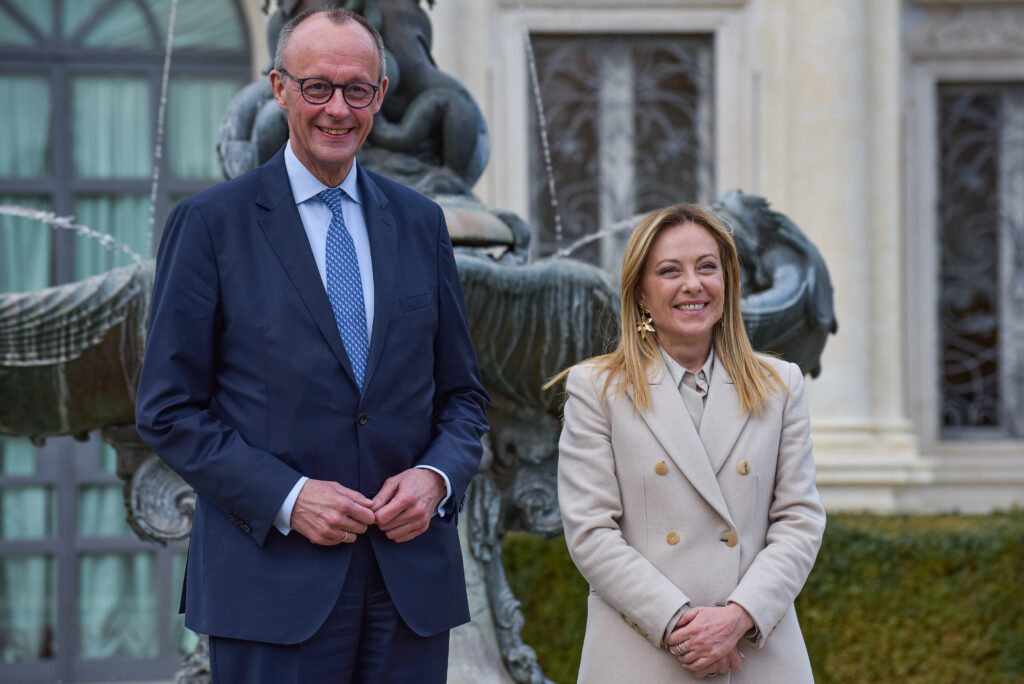
Italian Prime Minister Giorgia Meloni said Friday that she and German Chancellor Friedrich Merz wanted to start “a decisive change of pace … in terms of the competitiveness of our businesses.”
“A certain ideological vision of the green transition has ended up bringing our industries to their knees, creating new dangerous strategic dependencies for Europe without, however, having any real impact on the global protection of the environment and nature,” she added.
Her far-right coalition ally, Italian Transport Minister Matteo Salvini, has called the ETS and taxes on maritime transport and air transport “economic suicide” that “must be dismantled piece by piece.”
Commission says no
As with the 2035 policy for cars, the European Commission is strongly defending its policy against those attacks.
Apostolos Tzitzikostas, the transport commissioner, stressed the EU’s “firm commitment” to stick with aviation decarbonization policies.
“Investment decisions and construction must start by 2027, or we will miss the 2030 targets. It is as simple as that,” the commissioner said in November when announcing the bloc’s new plans to boost investment into sustainable aviation and maritime fuels.
Climate campaigners fought hard against the car sector’s efforts to gut 2035, and now they’re gearing up for another battle over aviation targets.
“The airlines’ whining comes as no surprise — yet it is disappointing to see airlines come after such a fundamental piece of EU legislation,” said Marte van der Graaf, aviation policy officer at green NGO Transport & Environment.
She was incensed about efforts to dodge the high prices set by the EU’s ETS in favor of the U.N.’s cheaper CORSIA emissions reduction scheme.
Airline lobbyA4E said its members paid €2.3 billion for ETS permits last year. “By 2030, [the ETS cost] should rise up to €5 billion because the free allowances are phased out,” said Monika Rybakowska, the lobby’s policy director.
A recent study by the think tank InfluenceMap found that airlines are working to increase their impact on policymakers by aligning their positions on ETS.
T&E also took aim at a recent position paper by A4E that asked the EU to postpone measures to curb non-CO2 pollution — such as nitrogen oxides and soot particles that, along with water vapor, contribute to contrails.
The A4E paper said that “the scientific foundation for regulating non-CO2 effects remains insufficient” and “introducing financial liability risks misdirecting resources.”
This is “an outdated excuse,” responded T&E, noting that the climate impact of contrails has been known for over 20 years.



Follow