



BRUSSELS ― Slovakia’s prime minister told EU leaders at a summit last week that a meeting with Donald Trump left him shocked by the U.S. president’s state of mind, five European diplomats briefed on the conversation said.
Robert Fico, one of the few EU leaders to frequently support Trump’s stance on Europe’s weaknesses, was concerned about the U.S. president’s “psychological state,” two of the diplomats said. Fico used the word “dangerous” to describe how the U.S. president came across during their face-to-face meeting at Trump’s Mar-a-Lago estate in Florida on Jan. 17, according to two of the diplomats.
The conversation between Fico and his European counterparts took place in Brussels on Jan. 22 on the sidelines of an emergency EU summit arranged to discuss transatlantic relations in the wake of Trump’s threats to seize Greenland. Leaders used that gathering to try to calm tensions after the U.S. president walked back his threat to slap tariffs on some European countries over the issue a day earlier.
The Slovak prime minister made his remarks in a separate informal huddle between some leaders and chief EU officials rather than during the formal roundtable talks, the diplomats said. While none of the diplomats who spoke to POLITICO were present, individual leaders briefed them separately on the content of the conversation shortly after it.
All the diplomats were granted anonymity by POLITICO to allow them to discuss the confidential exchanges between leaders. They come from four different EU governments. The fifth is a senior EU official. All of them said they didn’t know the details of what Trump had said to Fico that had triggered his reaction.
Fico’s comments are especially pertinent because he’s among Europe’s most pro-Trump politicians, touting his access to the U.S. president in a Facebook video after the Mar-a-Lago meeting and voicing support for Washington’s approach to the Russia-Ukraine war. A year ago, Fico spoke at the Conservative Political Action Conference and told Americans “your president is doing Europe a great service.”
Spokespeople for Fico did not respond to multiple requests for comment.
Anna Kelly, a White House spokesperson, said: “This is absolutely total fake news from anonymous European diplomats who are trying to be relevant. The meeting at Mar-a-Lago was positive and productive.”
A senior administration official who was in the meeting with Trump and Fico, granted anonymity to describe the conversation, said they couldn’t recall any awkward moments or off-key exchanges. They said the meeting, which Fico had requested, was pleasant, normal and included some lighthearted exchanges that were captured by a White House photographer.
Fico seemed to be “traumatized” by his encounter with Trump, one of the European diplomats said. Fico characterized Trump as being “out of his mind,” a diplomat said, using the words briefed to them by their leader, who was directly involved in the conversation.
Deep crisis
Fico’s private concerns contrast with the public account of his Mar-a-Lago visit that he gave via his official Facebook post.
In that video, Fico said his invitation to Trump’s Florida residence was a sign of “high respect and trust” from the U.S. president. The two leaders discussed Ukraine as well as their shared view that the EU was in “deep crisis” during what Fico called “informal and open talks.”
Fico, who signed a civil nuclear cooperation deal with Washington while on his trip to the U.S., did not mention Trump’s claims on Greenland or his operation to seize Venezuelan leader Nicolas Maduro earlier in January in the video.
He said discussions had focused on issues including Ukraine, asserting that Washington sought his view because Slovakia is “not a Brussels parrot” — meaning that it does not echo the positions of EU institutions.
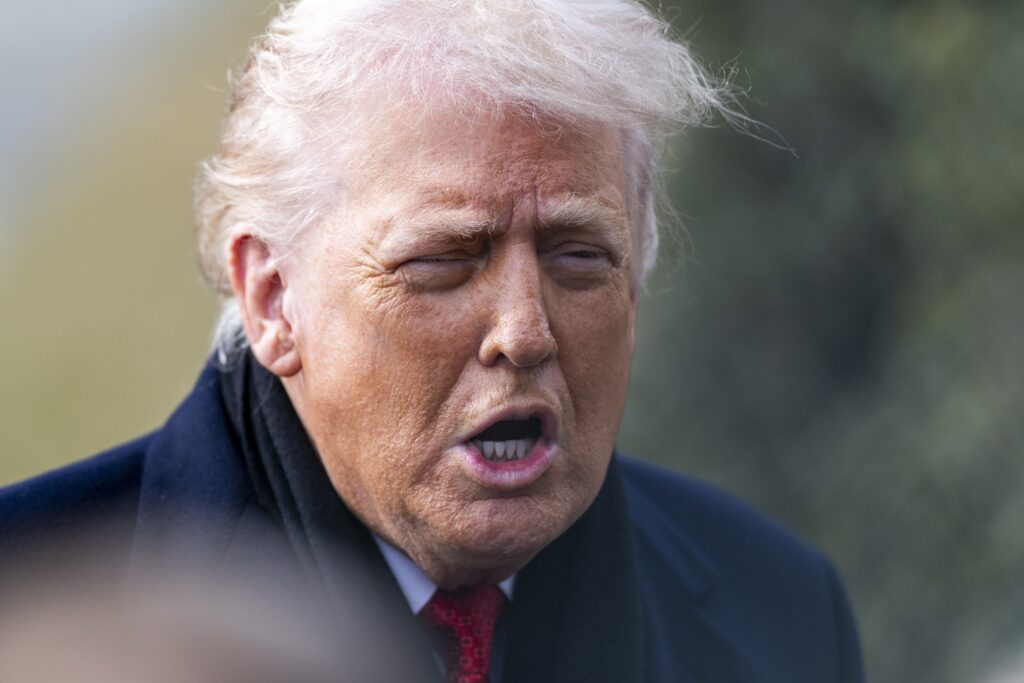
Even without Fico’s remarks, Europe’s leaders and senior officials are increasingly concerned about the U.S. president’s “unpredictability,” according to a sixth EU diplomat, who was not briefed directly by a leader on last week’s conversation.
Fears about the U.S. president’s health are “rapidly becoming a more conversed topic at all levels,” said an EU official who is involved in political discussions in Brussels and between capitals.
Trump, 79, has repeatedly and forcefully denied that he suffers from any condition affecting his cognition, telling New York Magazine this week that he doesn’t suffer from Alzheimer’s disease.
‘I won’t do that, OK?’
Ever since Trump returned to office a year ago, European governments have been grappling with how to deal with his positions on issues such as Russia’s invasion of Ukraine, his administration’s apparent backing for far-right politicians, barriers to free trade, and the U.S. role in the continent’s defense.
Earlier this month, Trump threatened new tariffs on eight European countries, including France, Germany and the U.K., which he said were blocking his efforts to take over Greenland, a semi-autonomous territory belonging to Denmark, an EU and NATO member. He also didn’t rule out taking the island by force.
In a speech in Davos, Switzerland last Wednesday, the U.S. president demanded “immediate negotiations” to obtain Greenland, but ruled out the use of military action.
“We probably won’t get anything unless I decide to use excessive strength and force, where we would be frankly unstoppable. But I won’t do that, OK?” Trump said in the speech.
After the speech, he said he’d agreed on a framework of a deal on Greenland with NATO Secretary-General Mark Rutte and withdrew his threat, although the details of the apparent agreement have still not been made public.
At last week’s summit, French President Emmanuel Macron and German Chancellor Friedrich Merz, the EU’s two most powerful leaders, warned their counterparts that despite that apparent deal, the bloc needed to become less dependent on the U.S. for its security.
Speaking after the gathering, European Commission President Ursula von der Leyen suggested the leaders had learned the lesson that standing up to Trump in a “firm” but “non-escalatory” way was an effective strategy that they should continue.
Jacopo Barigazzi, Camille Gijs and Tom Nicholson contributed reporting.



Follow