



BERLIN — A German parliamentary delegation visiting Washington late last month saw center-left MPs frozen out by the U.S. State Department, people familiar with the matter told POLITICO.
German MPs refused to take part in the meeting after their colleagues were blocked — a highly unusual step. U.S. authorities insisted there had been no effort to favor right-leaning parties and that they speak to a “wide spectrum” of politicians during such visits.
In a separate encounter, an MP with the far-right Alternative for Germany (AfD), Peter Felser, who was also part of the delegation, arranged a meeting at the Pentagon where he talked with a U.S. official about Germany’s defense posture.
The clash over the visit comes in the wake of a new National Security Strategy from December that harshly criticized U.S.-allied nations in Europe for their efforts to rein in far-right parties; denounced their high rates of migration; and called for the continent to “correct its current trajectory.”
The German lawmakers were supposed to be on a routine visit, during which they would take part in the German-American Dialogue on China.
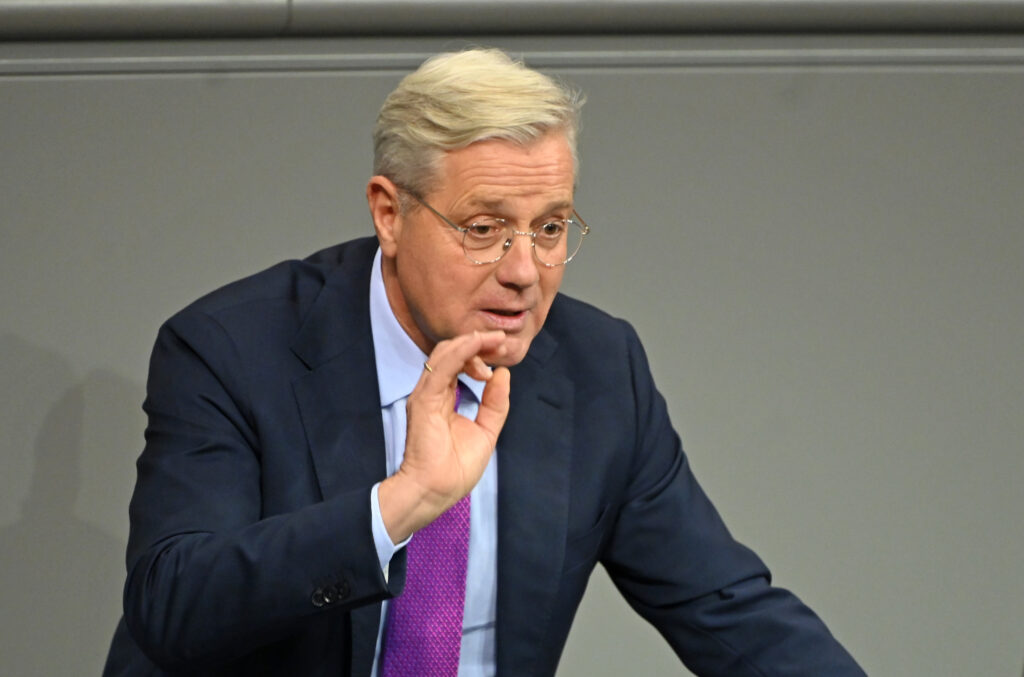
The delegation included two senior lawmakers from Germany’s governing coalition — Norbert Röttgen with the center-right Christian Democrats and Siemtje Möller for the center-left Social Democrats (SPD), as well as MPs from the opposition center-left Greens and the AfD.
The plan had been for lawmakers from all parties to attend a meeting with Brendan Hanrahan, a senior official at the State Department’s Bureau of European and Eurasian Affairs, on Jan. 21 before the China event.
Five people with knowledge of the matter, who spoke to POLITICO on condition of anonymity, said the planned meeting collapsed after State Department officials told the German Embassy in Washington that it was prepared to receive only Christian Democratic and AfD lawmakers, excluding the SPD and the Greens.
Röttgen rejected that format, saying he would not proceed without his coalition partner, four people familiar with the matter said.
It’s unclear, however, who ultimately cancelled the appointment.
In response to POLITICO’s request for comment, Germany’s foreign ministry declined to explain the cancellation, saying only that the State Department had called off the meeting for “scheduling reasons.”
The State Department denied any preference for particular parties during delegation visits, saying in a statement that “senior State Department officials engage regularly with representatives from a wide spectrum of political parties and leaders, and we do not comment on private diplomatic meetings.”
Such parliamentary trips are normally built around engagement with both sitting governments and opposition — and the episode left German officials privately uneasy about how parts of the Trump administration are approaching Europe.
Möller and Röttgen nonetheless went on to hold meetings with U.S. lawmakers and officials at the National Security Council during their visit.
Röttgen’s office did not immediately respond to POLITICO’s request for comment.
In a statement to POLITICO, Möller said the episode showed that “even a year into office, parts of the U.S. administration still lack clear coordination and reliable alignment,” but stressed that talks with administration officials and Republican members of Congress nevertheless took place.
Pentagon briefing
In the separately arranged Pentagon visit, the AfD’s Felser held a one-on-one meeting with David A. Baker, the deputy assistant secretary of defense for European and NATO policy.
Felser had requested the appointment roughly two weeks earlier through the German embassy, people familiar with the arrangements on both the U.S. and German side said. The conversation focused on the new U.S. National Security Strategy and Washington’s expectations that Germany take on a greater leadership role in European defense.
The AfD has surged in popularity and is now Germany’s most popular party, according to POLITICO’s poll of polls. Last year, Vice President JD Vance sharply criticized European centrists for excluding the far right and later met with AfD national co-leader Alice Weidel.
Felser told POLITICO that Washington’s willingness to meet him showed the U.S. was not “falling for” what he called the coalition’s attempt to sideline the AfD, adding that the “channel of conversation” the U.S. had opened amounted to “important support” for his party.
Speaking about the Pentagon meeting, a Department of Defense official said that its officials “meet with allied parliamentarians regularly to discuss defense issues of mutual concern.”
Both Felser and Gerald Otten, the other AfD politician who was present in Washington with the parliamentary delegation, said that U.S. officials had over the last months actively reached out to their party to establish whether future cooperation would be viable. For now, the conversations revolved around pinning down the AfD’s positions on a range of issues that included the EU, NATO, and the promise of NATO member countries to increase defense spending to 5 percent of GDP.
Back in Berlin, Röttgen told reporters he had been surprised at what he described as the “entrenched, virtually impenetrable worldview” of members of the pro-Trump MAGA camp — including the diplomats, politicians and lobbyists the German delegation had met over a lunch in the U.S. That was something, Röttgen said, he had “never encountered in all the years I have traveled to Washington.”



Follow