



The Environmental Protection Agency on Thursday revoked its own 2009 “endangerment finding,” a scientific conclusion that for 16 years has been the central basis for regulating planet-warming emissions from power plants, vehicles and other sources.
The finding itself is straightforward: Carbon dioxide and other greenhouse gases — caused by burning fossil fuels such as coal, oil and gas — endanger public health and welfare.
It was adopted after the U.S. Supreme Court ruled in 2007 that greenhouse gases are air pollutants that can be regulated under the Clean Air Act.
The Trump administration says the finding hurts industry and the economy and that the Obama and Biden administrations twisted science to determine that greenhouse gases are a public health risk.
Environmentalists say those gases are a clear threat because climate change worsens weather disasters such as floods, heat waves and drought.
Here’s what to know:
How has the endangerment finding been used?
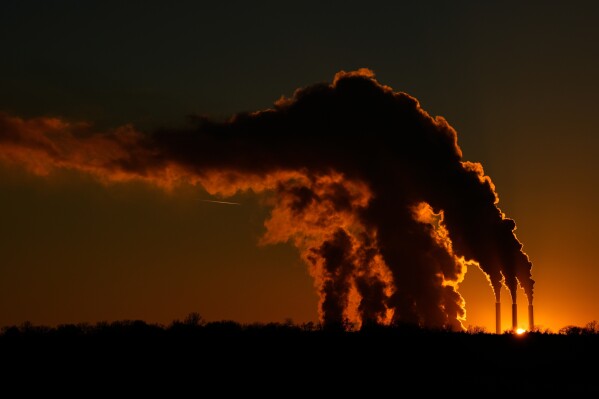
The Jeffrey Energy Center coal-fired power plant operates at sunset near Emmett, Kan., Jan. 3, 2026, in Topeka, Kan. (AP Photo/Charlie Riedel, File)
Since taking effect in 2010, during President Barack Obama’s first term, the endangerment finding has been the legal underpinning for new regulations targeting emissions from vehicles, oil and gas facilities and large industries, including power plants.
The EPA also determined that greenhouse gas emissions from some aircraft endanger health and welfare, setting the stage for future regulations.
Under President Donald Trump, the Department of Energy has suggested that climate models used by scientists to predict warming have overreached, that long-term trends for disasters generally don’t show much change and that climate has little impact on the economy.

3 MIN READ

1 MIN READ

2 MIN READ
Why does it matter?
Climate scientists warn that overturning the endangerment finding undermines decades of scientific progress and damages the credibility of U.S. institutions tasked with protecting the environment.
More importantly, scientists say rising global temperatures — the hottest years on record have all occurred since 2009 — cause more extreme weather that endangers people and causes billions of dollars in damage from more frequent and severe heat waves, wildfires, droughts and catastrophic flooding from more-intense storms.
The EPA action repeals all greenhouse gas emissions standards for cars and trucks, but experts say it could trigger a broader undoing of climate regulations for stationary sources such as power plants and oil and gas facilities. It also could prevent future administrations from proposing rules to address global warming because they would have to restart the scientific and legal process to establish a new endangerment finding, which could take years and face legal challenges, said David Doniger, a climate expert at the Natural Resources Defense Council.
What happens next?
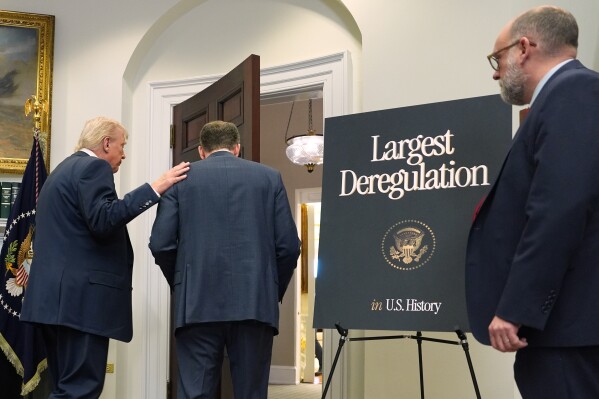
President Donald Trump departs with Environmental Protection Agency director Lee Zeldin and Office of Management and Budget director Russell Vought, right after announcing the EPA will no longer regulate greenhouse gases, in the Roosevelt Room of the White House, Thursday, Feb. 12, 2026, in Washington. (AP Photo/Evan Vucci)
Environmental groups are sure to challenge the revocation in court.
So far, federal courts have repeatedly rejected legal challenges to the finding, including a 2023 decision by the U.S. Court of Appeals for the District of Columbia Circuit.
___
The Associated Press’ climate and environmental coverage receives financial support from multiple private foundations. AP is solely responsible for all content. Find AP’s standards for working with philanthropies, a list of supporters and funded coverage areas at AP.org.



Follow