



Aquino calls it “a salon staple that delivers elasticity and manageability to all textures.” She explains that the oil “penetrates quickly to fill gaps in high-porosity hair, leaving curls supple and defined.” Because it can be used pre-shampoo, post-wash, or even overnight, it works like a repair-preserving layer that keeps fragile ends from unraveling further, a crucial benefit for high-porosity hair that loses moisture and integrity fastest at the tips. For colour-treated hair, Aquino adds, “it helps maintain vibrancy while adding incredible softness. The argan oil provides the kind of smoothness and flexibility that keeps both tone and texture healthy over time.”
More to know
- Key ingredients: argan oil, silicone
- Who’s it for: dry hair prone to splitting
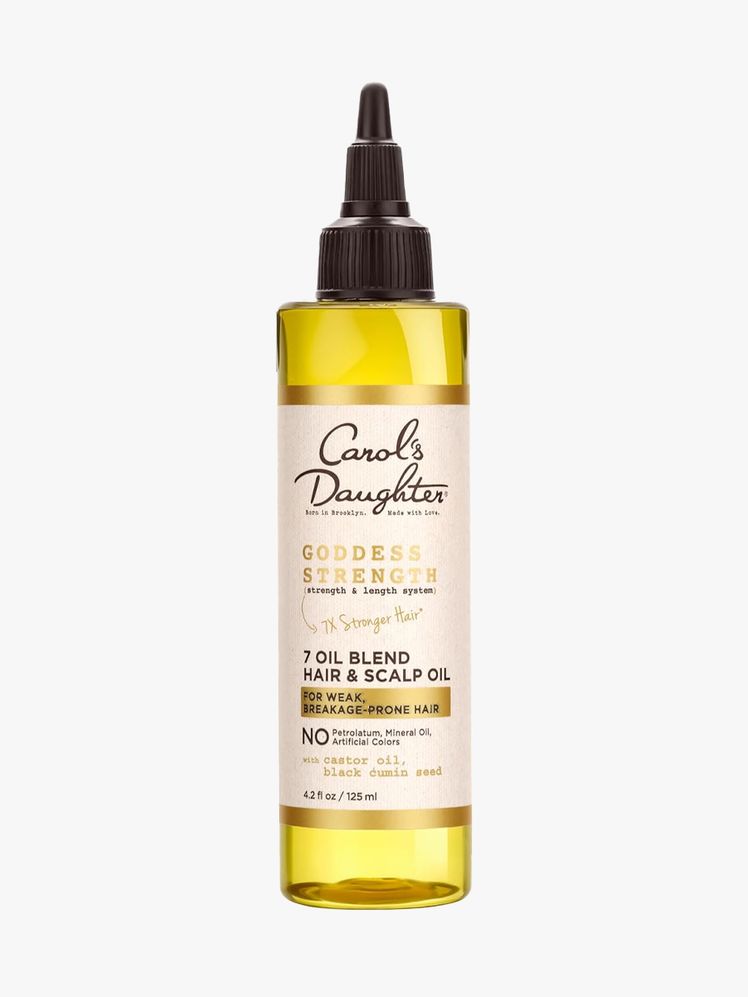
Best for Tighter Curls: Carol’s Daughter Strength 7 Oil Blend Scalp & Hair Oil

Carol’s Daughter Strength 7 Oil Blend Scalp & Hair Oil
Why we love it: Tighter curls and coils show damage quickly because every bend is a stress point, and high porosity at those bends causes moisture to escape even faster. Carol’s Daughter Goddess Strength 7 Oil Blend Hair & Scalp Oil addresses the issue with castor oil to add weight and structural support, while black cumin seed oil brings antioxidants to help defend the cuticle from further wear. “I particularly love using the seven oil blend on the hair from mid-lengths to tip to help seal and lock in moisture on high-porosity hair that does not retain moisture easily,” says James. She adds that it’s just as useful after heat-styling, noting, “On wavy to curly hair that has been blown out or silk-pressed, I apply it as a finisher to combat frizz, lay down flyaways, and temporarily seal split ends.
And when clients ask for a scalp treatment, James reaches for it because “it’s lightweight, designed for on-scalp application, and has an herbal fragrance that complements the body’s natural microbiome—perfect for a good ‘grease my scalp moment.”
More to know
- Key ingredients: castor oil, black cumin seed oil, sunflower seed oil
- Who’s it for: 4C and tightly coily hair
Frequently Asked Questions
What’s the difference between low-porosity and high-porosity hair?
Hair with a tightly compacted cuticle resists penetration; as Aquino explains, “Low-porosity hair has a tight, compact cuticle that repels moisture and products…it can feel dry but resists water and takes a long time to absorb treatments.” She draws the distinction clearly: “In short: Low-porosity hair struggles to let moisture in, while high-porosity hair struggles to keep it.” She also notes that routine must follow that logic, adding, “Low porosity needs gentle lift-and-penetrate strategies and high porosity needs sealing and rebuilding.”
On the other end of the spectrum, James states, “High-porosity hair looks and feels excessively dry, has an extremely frizzy appearance, and lacks elasticity, so the hair is prone to breakage.” She also points to cumulative damage as the cause, stating “chemically-treated hair, excessive heat-styling, and over-manipulation are often the root cause of high porosity.”
Which ingredients or oil compositions should people with high-porosity hair look for?
Aquino explains that high-porosity hair requires both internal strengthening and surface sealing through “ingredients that both strengthen the cortex and seal the cuticle: think hydrolysed proteins (collagen, keratin, silk) and humectants like glycerin or panthenol to attract moisture.” She recommends heavier oils and butters, such as castor, avocado, olive oil, and shea or mango butter, because “their fatty acids help plug gaps in the cuticle and slow moisture loss.” On the other hand, Aquino warns: “Lightweight oils alone won’t protect long-term; pair sealants with a protein-rich treatment and consistent moisturising steps.” James agrees with a dual approach and adds, “Typically, more protein, less moisture.”
What’s the best way to apply hair oil to high-porosity hair?
For high-porosity hair, experts agree that oil should be layered when the hair is hydrated but not dripping wet, so it can seal moisture inside the cuticle rather than just coat the surface. Aquino specifies that “damp, towel-squeezed hair after your leave-in or cream” is the ideal state because humectants can pull in water first before the oil locks it down. She advises warming a small amount in the palms and focusing on mid-lengths and ends, using heat or steam for deeper penetration.” Aquino also notes that “on soaking wet hair oils can slide off and won’t seal properly,” and that on dry hair a light glossing pass is enough only for frizz control. James offers a more intensive version of this same principle, recommending “the best way to apply the oil(s) on wet hair is after a detoxifying or clarifying shampoo for maximum absorption,” followed by “applying heat from a steamer, steam cap, or hooded dryer for 20–30 minutes.”
How can someone tell if their hair has absorbed the oil instead of the oil just sitting on top?
Absorption shows up in how the hair behaves, not just how it looks. Aquino explains that “if the hair feels soft, springy, and not tacky after a few minutes and the strands move naturally…the oil has likely been absorbed.” She recommends a transfer test to confirm, noting “if oil transfers easily to your fingers, it’s probably just sitting on the surface; if the strand stays supple but your fingers stay mostly clean, it’s absorbed.” James adds that sight can be just as telling, stating that “the key indicator…is individualised strands rather than the appearance of multiple strands in clusters.”
Meet the experts
How we test and review products
When we test a product, our editors look at it from every angle in an effort to best serve you. We review ingredients, scrutinise brand claims, and, when necessary, examine peer-reviewed scientific and medical studies. In addition to testing each and every product that’s included in each and every review, we rely on experts who shape their fields, including dermatology, cosmetic chemistry, and medicine, to help us vet the ingredients and formulas.
For our list of the best hair oils, we considered each product’s performance across five primary categories: product ingredients and efficacy, packaging, fragrance, texture, and product wear. Every product was determined to have excelled in each category by our editorial team of in-house writers and editors, as well as contributors, along with special consideration from dermatologists. To learn more about our reporting and testing processes, read our complete reviews process and methodology page.
This story was originally published by Allure, originally written Jailynn Taylor and adapted by Shani Cohen.



Follow