



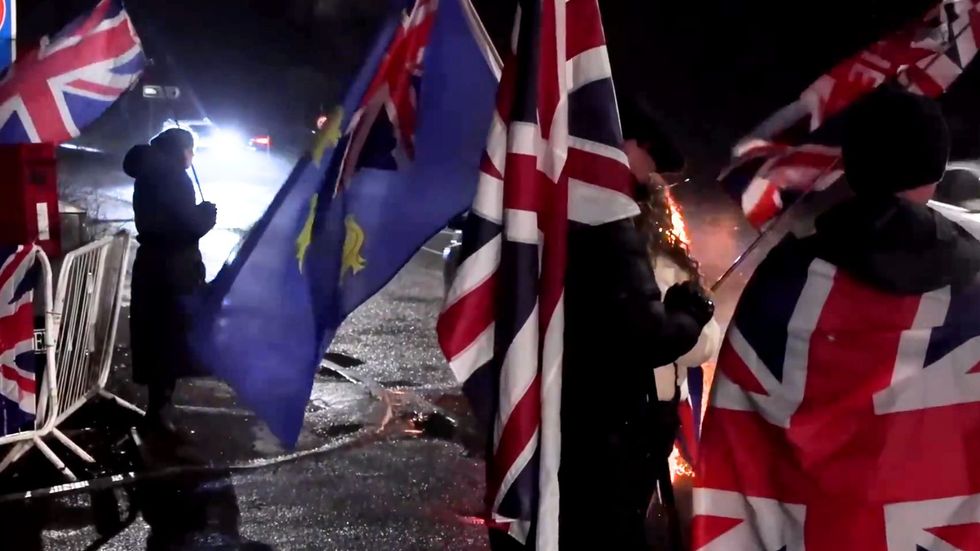
Overnight, under the cover of darkness, the first minibus carrying a group of migrants was escorted by police to the former army barracks in Crowborough.
A total of 27 male illegal immigrants arrived last night as the Home Office presses ahead with plans to eventually house up to 540 people on the site despite months of protests from furious local residents.
Campaign groups have raised concerns, citing hundreds of crimes committed by illegal immigrants housed in asylum accommodation across the UK. These offences include rape, sexual assault and even murder.
The Prime Minister was questioned about the use of barracks in Crowborough at the Liaison Committee in December. At the time, the Government said it was looking to open large sites in Crowborough and Inverness by the end of November. Those sites have still not opened.
Asked when they would open, he said it would be “as soon as we’re satisfied they’re ready”, adding that military sites were under consideration but must first pass suitability and safety checks.
He also pointed out that asylum hotels, which peaked at around 400, have been reduced to roughly 200, insisting he is “absolutely determined” to close them all by the end of this Parliament.
The Home Secretary, Shabana Mahmood, echoed that message today, saying illegal migration has placed immense pressure on communities and that this is why the Government is closing asylum hotels which are “blighting” neighbourhoods.
She said Crowborough is “just the start”, vowing to bring forward site after site until every asylum hotel is closed and returned to local communities.
But this is where the Government is fundamentally misunderstanding both the problem and public opinion.
Labour appears to believe that the public’s anger is specifically about asylum hotels and that by moving migrants into former military sites such as Crowborough, Wethersfield and potentially Inverness, concerns about illegal immigration will simply disappear. That is not the case.
This also ignores the expansion of houses in multiple occupancy, placing groups of illegal migrants into the heart of towns and cities across the country.
The British public understand that this entire system offends their basic sense of fairness. Illegal migrants are being rewarded for cutting the queue, breaking the law and undermining the integrity of the system.
LATEST DEVELOPMENTS
What people want is not merely the closure of hotels, but an end to illegal immigration itself. They want the boats stopped and a serious redefinition of what constitutes a refugee.
Under the current convention, the vast majority of those arriving by small boats will eventually be granted asylum and allowed to stay.
That is why Keir Starmer’s claims that he wants to remove those with no right to be here ring hollow.
In reality, almost everyone who arrives ultimately gains the right to remain unless the international convention itself is changed.
The Prime Minister has said: “Mark my words. We will stop this. We will smash the gangs. We will crack down on illegal working. We will remove people with no right to be here. And we will secure Britain’s borders.”
But those words increasingly look empty.
Studies have shown that vast numbers of people worldwide could qualify for refugee status under the 1951 convention.
Crowborough is a small community. The Home Secretary says she wants to protect communities but Crowborough is one too.
The army base, which once trained 6,000 Army and RAF cadets each year, as well as police and fire service personnel, will now instead house illegal immigrants.
If Crowborough really is just the start, then it is clear that public opinion is being ignored.
The priority must be stopping the boats – not simply stopping the hotels.
Our Standards:
The GB News Editorial Charter



Follow