




Danielle KayeBusiness reporter
 Reuters
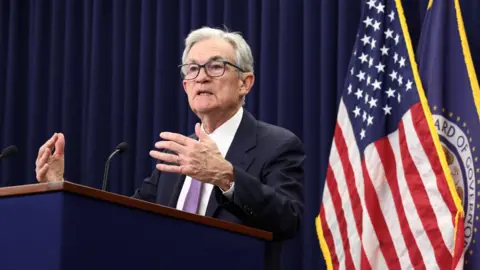
The US Federal Reserve has lowered interest rates for the third time this year despite growing divisions, as policymakers aim to prop up the slowing labour market.
The central bank said on Wednesday it was lowering the target for its key lending rate by 0.25 percentage points, putting it in a range of 3.50% to 3.75% – its lowest level in three years.
It remains unclear where rates will go in the months ahead. Policymakers disagree about how the Fed should balance competing priorities: a weakening job market on the one hand, and rising prices on the other.
The Fed’s economic projection released on Wednesday suggests one rate cut will take place next year, although new data could change this.
The decision to lower rates on Wednesday was not unanimous, suggesting widening divisions among central bankers over the outlook for the US economy.
Three Fed officials broke ranks and dissented.
Stephen Miran, who is on leave from his post leading Trump’s Council of Economic Advisers, voted for a larger 0.5 percentage point cut.
Austan Goolsbee, president of the Federal Reserve Bank of Chicago, and Jeffrey Schmid, president of the Federal Reserve Bank of Kansas City, voted to hold rates steady.
A data blackout during the longest-ever US government shutdown, which ended in November, has left policymakers partially in the dark about the state of the economy. But concerns about a slowing job market continue to outweigh inflation fears, at least for now.
The unemployment rate ticked up from 4.3% to 4.4% in September, Labor Department figures showed in a delayed report released last month. Cutting interest rates is aimed at stimulating the job market by creating lower borrowing costs for businesses.
Fears about tariff-driven inflation had taken centre stage earlier this year when Trump pushed forward with sweeping tariffs on many of the country’s largest trading partners.
Inflation is still above the Fed’s 2% target. In September, it hit 3% for the first time since January.
But while tariffs appear to be boosting some consumer prices, recent milder-than-expected inflation readings have allowed the Fed to focus on boosting the labour market by lowering rates, analysts said.
Dissents and disagreements
Still, policymakers remain divided over the path forward for interest rates.
“The current committee is more divided than it has been in a very long time,” said Matthew Pallai, chief investment officer at Nomura Capital Management.
“The Fed’s policy over the next few meetings will come down to a risk management exercise where one risk is considered more significant than the other,” he added.
The central bank’s so-called dot plot, a quarterly anonymous economic forecast, showed on Wednesday a median expectation for one additional 0.25 percentage point cut in 2026.
That prediction was unchanged from the previous dot plot in September.
Central bankers are poised to have a bit more clarity next week, with the expected release of official data on the labour market and inflation for November.
The incoming data could shift policymakers’ outlook, potentially bolstering calls for further easing next year if there are new signs that the job market is stalling.
The central bank’s latest cut also comes ahead of an expected announcement from the White House about Trump’s pick to replace Jerome Powell, whose term as Fed chair ends next May.
Trump could announce his pick as soon as within the next few weeks.
Kevin Hassett, a long-time conservative economist and key Trump economic adviser, is seen as the front-runner to succeed Powell.
A Trump loyalist, Hassett served as chair of the White House Council of Economic Advisers during Trump’s first term and now leads the National Economic Council.
He has been a stalwart defender of Trump’s economic policies, downplaying data showing signs of weakness in the US economy, doubling down on allegations of bias at the Bureau of Labor Statistics and backing Trump’s handling of the Fed.
Hassett’s allegiance to the president has drawn questions from analysts about whether he would act independently and how much sway he would have with other members of the board.
Other names that have been floated for the Fed chair include economist Kevin Warsh, current Fed Governor Christopher Waller and even Treasury Secretary Scott Bessent.
Trump is “still making up his mind, and he’s looking for someone who will be in his way of thinking,” Thomas Hoenig, a distinguished senior fellow at the Mercatus Center, told the BBC.
The candidates, he added, “have to project that they will be independent, or the markets will become quite nervous – and that will create more volatility”.



Follow