




Zoya Mateen and Nikhil Inamdar
 AFP via Getty Images
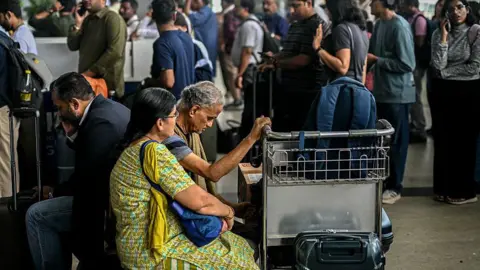
Last week, Manjuri carried her husband’s coffin from one town to another in India’s northeast region, hoping to catch a flight that would take her hundreds of miles away – to Kolkata city – for his final farewell.
But the difficult journey turned unbearable when delays by IndiGo, the country’s largest airline, left her stranded for hours before the flight was finally cancelled.
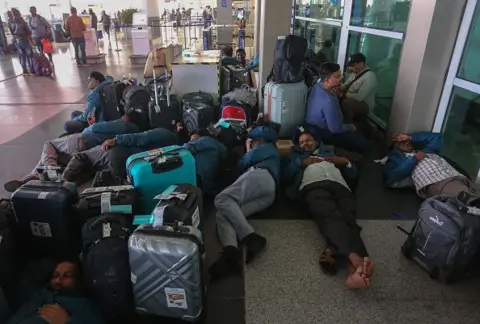
Manjuri was one of hundreds of thousands of passengers whose plans were upended as IndiGo’s sudden wave of cancellations pushed India’s aviation sector into one of its worst crises in years.
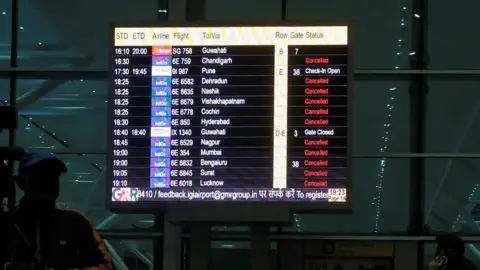
A trickle of delays suddenly became more than 1,000 cancellations on 5 December, stranding families and causing people to miss weddings, funerals and vital exams.
Once the poster child of India’s low-cost aviation boom – commanding a 60% market share and 2,000 daily flights – IndiGo now risks losing its hard-won reputation as the country’s reliable, no-frills carrier, experts say.
“IndiGo could face significant financial damage from loss of revenue because of flight cancellations, refunds and other compensation to affected customers, along with potential penalties imposed by DGCA [the aviation regulator]” Moody’s, a ratings agency said.
At the heart of the crisis are new crew-rostering rules that give pilots and cabin crew more rest – changes IndiGo is accused of failing to plan for, leaving it short of legally rested staff and forcing it to ground more than half its fleet.
The rules include longer weekly rest for pilots (48 hours instead of 36) and tighter limits on night landings (two instead of six) after years of fatigue complaints to the regulator.
 AFP via Getty Images
India’s aviation watchdog introduced the new duty rules nearly two years ago to align with global standards, with airlines meant to adopt them in two phases – in June and November this year.
While other major carriers like Air India say they have implemented them, IndiGo has admitted that it has not been in a position to fully do so in time.
“Did they do this because adopting the new rules would have required them to hire hundreds of new pilots and raised costs?” Mark Martin, an aviation expert, told the BBC.
“They had several months’ notice to implement the rules. All their competitors had complied. Why couldn’t IndiGo step up?” he asked.
In several statements, the airline apologised for the cancellations, acknowledging “unforeseen operational challenges” – from bad weather to “misjudgement and planning gaps” in rolling out the now-withdrawn pilot fatigue rules.
But at least three IndiGo pilots the BBC spoke to said the crisis was reflective of a deeper issue of the airline driving cost savings even at the cost of pilot fatigue.
“Working overtime may be normal for some industries, but aviation is a highly safety-centric profession where fatigue is a silent killer. You don’t even know its effects until it’s too late,” said a pilot who has been with the airline for more than a decade, speaking on condition of anonymity.
Besides the focus on costs, IndiGo’s aggressive expansion, including launching new international routes, “may also have distracted its management from looking into the ‘boring’ nitty-gritty [of rest norms]”, GR Gopinath, founder of the now-defunct Air Deccan, wrote in the Economic Times newspaper.
He also blamed the airline’s undisputed dominance in the aviation sector – with a 60% market share in India, the company flies more than 100 million passengers annually.
“For all practical purposes, the airline is now a monopoly. And what comes with monopolies is indifference,” Mr Gopinath wrote.
 AFP via Getty Images
Over the past 15 years, several Indian airlines – from Jet Airways and Kingfisher to GoAir – have collapsed under debt or crippling fuel and engine costs. As rivals fell away, IndiGo quickly filled the gaps, expanding into smaller cities and secondary routes where its blue-and-white aircraft became synonymous with air travel.
The changing market dynamics allowed the carrier to consolidate a level of market share no Indian airline had held in decades.
But the airline’s lean operations, which provide cost efficiencies in stable times, “lacked the resilience needed for this change in regulations, leading to the need for a system-wide reboot that led to cancellation of around 1,600 flights on 5 December”, Moody’s, the rating agency said.
As the crisis deepened, IndiGo secured a one-time exemption from the new rules until February and said operations would stabilise between 10 and 15 December.
But in a strongly worded letter to the regulator, the Airline Pilots Association of India says this has undermined the very spirit of the new regulations “and gravely compromised the safety of the flying public”.
The BBC has asked IndiGo to respond to its pilots’ comments and the claims in the Pilots Association letter, but the airline declined.
Experts told the BBC it could take years for IndiGo to recover, with lasting effects on its finances, safety and reputation amid ongoing concerns over falling on-time performance.
Some 54% of passengers who flew the airline reported an issue with its timeliness in the past 12 months, according to a recent survey by online community platform LocalCircles. And its on-time performance dropped to 68% in November from 84% in October, according to Moody’s.
 Reuters
Since the crisis began, IndiGo’s share price has tumbled in Mumbai, as investors fear rising costs from operational disruptions and higher crew expenses under the new rules.
The biggest challenge, though, will be rebuilding the trust of millions of passengers who swore by the brand.
“IndiGo has shot itself in the foot and caused irreparable damage to its brand,” Mr Martin said. “Other airlines will go after IndiGo’s passengers.”
Carriers like Air India and Spice Jet have already begun to do that, announcing hundreds of additional flights to accommodate affected IndiGo passengers.
Given the situation, the airline could also have difficulty filling pilot vacancies, says Mr Martin.
On Monday the issue was discussed in parliament, with India’s aviation minister warning the airline of “very strict action”.
India’s aviation regulator has issued a show-cause notice to IndiGo, citing “significant lapses in planning, oversight,” and reportedly asked the airline to cut its flight schedule by 5%.
It is unclear how the airline will be held to account, but this is a “golden chance for the regulator to focus on making a good example out of IndiGo”, says aviation expert Ameya Joshi. The BBC has reached out to the regulator for comment.
“We have a case where a well-capitalised airline has not been able to perform a basic task. The country is looking up to the regulator and the ministry,” Mr Joshi said.



Follow