



BRUSSELS — Donald Trump blew up global efforts to cut emissions from shipping, and now the EU is terrified the U.S. president will do the same to any plans to tax carbon emissions from long-haul flights.
The European Commission is studying whether to expand its existing carbon pricing scheme that forces airlines to pay for emissions from short- and medium-haul flights within Europe into a more ambitious effort covering all flights departing the bloc.
If that happens, all international airlines flying out of Europe — including U.S. ones — would face higher costs, something that’s likely to stick in the craw of the Trump administration.
“God only knows what the Trump administration will do” if Brussels expands its own Emissions Trading System to include transatlantic flights, a senior EU official told POLITICO.
A big issue is how to ensure that the new system doesn’t end up charging only European airlines, which often complain about the higher regulatory burden they face compared with their non-EU rivals.
The EU official said Commission experts are now “scratching their heads how you can, on the one hand, talk about extending the ETS worldwide … [but] also make sure that you have a bit of a level playing field,” meaning a system that doesn’t only penalize European carriers.
Any new costs will hit airlines by 2027, following a Commission assessment that will be completed by July 1.
Brussels has reason to be worried.
“Trump has made it very clear that he does not want any policies that harm business … So he does not want any environmental regulation,” said Marina Efthymiou, aviation management professor at Dublin City University. “We do have an administration with a bullying behavior threatening countries and even entities like the European Commission.”
The new U.S. National Security Strategy, released last week, closely hews to Trump’s thinking and is scathing on climate efforts.
“We reject the disastrous ‘climate change’ and ‘Net Zero’ ideologies that have so greatly harmed Europe, threaten the United States, and subsidize our adversaries,” it says.
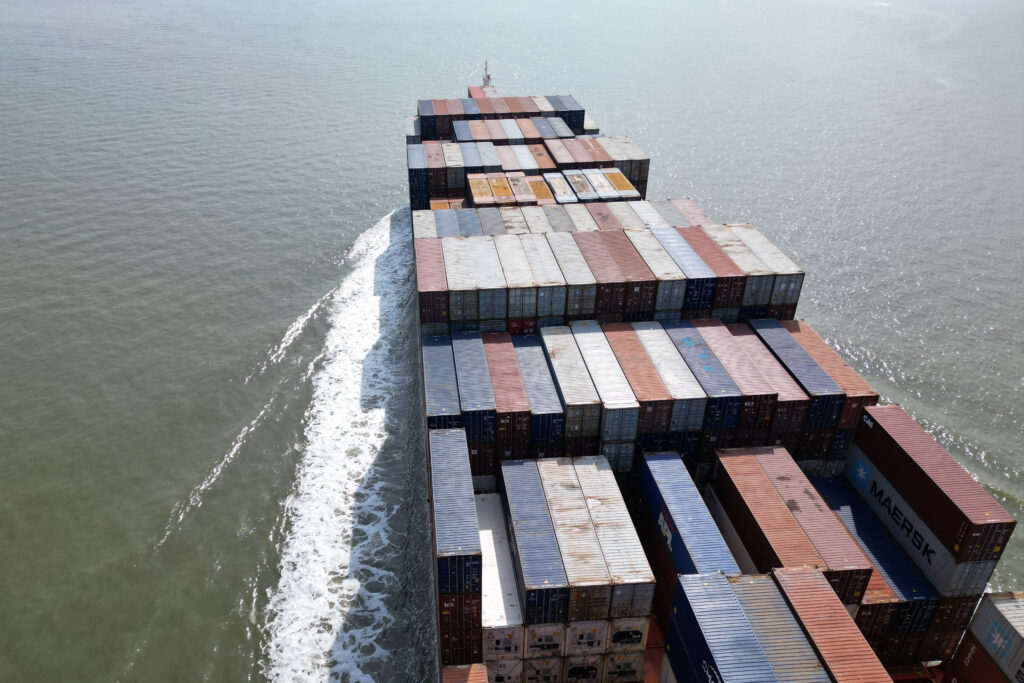
In October, the U.S. led efforts to prevent the International Maritime Organization from setting up a global tax to encourage commercial fleets to go green. The no-holds-barred push was personally led by Trump and even threatened negotiators with personal consequences if they went along with the measure.
This “will be a parameter to consider seriously from the European Commission” when it thinks about aviation, Efthymiou said.
The airline industry hopes the prospect of a furious Trump will scare off the Commission.
“The EU is not going to extend ETS to transatlantic flights because that will lead to a war,” said Willie Walsh, director general of the International Air Transport Association, the global airline lobby, at a November conference in Brussels. “And that is not a war that the EU will win.”
European ETS vs. global CORSIA
In 2012, the EU began taxing aviation emissions through its cap-and-trade ETS, which covers all outgoing flights from the European Economic Area — meaning EU countries plus Iceland, Liechtenstein and Norway. Switzerland and the U.K. later introduced similar schemes.
In parallel, the U.N.’s International Civil Aviation Organization was working on its own carbon reduction plan, the Carbon Offsetting and Reduction Scheme for International Aviation. Given that fact, Brussels delayed imposing the ETS on flights to non-European destinations.
The EU will now be examining the ICAO’s CORSIA to see if it meets the mark.
“CORSIA lets airlines pay pennies for pollution — about €2.50 per passenger on a Paris-New York flight,” said Marte van der Graaf, aviation policy officer at green NGO Transport & Environment. Applying the ETS on the same route would cost “€92.40 per passenger based on 2024 traffic.”
There are two reasons for such a big difference: the fourfold higher price for ETS credits compared with CORSIA credits, and the fact that “under CORSIA, airlines don’t pay for total emissions, but only for the increase above a fixed 2019 baseline,” Van der Graaf explained.
“Thus, for a Paris-New York flight that emits an average of 131 tons of CO2, only 14 percent of emissions are offset under CORSIA. This means that, instead of covering the full 131 tons, the airline only has to purchase credits for approximately 18 tons.”
Efthymiou, the professor, warned the price difference is projected to increase due to the progressive withdrawal of free ETS allowances granted to aviation.
The U.N. scheme will become mandatory for all U.N. member countries in 2027 but will not cover domestic flights, including those in large countries such as the U.S., Russia and China.
Key decisions
By July 1, the Commission must release a report assessing the geographical coverage and environmental integrity of CORSIA. Based on this evaluation, the EU executive will propose either extending the ETS to all departing flights from the EU starting in 2027 or maintaining it for intra-EU flights only.

According to T&E, CORSIA doesn’t meet the EU’s climate goals.
“Extending the scope of the EU ETS to all departing flights from 2027 could raise an extra €147 billion by 2040,” said Van der Graaf, noting that this money could support the production of greener aviation fuels to replace fossil kerosene.
But according to Efthymiou, the Commission might decide to continue the current exemption “considering the very fragile political environment we currently have with a lunatic being in power,” she said, referring to Trump.
“CORSIA has received a lot of criticism for sure … but the importance of CORSIA is that for the first time ever we have an agreement,” she added. “Even though that agreement might not be very ambitious, ICAO is the only entity with power to put an international regulation [into effect].”
Regardless of what is decided in Brussels, Washington is prepared to fight.
Opposition to the ETS in the U.S. dates back to the Barack Obama administration, when then-Secretary of State Hillary Clinton sent a letter to the Commission opposing its application to American airlines.
During the same term, the U.S. passed the EU ETS Prohibition Act, which gives Washington the power to prohibit American carriers from paying for European carbon pricing.
John Thune, the Republican politician who proposed the bill, is now the majority leader of the U.S. Senate.



Follow