



Europe isn’t doomed to inexorable decline — and in fact is doing better than most people realize, said the IMF’s Kristalina Georgieva.
Much of the European Union’s policymaking bubble has been gripped with despair since the bloc’s weakness was exposed during a recent confrontation with the U.S. over Greenland.
While U.S. President Donald Trump eventually backed down, the European military response — sending a symbolic handful of soldiers to the North Atlantic island — underlined that had the White House really wanted to seize Greenland, Europeans would have had no choice but to accede.
But in an interview with POLITICO, Georgieva, managing director of the International Monetary Fund, said the pessimism was misplaced.
In an end-of-year shortlist of top-performing economies put together by the Economist, she noted, the top 10 included seven EU countries, with Portugal in the top spot. The Iberian economy has recorded steady growth while comfortably paying down its debt in the past few years.
That’s a fact, she said, that should be celebrated.
“Europeans — we are modest people. We don’t brag,” the IMF head stated.
She recalled how a U.S. colleague had recently done “something marginal.”
“He said ‘oh, let’s look at this. I’m great. I’m fantastic,’” Georgieva recounted. “In Europe you do something great and you say ‘not too bad.’ In this world we are in now, you have to brag a little, exude confidence.”
Even before the Greenland standoff, a sense of despair had settled over the top echelons of European economic decision-making. Mario Draghi, former head of the European Central Bank, warned that the bloc faced “slow agony” if it didn’t reform.
Georgieva acknowledged the increasingly sharp-elbowed way in which countries now operate — one that leaves little room for multilateral organizations like her own IMF. In a speech earlier on Monday she acknowledged that the world had become “multipolar” — code for a new era of jostling geopolitical blocs that has replaced unilateral American dominance.
Speaking to POLITICO, Georgieva said that “geopolitical factors play an increasingly bigger role in defining the world economy.” On Greenland, she said the fact that “allies find it more difficult to retain their sense of common purpose” was a “significant change.”
But she insisted that the “destiny of Europe is in the hands of Europeans.” The IMF’s list of advice to reform the EU’s economy echoes Draghi’s own, contained in his competitiveness report from 2024: They include strengthening the single market, cutting regulations on businesses, and integrating the continent’s fragmented energy and financial systems.
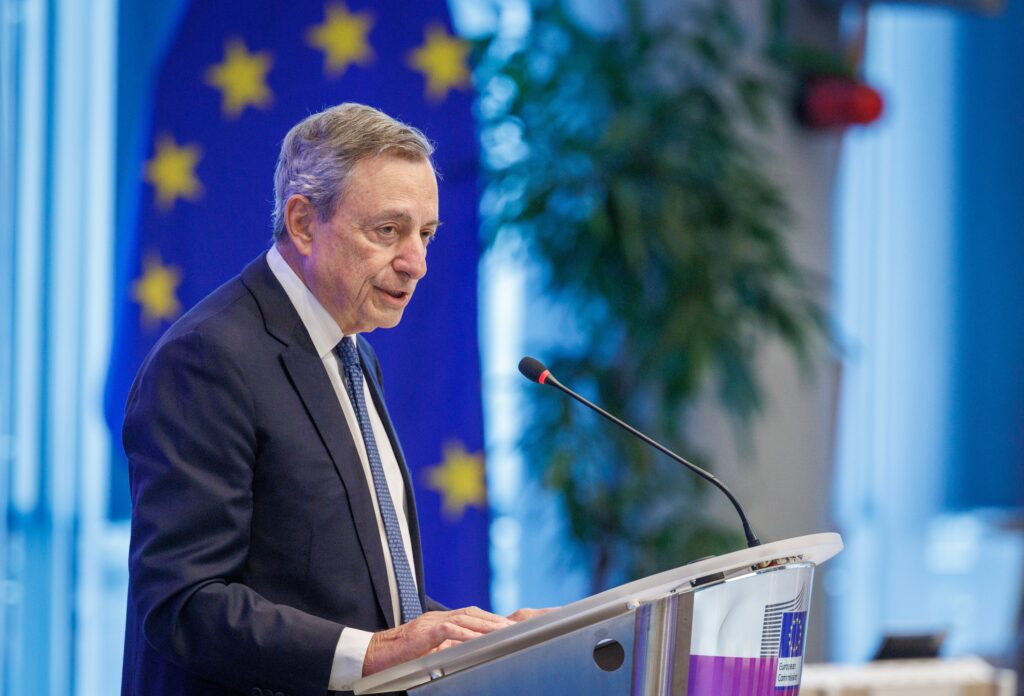
Georgieva said it was “paramount” for the EU to press ahead with reform. “Get your own house in order,” she said.
Three of the Economist shortlist’s best-performing countries — Ireland, Portugal and Greece — were put under IMF supervision at the height of the eurozone crisis. There, they had to agree to painful adjustments known as structural reform programs, which included tax hikes and brutal cuts to public services. In the case of Greece in particular, those structural reforms resulted in a sharp increase in unemployment and poverty levels; gross domestic product per capita is still not at its pre-crisis level.
But, said Georgieva, their current success is proof that countries, and the EU as a whole, can change their economic trajectories.
Asked whether Europe should consider retaliating against U.S. aggression by selling off assets like government bonds, a suggestion included in a recent analyst report from Deutsche Bank, the senior official urged caution.
“I would say that the smooth functioning of the international monetary system is of value to all countries,” she said. “Disturbing that smooth functioning of the international monetary system with the same token can bring negative impact.”
The Bulgarian boss of the Washington, D.C.-based fund did, however, back a deeper pool of joint EU debt — an idea favored by Draghi but regarded with suspicion by frugal countries like Germany and the Netherlands.
As for the disbursement of $8.1 billion in IMF funds to Ukraine to help the country meet its financing needs, Georgieva said she was aiming to hold an IMF board meeting in the second half of `February at which the board could approve the program and start paying out funds. Though the amount is relatively small — less than a tenth of the €90 billion that the EU has agreed to lend to Ukraine — IMF approval is a signal of confidence for financial markets.
The IMF chief also said that a meeting “is scheduled” with U.S. Treasury Secretary Scott Bessent regarding the situation in Venezuela, and that it would happen in the “nearest future.”
The IMF stopped working with Venezuela in 2019. The fund estimates that the South American country’s economy, battered by U.S. sanctions and plagued by mismanagement, has shrunk to a third of its previous largest size. Since the U.S. captured Venezuelan President Nicolás Maduro at the start of the year, it has floated the possibility of allowing Venezuela to access IMF financing again.



Follow