




Nadine YousifSenior Canada reporter
 Getty Images
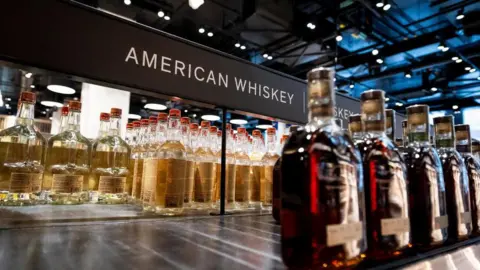
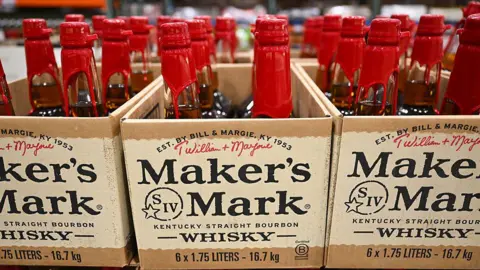
Canadian provinces have a strange problem: What to do with millions of dollars worth of American alcohol, pulled from the shelves in anger over US tariffs and now gathering dust in stock rooms?
At least two provinces say the booze will go to a good cause, promising to sell remaining inventory and donate proceeds to charity.
One province is offloading it to restaurants and bars instead of selling it to the public.
Others have not said what they plan to do with the shelved liquor. That includes Ontario, which has an eye-popping C$80m ($57.7m; £43.3m) worth of US booze stockpiled, some of which will soon expire.
Only two Canadian provinces – Alberta and Saskatchewan – are still selling US booze.
In Canada, alcohol sales are largely controlled by provincial governments, which operate boards that manage the import and sale of most wine and spirits, giving them broad authority over what is sold. Only Alberta and Saskatchewan have a fully-privatised liquor retail system.
Manitoba and Nova Scotia said last week they will sell their remaining inventory—worth C$17.4m—and donate proceeds to local charities.
Since restocking their shelves with US liquor last week, Nova Scotia stores saw higher than usual sales, said Terah McKinnon, spokesperson for the province’s liquor board.
The top-selling product was Kentucky bourbon, Ms McKinnon told the BBC.
Nova Scotia Premier Tim Houston said remaining inventory is being sold so that products don’t go to waste. He added that Nova Scotia will not be ordering anymore alcohol from the US once it sells out.
The province estimated that sales will generate C$4m in revenue that will be donated to Feed Nova Scotia and other local food banks.
Shortly after Nova Scotia’s announcement, Manitoba said that it, too, will sell off its remaining inventory for charity, starting on Monday.
Removing US alcohol from the shelves “is the right thing to do”, said Manitoba municipal relations minister Glen Simard.
But he added the province also does not want to wait for the products to expire and be destroyed.
 Getty Images
Quebec’s liquor board said in August that it may have to destroy C$300,000 worth of American products that were set to expire – a decision criticised by some.
The province’s finance minister later announced on X that Quebec would instead donate soon-to-expire liquor to charity events and hospitality schools.
Quebec has an estimated total of C$27m worth of American booze that has been shelved, according to figures reported by the Canadian Press.
British Columbia has taken a different approach, telling Canadian news outlet Global in August that it has sold its US inventory to restaurants and bars.
Two provinces that have remained silent on their plans for the stockpiles are Ontario and Newfoundland and Labrador.
In a November interview with local radio channel Newstalk 1010, Ontario Finance Minister Peter Bethlenfalvy said the province has no plans to sell off its inventory of US alcohol as of now, adding that less than C$2m will soon expire.
“Most of it is spirits and wine that will last a long time,” Bethlenfalvy said. He added the province is going to continue its boycott until Canada secures “a tariff-free deal or low-tariff deal” with the US.
The booze boycotts began in February after Trump imposed sweeping tariffs on Canadian goods. Most are now exempt thanks to a long-standing North American free trade agreement, but sector-specific tariffs on metals, lumber and automotives remain in place.
The levies are part of a broader policy shift by Trump, who says they will increase the amount of tax raised by the government and boost investment in the US.
Trade talks with Canada were halted by the US president in October after Ontario ran anti-tariff advertisements that aired on US networks.
Decline in sales ‘very troubling’, says US liquor council
US ambassador to Canada Pete Hoekstra has signalled that the liquor boycott has been an irritant. Speaking to a US crowd in July, he said it is among the reasons why Trump and his team have referred to Canada as “mean and nasty”.
British Columbia Premier David Eby responded at the time by saying that “clearly, our efforts are having an impact”.
Mid-year figures released by the Distilled Spirits Council of the United States (DISCUS) show that Canada’s boycott has contributed to a decline in sales that is “very troubling”, said council president and CEO Chris Swonger.
Exports to Canada have dropped by 85% and have also declined to other markets, including the UK and the EU.
In a statement to the BBC on Monday, Mr Swonger said American liquor producers hope that both Canada and the US can address their trade concerns, and that “our products can return to Canadian retail shelves as soon as possible”.



Follow