




MaryLou CostaTechnology Reporter
 Board Intelligence
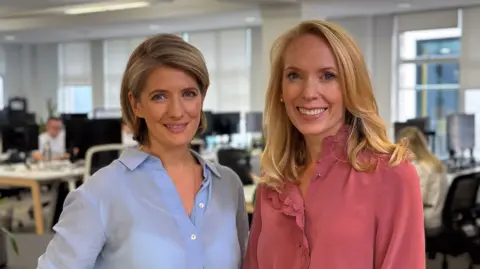
For almost 16 years, Pippa Begg ran Board Intelligence as co-chief executive with Jennifer Sundberg.
Together they grew the business, which provides analysis and services for company boards, and today it employs 200 staff and has big big name clients, including Nationwide, Rolls-Royce and Reckitt.
“We are quite different people – very much yin and yang – but I think decisions are better made with two brains rather than one as it stops hubris,” says Begg, who is London-based.
Begg and Sundberg are part of a trend, that’s seen more companies experimenting with a co-CEO leadership structure.
In 2015, there were 11 companies with co-CEOs in the Russell 3000 group of the biggest public companies in the US, while in 2024, this had more than doubled to 24, according to an analysis by public company intelligence firm MyLogIQ.
A raft of major companies also made such appointments in 2024, such as Oracle, Comcast, and Spotify. Netflix, meanwhile, has had co-CEOs since 2020.
Top corporate executives are well rewarded – a report from last year showed that chief executives at the UK’s biggest firms are paid, on average, 122 times the salary of the average full-time, UK worker.
However, there are downsides to being in charge.
According to a survey by leadership advisory firm ICEO, 56% of top executives felt burnt out in 2024.
A co-CEO model divides responsibility, accountability, and, ultimately, the burden between two people.
Leadership coach Audrey Hametner has observed that co-CEOs can take time out that sole CEOs might otherwise feel they can’t do. She recalls a CEO client who had not taken a holiday in five years, but was finally able to have a family holiday once he found a co-CEO partner.
Hametner says it also allows bosses to play to their strengths.
She gives the example of a previous client where one co-CEO worked more closely with the marketing and product departments, and the other mainly with finance, government regulatory bodies and legal.
“You may have co-CEOs where one is an outgoing and high-level thinker, who may find it more challenging to focus on all the small tasks, and the other CEO is more detail-oriented and loves to speak to the data and the nuances,” she says.
Sharing the workload may also give the co-CEOs more time with their family. That’s something they might be lacking – 60% of CEOs report spending too little time with their family, according to a study by executive search firm Russell Reynolds.
Begg took three maternity leaves of around six months in the space of five years, returning to work each time in a four-day week capacity.
Similarly, Sundberg took two maternity leaves in that period.
Begg notes that it’s unusual for a CEO on both counts.
Some female CEOs have been public about taking minimal maternity leave, with 71% of women in leadership positions taking less than six months’ leave for fear of jeopardising their jobs, according to data from That Works For Me.
The same study reveals a 32% drop in women at managerial level after having children.
Begg credits her co-CEO partnership for not turning her into another statistic.
“Without the co-CEO structure, the trade off would have either been too great for the business, or too great for the way that we wanted to have our children and have maternity leave,” she reflects.
“If we hadn’t had the co-CEO model, we probably would have felt that we needed to find a new CEO, or even sell the business, which are things that happen to so many female-run businesses because they don’t see how it’s going to work. Our experience was that this can really work.”
 Anything
It’s been the case for Dhruv Amin and Marcus Lowe, the co-founders and co-CEOs of Anything, a startup focused on “vibe coding”, which allows anyone to create an app without knowing how to code.
Thanks to the set up, Amin was able to take two paternity leaves of three weeks each in 2024 and 2025.
“Marcus has covered for me twice. We’ve both had times when we’re gunning hard for the company, and times we’re not. The structure gives us permission to be human without everything falling apart,” says Amin, who is based in San Francisco.
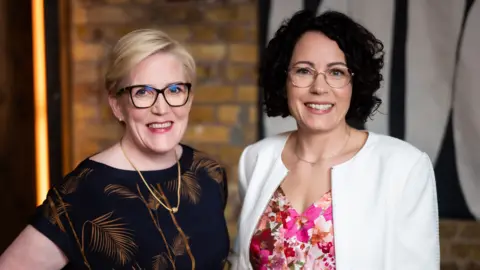
In Finland, Denise Johansson was able to take three weeks away from work when her father died suddenly in 2024. She has been co-CEO and co-founder of payment processing platform Enfuce with Monika Liikamaa since 2016.
“It was not only a huge emotional shock, it also came with a lot of unexpected responsibility as I inherited another business at the same time,” says Johansson, who is based in Mariehamn, in the Åland Islands.
“Monika stepped in without hesitation, took on more of the day-to-day load, and created the space I needed to deal with both grief and practical issues.”
With six children between them, Johansson and Liikamaa are also able to take time with family while the other one holds the fort.
“If my kids need me, I will be off with them – no question. We coordinate so that key moments for our children are protected, while the company still has a steady hand on the wheel,” says Johansson.
 Piranha Photography
Yet a co-CEO model has yet to become a mainstream, long-term solution. Salesforce, SAP and Marks and Spencer all appointed co-CEOs in the early 2020s, lasting no more than two years.
Tierney Remick is a Chicago-based vice chairman and co-leader of the global board and CEO practice at business consultancy Korn Ferry.
She’s observed that co-CEOs tend to work best at independent companies without complex structures, and with two people that have already worked together.
Otherwise, there can be power struggles, misalignment in vision, and confusion amongst the wider company.
“Leaders trying to establish their partnership, as well as drive the business and evolve the strategy – and doing it in a way that doesn’t create confusion in the organisation – is usually very difficult if they don’t know each other,” says Remick.
Co-CEO pairings can also be used as a type of succession planning to see if one will ultimately become the sole, core CEO, she adds.
“There’s a tremendous amount of succession planning happening at the moment. And there is the reality that the pipeline of ‘ready-now’ CEOs has decreased over the last several years,” she says.
“So we are seeing boards find different ways to expand the roles and responsibilities of high potential leaders, to see how they accelerate and grow in a market that is creating a lot of change and ambiguity every day.”
For Begg, her co-CEO days came to an end in 2024 when Board Intelligence acquired private equity backers, which became a natural point for Sundberg to stand down. Sundberg remains on the company’s advisory board.
Now Begg is the sole CEO, she acknowledges she has less time to spend with family, so her husband left his job to be more present at home.
After their youngest child started school last September, he set up a consultancy that he works on during school hours.
“He carries the load of home and family life. It still probably raises an eyebrow when he’s called into a meeting and he says it has to be between 10am and 3pm. They’ll be shocked that a man has said that,” says Begg.



Follow