



LONDON — Britain stepped up a promise to send troops into Ukraine — and left open a host of questions about how it will all work in practice.
At a meeting of the “coalition of the willing” in Paris this week, the U.K. and France signed a “declaration of intent” to station forces in Ukraine as part of a multinational bid to support any ceasefire deal with Russia. It builds on months of behind-the-scenes planning by civil servants and military personnel eager to put heft behind any agreement.
Despite promising a House of Commons vote, U.K. Prime Minister Keir Starmer has so far shared very little information publicly about how the operation might work and what its terms of engagement will be, at a time when Britain’s armed forces are already under significant strain.
This lack of transparency has begun to raise alarm bells in defense circles. Ed Arnold of think tank the Royal United Services Institute has described the U.K. as being in “a really dangerous position,” while retired commander Tim Collins said any peacekeeping mission would not be credible without higher defense spending.
Even Nigel Farage was in on the action Wednesday — the populist leader of Britain’s Reform UK party said he couldn’t sign up to the plan in its current form, and predicted the country could only keep its commitments going “for six or eight weeks.”
Here are the key questions still lingering for Starmer’s government.
Has the UK got enough troops?
In France, Emmanuel Macron is at least starting to get into the numbers. The French president gave a televised address Tuesday in which he said France envisaged sending “several thousands” of troops to Ukrainian territory.
But Starmer has given no equivalent commitment. Under pressure in the House of Commons, the British prime minster defended that position Wednesday, saying the size of the deployment would depend on the nature of the ceasefire agreed between Russia and Ukraine.
However, analysts say it is difficult to imagine a scenario in which a deployment does not place a genuine strain on the U.K.’s military. The country’s strategic defense review, published last year, stressed that the Britain’s armed forces have dwindled in strength since the Cold War, leaving “only a small set of forces ready to deploy at any given moment. The latest figures from the Ministry of Defence put the number of medically-deployable troops at 99,162.
Figures including former head of the army Richard Dannatt and Matthew Savill, director of military sciences at RUSI, have warned that a new deployment in Ukraine would mean pulling away from existing operations.
There is also a hefty question mark over how long troops might be deployed for, and whether they might be taking on an open-ended commitment of the kind that snarled Britain for years in Afghanistan. RUSI’s Arnold said positioning troops in Ukraine could be “bigger” than deployments in Iraq, Afghanistan, Kosovo and Libya, “not necessarily in numbers, but in terms of the consequences… This mission absolutely can’t fail. And if it’s a mission that can’t fail, it needs to be absolutely watertight.”
What happens if Russia actually attacks?
Ministers have refused to be drawn so far on the expectations placed on troops who might be stationed in Ukraine as part of the plan.
They have instead placed an emphasis on the U.K.’s role as part of a “reassurance” force, providing air and maritime support, with ground activity focused on training Ukrainian soldiers, and have not specified what would happen if British troops came under direct threat.
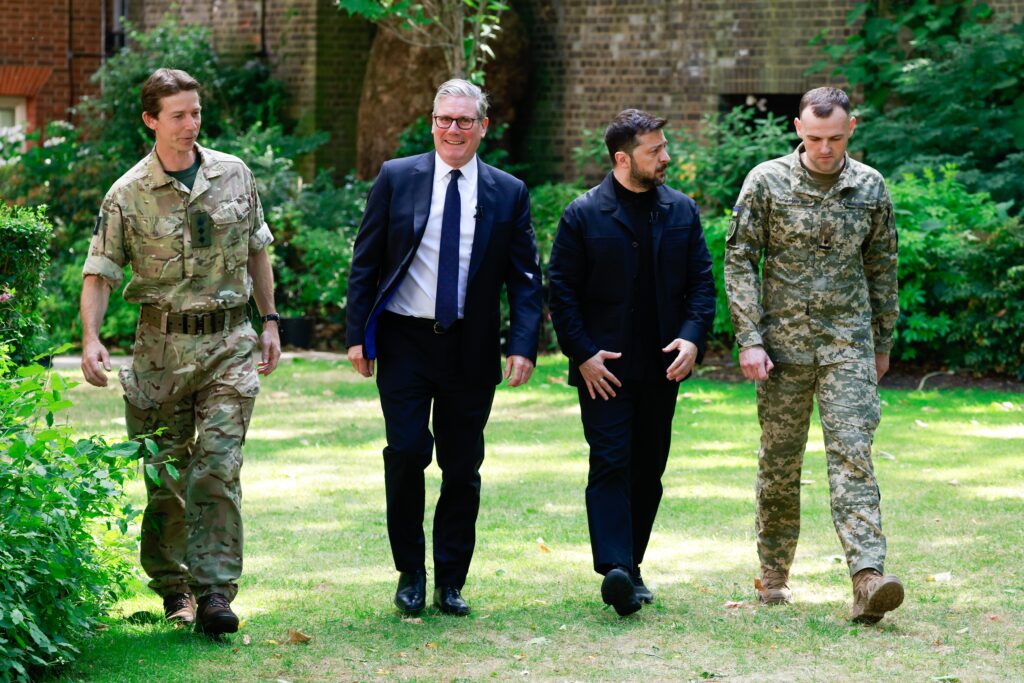
That’s already got Kyiv asking questions. “Would all the COW partners give a strong response if Russia attacks again? That’s a hard question. I ask all of them, and I still have not gotten a clear answer,” Ukrainian President Volodymyr Zelenskyy told reporters via WhatsApp chat on Wednesday.
“I see political will. I see partners being ready to give us strong sanctions, security guarantees. But until we have legally binding security guarantees, approved by parliaments, by the U.S. Congress, we cannot answer the question if partners are ready to protect us,” Zelenskyy added.
Richard Shirreff, former deputy supreme commander of NATO in Europe, told LBC: “This can’t be a lightly armed ‘blue beret’-type peacekeeping force … enforcing peace means being prepared to overmatch the Russians, and that means also being prepared to fight them if necessary.”
A U.K. military official, granted anonymity to speak candidly, said: “There is no point in troops being there if they’re not prepared to fight.”
Asked if British troops could return fire if they came under attack from Russia, a Downing Street spokesman said Wednesday afternoon that they would not comment on “operational hypothetical scenarios.”

Returning fire might even be one of the simpler possibilities for the army to contemplate, with less clarity over how peacekeeping forces could respond to other types of hostile activity designed to destabilize a ceasefire, such as drone incursions or attempted hacking.
Will the US really provide a backstop?
Starmer has long stressed that U.K. military involvement will depend on the U.S. offering back-up.
John Foreman, a former British defense attaché in Moscow and Kyiv, said it was right for the multinational force to focus on support for Ukraine’s own forces, pointing out: “It was never going to be able to provide credible security guarantees — only the U.S. with perhaps key allies can do this.”
While Washington has inched forward in its apparent willingness to provide security guarantees — including warm words from Donald Trump’s top envoys in Paris Tuesday — they are by no means set in stone.
The final statement, which emerged from Tuesday’s meeting, was watered down from an earlier draft, removing references to American participation in the multinational force for Ukraine, including with “U.S. capabilities such as intelligence and logistics, and with a U.S. commitment to support the force if it is attacked.”
This will only add to fears that the U.K. is talking beyond its capabilities and is overly optimistic about the behavior of its allies.
Government officials pushed back against the accusation that British military plans lack substance, arguing that it would be “irresponsible” to share specific operational details prematurely. That position could be difficult to maintain for long.



Follow