



BRUSSELS — The European Union is on track to get nearly half its gas from the United States by the end of the decade, creating a major strategic vulnerability for the bloc as relations with Washington hit an all-time low.
New data shared with POLITICO shows Europe is already importing a quarter of its gas from the U.S., a figure that is set to soar as the bloc’s total ban on Russian gas imports is phased in.
It comes as an increasingly belligerent U.S. President Donald Trump flirts with seizing Greenland, a territory of Denmark, in a move that could destroy the NATO alliance and throw transatlantic relations into crisis. Tensions escalated over the weekend when Trump announced he would put new tariffs on European countries including France, Denmark, Germany and the U.K. until a deal to sell Greenland to the U.S. was reached, prompting calls for the EU to retaliate with drastic trade restrictions of its own.
The EU’s growing reliance on imports of U.S. liquefied natural gas “has created a potentially high-risk new geopolitical dependency,” said Ana Maria Jaller-Makarewicz, lead energy analyst at the the Institute for Energy Economics and Financial Analysis, the think tank that produced the research.
“An over-reliance on U.S. gas contradicts the [EU policy] of enhancing EU energy security through diversification, demand reduction and boosting renewables supply,” she said.
Alarm over this strategic weak spot is also growing among member countries, with some EU diplomats fretting that the Trump administration could exploit the new dependency to achieve its foreign policy goals.
While “there are other sources of gas in the world” beyond the U.S., the risk of Trump cutting off supplies to Europe in the wake of an incursion in Greenland “should be taken into account,” one senior EU diplomat told POLITICO, who like others in this article spoke on condition of anonymity. But “hopefully we’ll not get there,” the official added.
After Russia invaded Ukraine in 2022, the EU went to drastic lengths to wean itself off Russian natural gas, which in 2021 made up 50 percent of its total imports but now accounts for only 12 percent, according to data from Bruegel, a Brussels-based economic think tank.
It accomplished this largely by switching imports of pipeline gas from Russia with liquefied natural gas shipped from the U.S., which at the time was a firm ally. The U.S. is already the biggest exporter of LNG, and its product now accounts for around 27 percent of EU gas imports, up from 5 percent in 2021. France, Spain, Italy, the Netherlands and Belgium are the largest importers; non-EU member the U.K. is also a major importer of U.S. LNG.
A raft of new deals with U.S. energy companies could raise that figure to as high as 40 percent of the EU’s total gas intake by 2030, and to around 80 percent of overall LNG imports into the bloc, according to data from IEEFA, a U.S. nonprofit that promotes clean energy.
Changes afoot
Despite efforts to switch away from fossil fuels, Europe still relies on carbon-emitting natural gas for a quarter of its total energy needs. Gas is used to generate electricity, heat buildings and power industry.
European consumers and manufacturers already face some of the highest energy costs in the world, `making it hard for the EU to refuse cheaper gas from the U.S. despite Washington’s threatening language.
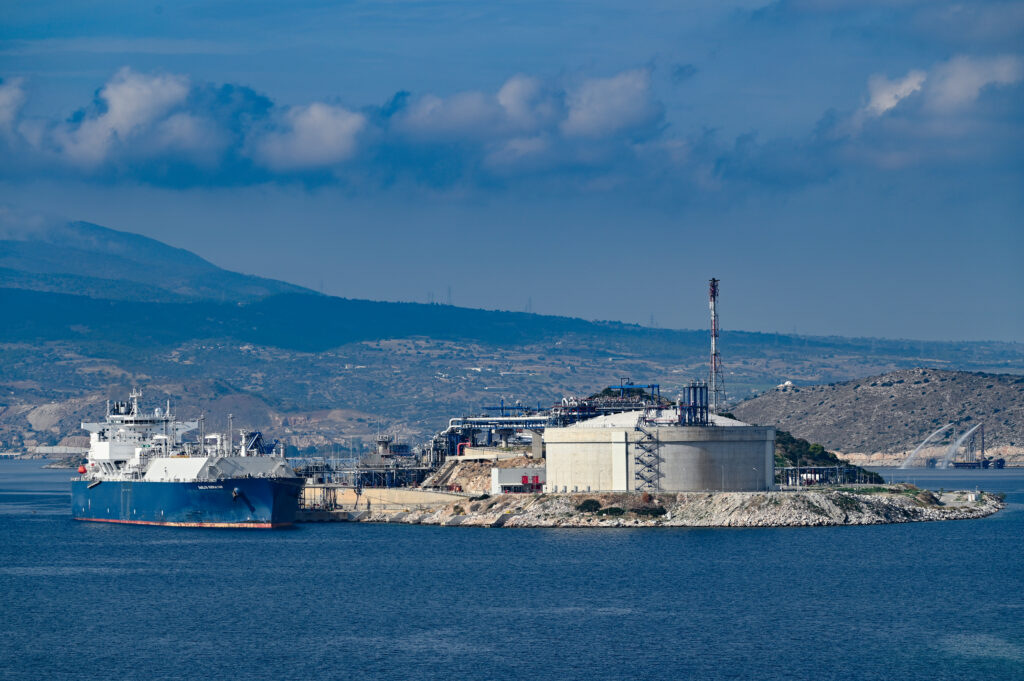
EU countries have already committed to diversifying their gas imports under new laws passed last year, but officials warn this will be difficult to achieve in the short term, given that the global supply of LNG is limited to just a few countries. They’re pinning their hopes on new production in Qatar and the United Arab Emirates, expected in 2030.
On top of the future energy deals — including a commitment to buy €750 billion of U.S. energy products as part of last year’s trade agreement — the EU is set to pave new inroads for U.S. gas under a sweeping overhaul of Europe’s energy infrastructure.
For instance, the EU has restated its commitment to two major gas pipelines that will connect Malta and Cyprus to mainland Europe, which could facilitate still more flows of American gas. The U.S. is also looking to build a pipeline linking Bosnia to EU-member Croatia.
‘No alternative‘
To some, the EU’s growing dependence on U.S. gas highlights that it should hasten its transition to renewables as a replacement for fossil fuels.
Thomas Pellerin-Carlin, a Socialist EU lawmaker, said demand for natural gas has fallen sharply across the bloc as the green transition picks up, even if demand for U.S. LNG is increasing as an overall proportion of intake.
“If we have the courage to keep calm and carry on making profitable investments in efficiency and renewables, we will reduce EU gas demand so much that we will reduce our dependence on U.S. LNG, even as we fully phase out Russian gas,” Pellerin-Carlin told POLITICO.
The lawmaker also argued that Trump was unlikely to weaponize LNG supply to the EU as Russian President Vladimir Putin had done, since it would severely damage the interests of key Trump donors in the U.S. LNG industry, who are desperate to find new buyers to absorb soaring supply of the fossil fuel.
The issue of U.S. LNG dependence is addressed by a broader EU commitment to energy diversification that was baked into a wider ban on Russian gas set to take effect this year, according to diplomats familiar with the matter. The official line, however, is that the U.S. remains a “strategic ally and supplier,” one of the diplomats said.
“The dependence is certainly there, but we’re kind of stuck where we are,” said one European government official. “There’s really no alternative.”



Follow