



MUNICH, Germany — German Chancellor Friedrich Merz said that U.S. leadership can no longer be taken for granted and Europe must prepare to stand more firmly on its own, in a stark warning to world leaders in Munich.
“The leadership claim of the U.S. is being challenged, perhaps already lost,” Merz said during the opening of the Munich Security Conference, laying out the starkest assessment yet from Berlin of a world increasingly defined by great-power rivalry. “In the era of great powers, our freedom is no longer simply guaranteed. It is under threat.”
He argued the global system itself may already have collapsed. “The international order based on rights and rules … no longer exists in the way it once did,” he said.
Merz also drew a lesson from Germany’s own history. “We Germans know a world in which might makes right would be a dark place,” he said. “Our country has gone down this path in the 20th century until the bitter and dreadful end.”
Most strikingly, the chancellor confirmed discussions with French President Emmanuel Macron about a European nuclear deterrent.
The speech amounted to a strategic repositioning of Germany: still anchored in NATO, but preparing for a future in which American guarantees are less reliable and Europe must carry more responsibility.
That message echoed remarks earlier in Munich from U.S. Deputy Defense Secretary Elbridge Colby, who called for a “NATO 3.0” in which European allies assume a far greater share of defense burdens while Washington prioritizes other theaters.
The United States wants “vigorous, capable, more self-reliant European allies,” Colby said, adding America had long carried a “vastly disproportionate share” of the burden. He singled out Germany for special praise for its “historic, tremendous shift” in defense spending.
Merz signaled Berlin is already preparing for a scenario with a smaller American footprint in Europe, and that Germany may at times diverge from the U.S. “We Europeans are taking precautions. In doing so, we arrive at different conclusions than the administration in Washington,” he said.
European nuclear deterrent
How far France will go to reassure its allies that they would be protected by its nuclear weapons is one of the most sensitive questions in Europe’s security architecture.
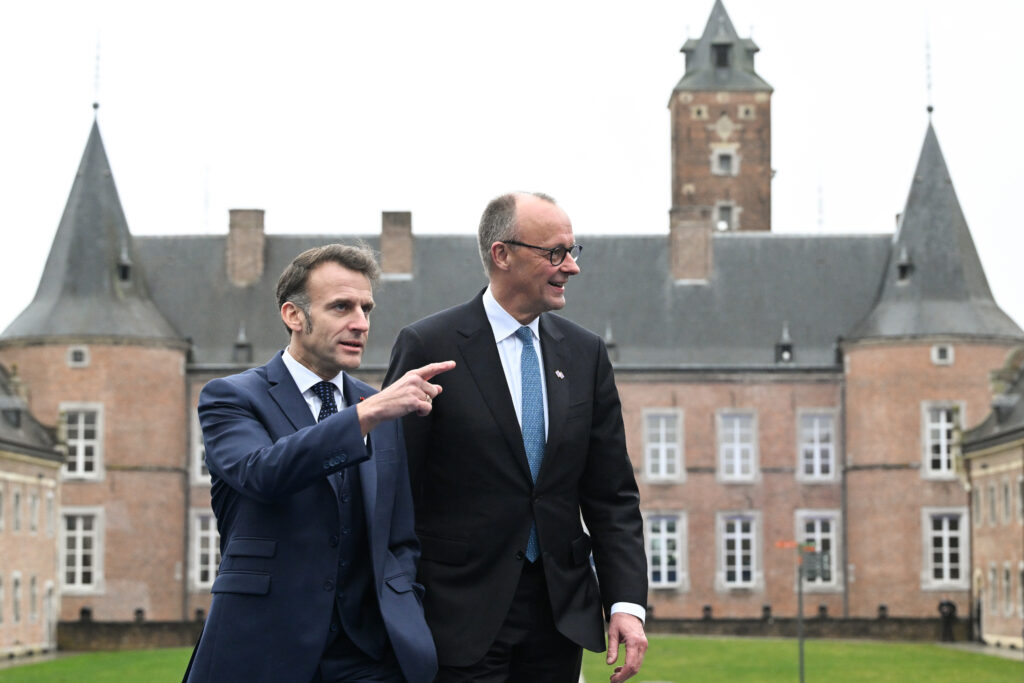
“I spoke with Emmanuel Macron about a European nuclear deterrence,” Merz said, suggesting Germany is openly considering alternatives amid uncertainty about long-term U.S. protection.
The debate reflects fears across Europe about whether the American nuclear umbrella would protect the continent in a crisis — a concern increasingly voiced by policymakers on both sides of the Atlantic.
Merz also underscored growing political and economic divergence with Washington, referencing ideological and trade disputes linked to Donald Trump’s policies.
“A deep divide has opened between Europe and the United States,” he said. “The culture wars of the U.S. are not ours. And we do not believe in tariffs and protectionism, but in free trade.”
The remarks signaled that tensions are no longer confined to burden-sharing in NATO but extend to economic policy and democratic norms.
A world of power politics
Merz paired his warnings about the United States with a hardening stance toward Beijing ahead of a planned visit to China later this month. He warned China could soon rival American military power and accused it of exploiting economic dependencies — citing rare-earth export controls that disrupted German industry.
The message: European autonomy will not mean alignment with China.
Throughout the speech, Merz returned to a central theme — Europe is entering a harsher geopolitical era shaped by Russia’s war in Ukraine and the rise of major powers unconstrained by old international norms.
He also reiterated Germany’s long-term support for Ukraine. “This war will only end when Russia is at least economically, potentially militarily, exhausted,” he said.
He praised European solidarity, including support for Greenland’s sovereignty after Trump’s political pressure to annex the Danish territory, framing unity as Europe’s main strategic asset.
“This does not mean we accept this reality as fate,” Merz said. “We are not helpless in this world. We will open new doors and seize new opportunities.”



Follow