



BRUSSELS — Donald Trump’s barrage of attacks on the European Union is forcing its leaders to confront the unthinkable: a future in which America is no longer their primary security guarantor and Europe has to organize its own defense far sooner than anyone imagined.
In anticipation of a reduced American role, EU leaders are already road-testing a Europe-led security order. Many of the most important decisions regarding Ukraine are being hammered out in a loose “coalition of the willing,” which is led by the U.K. and France and also includes Germany.
Meanwhile, EU policymakers are exploring deeper coordination through the U.K.-led Joint Expeditionary Force or by pushing for a stronger “European pillar” inside NATO — an idea long backed by Paris and now gaining traction in Berlin.
A senior defense official from a mid-sized European country said that conversations about security guarantees for Ukraine with American officials had grown “awkward.” More significantly, the official said, so had discussions about Article 5 — the clause in the NATO treaty that requires allies to come to each other’s defense if one is attacked.
“The uncertainty” on how the U.S. would behave in the event of an attack on a frontline state “is just too high,” said the official.
Open question
Other current and former security officials said the key question was no longer if Europe would take over primary responsibility for its defense and security, but when.
The absence of U.S. Secretary of State Marco Rubio at a recent meeting of NATO foreign ministers — something that has happened only a handful of times in alliance history — sparked concern among EU and former NATO officials. That grew to alarm after his deputy Christopher Landau berated EU countries for prioritizing their own defense industries instead of continuing to buy from the U.S.
The efforts to carve out new forums, independent of Washington, got a new push last week with the publication of the Trump administration’s National Security Strategy.
“The days of the United States propping up the entire world order like Atlas are over,” reads the document. “Wealthy, sophisticated nations … must assume primary responsibility for their regions.”
In Europe, the document argued, mass migration is “transforming the continent and creating strife.”
“Should present trends continue, the continent will be unrecognizable in 20 years or less. As such, it is far from obvious whether certain European countries will have economies and militaries strong enough to remain reliable allies.”
If NATO allies become majority non-European, it continued, “it is an open question whether they will view their place in the world, or their alliance with the United States, in the same way as those who signed the NATO charter.”
In an interview Monday, Trump doubled down on the idea that a Europe subjected to “mass migration” is “decaying” and aimless. The bloc’s “weak” leaders simply “don’t know what to do,” he told POLITICO’s Dasha Burns for a special episode of The Conversation.
“The people coming in have a totally different ideology,” he added. “They’ll be much weaker, and they’ll be much different.”
New European order
In the face of relentless attacks from the Trump administration, the European Union is quietly working on establishing new security guarantees in case the NATO one proves unreliable.
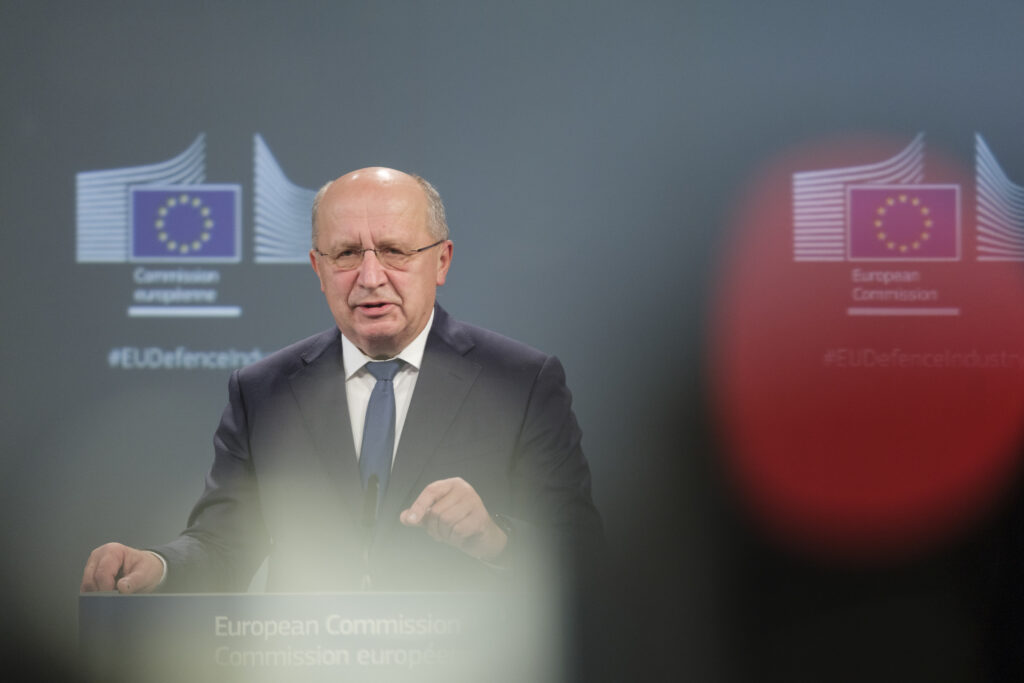
“The question is whether we need to have some kind of additional security guarantees and institutional arrangements in order to be ready — in case Article 5 suddenly is not implemented,” EU Defense Commissioner Andrius Kubilius told POLITICO at the end of November. Even so, “we should always count on Article 5,” he added.
One legal basis for such a guarantee can be found in the EU’s common defense clause, Article 42.7, which was born after the Kosovo war of the late 1990s when then-French and British leaders Jacques Chirac and Tony Blair jointly pushed for Europe to take defense into its own hands.
Kubilius, a former Lithuanian prime minister, added that he wants to use the coming year to flesh out provisions in the clause to spell out what actions countries would take to defend one another.
He pointed to recent comments by U.S. NATO Ambassador Matthew Whitaker suggesting that Germany should take over NATO’s top military job from an American.
The comment “is a signal that really Americans are asking us to take care about European defense.”
End of an era
With European military chiefs and intelligence agencies warning that an attack from Russia could come as early as 2028, traditional European attitudes toward defense — and reliance on the United States — are quickly shifting.
Until recently, Germany has been unwavering in its support for a U.S.-led NATO. But under Chancellor Friedrich Merz, Berlin is now holding talks with Paris about how the French nuclear deterrent could contribute to Europe’s security.
At the same time, Merz has shown a growing willingness to differ from Washington on the subject of Ukraine and Europe’s security architecture. Parts of the Trump administration’s National Security Strategy were “unacceptable,” the conservative leader said on Tuesday.
The document confirmed Merz’s view that “we in Europe, and therefore in Germany, must become much more independent of the United States in security policy.”
The shift reflects changing dynamics within Germany’s security establishment. In a statement, Roderich Kiesewetter, a former German army general staff officer and a conservative lawmaker in the Bundestag, called Trump’s security strategy a “slap in the face.”
“Anyone who writes about partners in this way won’t defend them when it really counts,” he wrote. “What does that mean? The era of the ‘security guarantee’ is over.”
Capability gaps
The challenge for Europe is how to move from rhetoric to action. The stakes are huge — not least because embracing continental defense would involve major tradeoffs on welfare spending, which in turn could topple governments.
Another obstacle is institutional. Given that the United States is the biggest partner inside NATO, the alliance is not a place where allies can plan for any sort of post-American future. “That would defeat the very purpose of NATO,” said one senior alliance diplomat.
Inside the alliance there is no contingency planning for a NATO without the U.S., according to three NATO diplomats. They interpret the signals from Washington not as a prelude to U.S. withdrawal from the alliance but as a powerful wakeup call for Europe as Washington refocuses on the Arctic and the Indo-Pacific.
“The United States and NATO allies take our Article 5 commitments … very seriously,” Whitaker, the U.S. ambassador, said last week. “Article 5 is ironclad.”
“But we have expectations,” he said at the Doha Forum in Qatar, namely “[Europeans] picking up the conventional defense of the European continent.”
A third and particularly daunting task for Europeans would be to replicate or replace military capacities currently provided by the U.S.
Europeans provide up to 60 percent of capabilities in some domains, said Oana Lungescu, a former NATO spokesperson who is now a fellow at the Royal United Services Institute think tank. But in others — such as intelligence, heavy airlift and deep strikes — the United States typically provides an outsized share.
“It would be very hard for Europeans to fill some of those capability gaps, certainly within a year or two,” Lungescu said.
Some officials pointed to the fact that even if the Trump administration wants to leave NATO, the U.S. Congress might stand in the way. Indeed, U.S. defense legislation set for a vote as soon as this week would place new restrictions on reducing troop levels in Europe, a bipartisan rebuke of the Trump administration’s strategy.
Anthony Gardner, a former U.S. ambassador to the EU, said the NSS was nothing less than a “betrayal of 80 years of U.S. bipartisan policy.”
For many Europeans, the message is clear. The Trump administration has laid out its position. More than ever, Europe is listening — and taking action.



Follow