



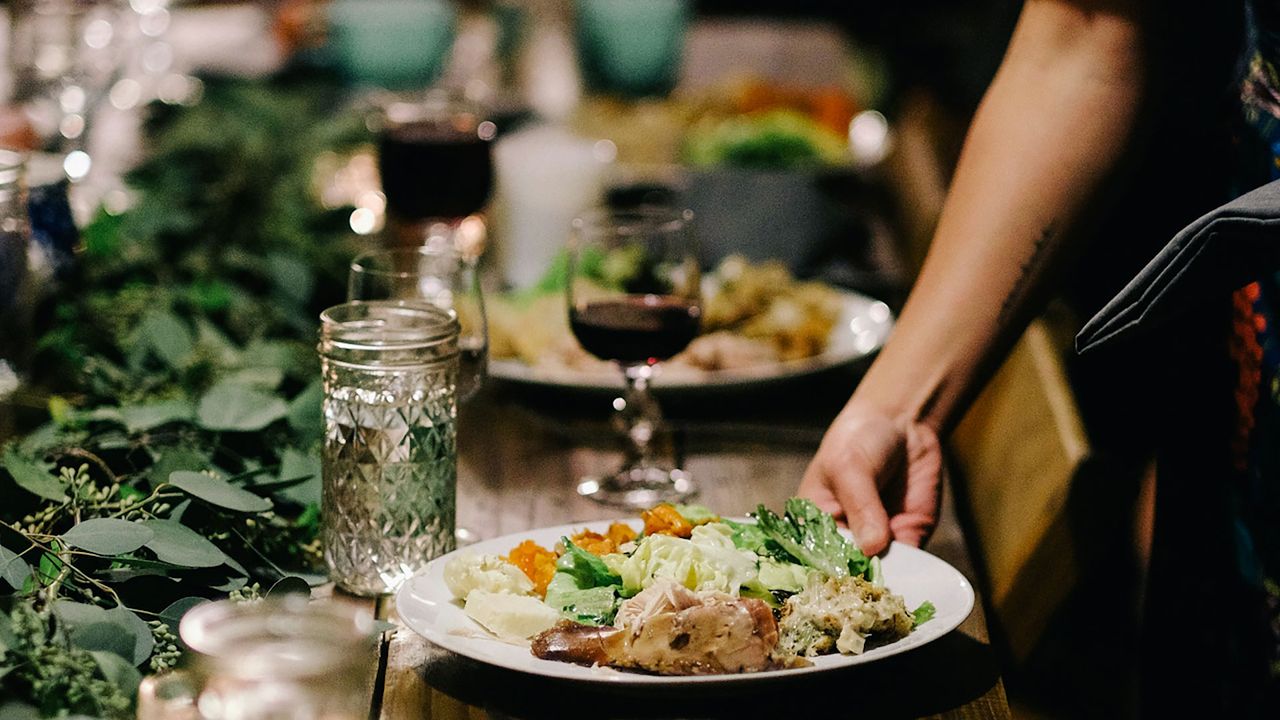
The Christmas season is a strange paradox: it’s a season built around indulgence – rich food, celebration, endless treats and a constant flow of alcohol – and yet it’s also the time where we feel pressure to be ‘good’, to make ‘healthy swaps’, ‘stay on track’ and somehow enjoy everything without ever letting it show on our bodies.
It’s confusing and it leads to a lot of tension for so many of us around the dinner table. We’re trying to celebrate, while quietly negotiating every single bite in our heads and we’re trying to be present with the people we love amidst a background hum of food guilt.
It shouldn’t be this complicated. Eating is meant to be a pleasure, especially at a time of year that revolves around ritual, tradition and social connection. But diet culture has trained us to second-guess ourselves, teaching us that our appetite can’t be trusted, that enjoyment needs to be earned and that food is something to ‘manage’ rather than experience or enjoy.
So how do we give ourselves permission to eat and actually enjoy it this Christmas?
We can start by acknowledging that the problem isn’t the food, it’s the rules. It’s the internal commentary that’s born out of a lifetime of conditioning – none of it our own fault and, actually, it has very little to do with us or what’s on the table in front of us.
When you take the moral charge out of food, everything gets quieter. Meaning that when you stop labelling foods as ‘good’ or ‘bad’, or judging yourself for what you choose to eat, the internal battle softens. Instead of a running commentary about what you ‘should’ eat or how you’ll ‘make up for it later’, you can simply be left with what’s actually happening: a plate of food and your own appetite. Taking the moral charge out of food turns eating into a choice, rather than an exhausting mental negotiation.
One practical way to break the cycle? Stop ‘saving up’ calories and honour our hunger instead. One of the most damaging festive habits is restricting earlier in the day to ‘earn’ a bigger meal later. In reality, this almost always backfires: biological deprivation leads us to feeling out of control around food – not because we’re ‘weak’, but because our body is trying to protect us. When we honour our hunger, we regulate our body and our mind.
It also helps to let ourselves eat the things we genuinely want this Christmas. Not the ‘lighter’ option we don’t actually fancy eating but think we should pick because it’s the ‘sensible’ choice: satisfaction is a crucial part of eating well and intuitively, and when we let ourselves have the real thing that we crave, or that everyone else is eating, we’re less likely to be consumed by it or grazing endlessly while feeling unsatisfied and guilty.
And let’s talk about pleasure. Somewhere along the way, diet culture convinced us that enjoying food is suspicious, or equals a lack of control… That liking something too much makes it dangerous. But pleasure and enjoyment is a legitimate and important part of nourishment and part of being a human – let’s let ourselves experience it and enjoy the Christmas foods we love.
Remember too that while Christmas can feel wildly out of control when it comes to food and eating, it is not a six-week binge. It’s a handful of meals and events scattered through a month… A mince pie on a Wednesday afternoon or a second helping of stuffing isn’t the crisis it can end up feeling like in our heads. One meal doesn’t change your body, but the shame attached to it can absolutely change the way you feel about yourself.



Follow