



This article is presented by EFPIA with the support of AbbVie
I made a trip back to Europe recently, where I spent the vast majority of my pharmaceutical career, to share my perspectives on competitiveness at the European Health Summit. Now that I work in a role responsible for supporting patient access to medicine globally, I view Europe, and how it compares internationally, through a new lens, and I have been reflecting further on why the choices made today will have such a critical impact on where medicines are developed tomorrow.
Today, many patients around the world benefit from medicines built on European science and breakthroughs of the last 20 years. Europeans, like me, can be proud of this contribution. As I look forward, my concern is that we may not be able to make the same claim in the next 20 years. It’s clear that Europe has a choice. Investing in sustainable medicines growth and other enabling policies will, I believe, bring significant benefits. Not doing so risks diminishing global influence.
Today, many patients around the world benefit from medicines built on European science and breakthroughs of the last 20 years
I reflect on three important points: 1) investment in healthcare benefits individuals, healthcare and society, but the scale of this benefit remains underappreciated; 2) connected to this, the underpinning science for future innovation is increasingly happening elsewhere; and 3) this means the choices we make today must address both of these trends.
First, let’s use the example of migraine. As I have heard a patient say, “Migraine will not kill you but neither [will they] let you live.”[1] Individuals can face being under a migraine attack for more than half of every month, unable to leave home, maintain a job and engage in society.[2] It is the second biggest cause of disability globally and the first among young women.[3] It affects the quality of life of millions of Europeans.[4] From 2011-21 the economic burden of migraine in Europe due to the loss of working days ranged from €35-557 billion, depending on the country, representing 1-2 percent of gross domestic product (GDP).[5]
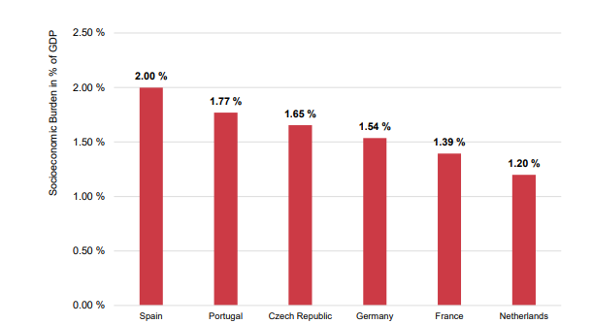
Source: WifOR, The socioeconomic burden of migraine. The case of 6 European Countries.5
Access to effective therapies could radically improve individuals’ lives and their ability to return to work.[6] Yet, despite the staggering economic and personal impacts, in some member states the latest medicines are either not reimbursed or only available after several treatment failures.[7] Imagine if Europe shifted its perspective on these conditions, investing to improve not only health but unlocking the potential for workforce and economic productivity?
Moving to my second point, against this backdrop of underinvestment, where are scientific advances now happening in our sector?
In recent years it is impressive to see China has become the second-largest drug developer in the world,[8] and within five years it may lead the innovative antibodies therapeutics sector,[9] which is particularly promising for complex areas like oncology.
Cancer is projected to become the leading cause of death in Europe by 2035,[10] yet the continent’s share of the number of oncology trials dropped from 41 percent in 2013 to 21 percent in 2023.10
Today, antibody-drug conjugates are bringing new hope in hard-to-treat tumor types,[11] like ovarian,[12] lung[13] and colorectal[14] cancer, and we hope to see more of these advances in the future. Unfortunately, Europe is no longer at the forefront of the development of these innovations. This geographical shift could impact high-quality jobs, the vitality of Europe’s biotech sector and, most importantly, patients’ outcomes. [15]
This is why I encourage choices to be made that clearly signal the value Europe attaches to medicines
This is why I encourage choices to be made that clearly signal the value Europe attaches to medicines. This can be done by removing national cost-containment measures, like clawbacks, that are increasingly eroding the ability of companies to invest in European R&D. To provide a sense of their impact, between 2012 and 2023, clawbacks and price controls reduced manufacturer revenues by over €1.2 billion across five major EU markets, corresponding to a loss of 4.7 percent in countries like Spain.[16] Moreover, we should address health technology assessment approaches in Europe, or mandatory discount policies, which are simply not adequately accounting for the wider societal value of medicines, such as in the migraine example, and promoting a short-term approach to investment.
By broadening horizons and choosing a long-term investment strategy for medicines and the life science sector, Europe will not only enable this strategic industry to drive global competitiveness but, more importantly, bring hope to Europeans suffering from health conditions.
AbbVie SA/NV – BE-ABBV-250177 (V1.0) – December 2025
[1] The Parliament Magazine, https://www.theparliamentmagazine.eu/partner/article/unmet-medical-needs-and-migraine-assessing-the-added-value-for-patients-and-society, Last accessed December 2025.
[2] The Migraine Trust; https://migrainetrust.org/understand-migraine/types-of-migraine/chronic-migraine/, Last accessed December 2025.
[3] Steiner TJ, et al; Lifting The Burden: the Global Campaign against Headache. Migraine remains second among the world’s causes of disability, and first among young women: findings from GBD2019. J Headache Pain. 2020 Dec 2;21(1):137
[4] Coppola G, Brown JD, Mercadante AR, Drakeley S, Sternbach N, Jenkins A, Blakeman KH, Gendolla A. The epidemiology and unmet need of migraine in five european countries: results from the national health and wellness survey. BMC Public Health. 2025 Jan 21;25(1):254. doi: 10.1186/s12889-024-21244-8.
[5] WifOR. Calculating the Socioeconomic Burden of Migraine: The Case of 6 European Countries. Available at: [https://www.wifor.com/en/download/the-socioeconomic-burden-of-migraine-the-case-of-6-european-countries/?wpdmdl=358249&refresh=687823f915e751752703993]. Accessed June 2025.
[6] Seddik AH, Schiener C, Ostwald DA, Schramm S, Huels J, Katsarava Z. Social Impact of Prophylactic Migraine Treatments in Germany: A State-Transition and Open Cohort Approach. Value Health. 2021 Oct;24(10):1446-1453. doi: 10.1016/j.jval.2021.04.1281
[7] Moisset X, Demarquay G, et al., Migraine treatment: Position paper of the French Headache Society. Rev Neurol (Paris). 2024 Dec;180(10):1087-1099. doi: 10.1016/j.neurol.2024.09.008.
[8] The Economist, https://www.economist.com/china/2025/11/23/chinese-pharma-is-on-the-cusp-of-going-global, Last accessed December 2025.
[9] Crescioli S, Reichert JM. Innovative antibody therapeutic development in China compared with the USA and Europe. Nat Rev Drug Discov. Published online November 7, 2025.
[10] Manzano A., Svedman C., Hofmarcher T., Wilking N.. Comparator Report on Cancer in Europe 2025 – Disease Burden, Costs and Access to Medicines and Molecular Diagnostics. EFPIA, 2025. [IHE REPORT 2025:2, page 20]
[11] Armstrong GB, Graham H, Cheung A, Montaseri H, Burley GA, Karagiannis SN, Rattray Z. Antibody-drug conjugates as multimodal therapies against hard-to-treat cancers. Adv Drug Deliv Rev. 2025 Sep;224:115648. doi: 10.1016/j.addr.2025.115648. Epub 2025 Jul 11. PMID: 40653109..
[12] Narayana, R.V.L., Gupta, R. Exploring the therapeutic use and outcome of antibody-drug conjugates in ovarian cancer treatment. Oncogene 44, 2343–2356 (2025). https://doi.org/10.1038/s41388-025-03448-3
[13] Coleman, N., Yap, T.A., Heymach, J.V. et al. Antibody-drug conjugates in lung cancer: dawn of a new era?. npj Precis. Onc. 7, 5 (2023). https://doi.org/10.1038/s41698-022-00338-9
[14] Wang Y, Lu K, Xu Y, Xu S, Chu H, Fang X. Antibody-drug conjugates as immuno-oncology agents in colorectal cancer: targets, payloads, and therapeutic synergies. Front Immunol. 2025 Nov 3;16:1678907. doi: 10.3389/fimmu.2025.1678907. PMID: 41256852; PMCID: PMC12620403.
[15] EFPIA, Improving EU Clinical Trials: Proposals to Overcome Current Challenges and Strengthen the Ecosystem, efpias-list-of-proposals-clinical-trials-15-apr-2025.pdf, Last accessed December 2025.
[16] The EU General Pharmaceutical Legislation & Clawbacks, © Vital Transformation BVBA, 2024.



Follow