



TERNEUZEN, the Netherlands — Europe’s huge chemicals sector is campaigning to weaken the European Union’s most important climate policy — and Brussels is listening.
At a meeting in Antwerp on Wednesday, industry chiefs will attempt to persuade European Commission President Ursula von der Leyen and national leaders to water down the Emissions Trading System (ETS), a cap-and-trade strategy to cut greenhouse gas emissions.
They come with a well-rehearsed pitch: Their sector, one of the biggest in Europe, is in crisis. Factories are being squeezed by a perfect storm of high energy prices, intense competition from China, weak demand from downstream industries — and the world’s most expensive carbon pricing scheme.
Virtually no other jurisdiction in the world faces carbon costs as high as the EU, they argue: If current plans to strengthen the scheme go ahead, Europe’s chemicals industry could be dead within a decade.
“Our competitors abroad don’t face comparable ETS regimes,” Markus Steilemann, CEO of German chemicals producer Covestro, told POLITICO, calling for “an urgent reform of the EU ETS to align climate ambition with competitive reality.”
For environmental advocates, however, touching the ETS is akin to sacrilege. The 20-year-old scheme — which puts strict limits on the amount of planet-warming gases industry can emit, and covers nearly half of the bloc’s emission — is the bedrock of EU climate policy, forcing industry to find cleaner energy sources.
Industries currently pay around €80 for every ton of carbon they emit, and by 2039 will no longer be allowed to emit any carbon at all.
But the ETS legislation is up for review this year, and momentum is growing for it to be significantly weakened. Several member countries and political groups — including von der Leyen’s own center-right European People’s Party — have signaled they want to see reforms.
“Becoming greener cannot be our goal; it means becoming poorer,” Austrian Chancellor Christian Stocker said on Tuesday, adding he would push for exemptions to the ETS to “ensure that domestic industry remains competitive and that our companies do not relocate.”
If the ETS is substantially weakened, it would be the biggest green policy yet to fall victim to the green backlash that has defined the first 14 months of von der Leyen’s second term.
Alarmed? You should be
EU chemicals industry body CEFIC — one of the richest lobby groups in Brussels, according to the Corporate Europe Observatory — has long warned that doomsday is near for Europe’s chemicals sector. It has released report after report outlining the loss of market share to China, the closure of plants and plummeting investment.
It has even sponsored an advertising campaign in Brussels metro stations that booms out in bold letters: “Alarmed? You should be. Europe is losing production sites, quality jobs and independence.” It ends with a plea to “save our industry.”
That warning is echoed by industry chiefs. Markus Kamieth, CEO of BASF, Europe’s largest chemicals company, told reporters late last year that Europe “has the theoretical potential” to compete with the U.S. and China. “But [in] real life, I think we shoot ourselves in the foot way too often.”
The chemicals lobby has come under fire for its outsized influence in Brussels. “CEFIC already maintains almost unparalleled access to EU decision-makers, registering the third-highest number of lobby meetings with the European Commission of all lobby organisations in the EU,” said Raphaël Kergueno, a senior policy officer at NGO Transparency International.
Still, the sector has plenty of facts to back up its apocalyptic warnings. Since 2023 more than 20 major chemical sites have shut across Europe, costing some 30,000 jobs, according to trade union IndustriALL, which warns that a further 200,000 jobs in the sector could be lost over the next five years.
Chemical investments in Europe collapsed by more than 80 percent in 2025 from the year before, according to a recent report from CEFIC, while capacity closures continue to outpace new projects — turning Europe into a place to shut plants, not build them.
Analysts say China’s rapid expansion into chemicals production is adding pressure. “European producers are especially hit, largely due to high energy costs and a reliance on uncompetitive liquid feedstocks, with the least competitive assets continuing to post negative margins,” said Andrew Neale, global head of chemicals at S&P Global Energy. As a result, he said, “longer-term investment in decarbonization and circularity have been deprioritized.”
Dow’s recent investment decisions illustrate this well. The American chemical giant plans to close three plants in Europe and cut 800 jobs, citing the need to exit “higher-cost, energy-intensive assets” as the continent’s competitiveness erodes.
“It’s very clear that Europe currently suffers from a lack of competitiveness,” Julia Schlenz, president of Dow Europe, told POLITICO, warning that carbon costs and regulation are moving faster than the infrastructure needed to decarbonize.
As the bad news keeps coming, the sector has increasingly called for the ETS to be weakened. In July last year CEFIC published its demands, including the issuance of free carbon allowances, a longer timeline for phasing out emissions, and the inclusion of carbon removal credits. BASF’s Kamieth, who is also president of CEFIC, repeated those calls this week in an interview with the Financial Times, calling the ETS in its current form “obsolete.”
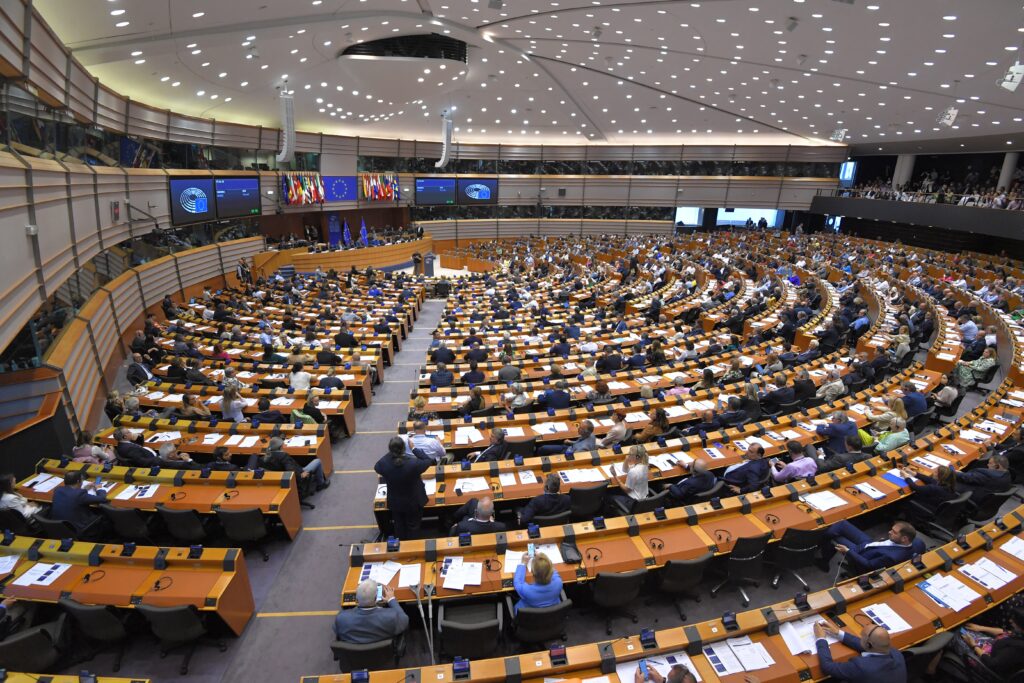
Member countries and the European Parliament have already agreed to consider these proposed changes in the upcoming review of the ETS.
Germany’s environment minister, Carsten Schneider, said at an energy summit in January that it was “not the case that what has been set until 2039 can never be revised,” adding that it is possible “to allow further free allocations and to permit certificates beyond 2039 as well.”
Some business groups and member countries have gone further, with Italy’s primary industry body Confindustria as well as the Czech and Slovak governments calling for the ETS to be temporarily suspended altogether.
“In a deeply changed geopolitical context, the ETS, in its current configuration, has revealed all of its limitations,” Confindustria President Emanuele Orsini said in a statement Tuesday. “The ETS is an unbalanced system that fails to deliver the decarbonisation benefits it claims to pursue, while in practice undermining the competitiveness of European industry.”
Defenders of the ETS insist this is the wrong approach. They argue that the emphasis should be on more rapid decarbonization, which for the chemicals sector hinges on electrifying its industrial processes.
But that, too, costs money.
Electrify everything
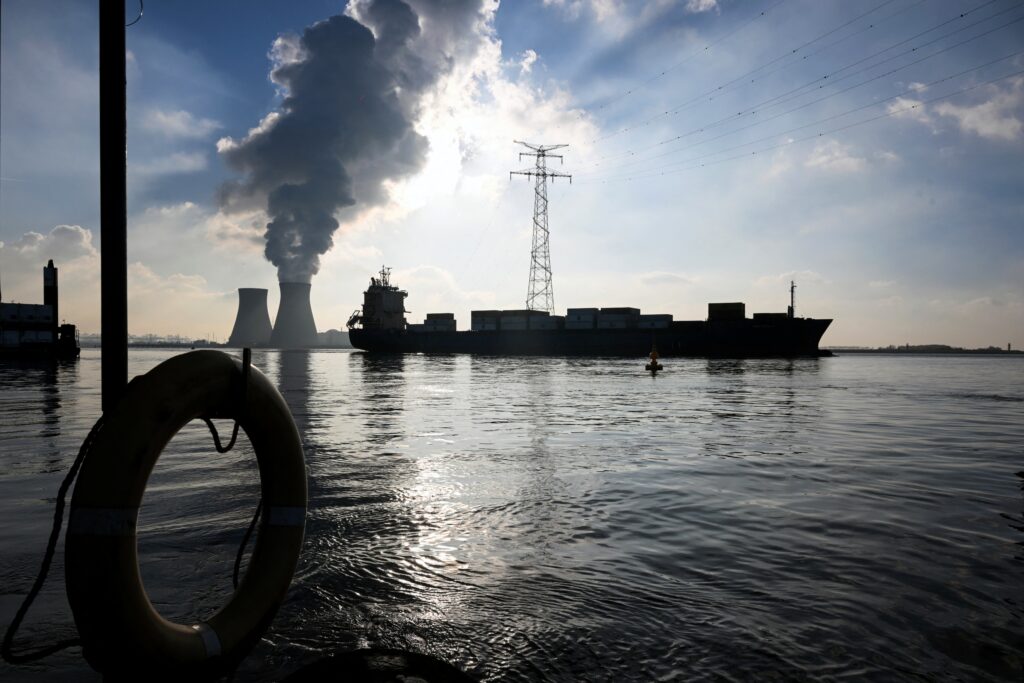
The chimneys of Terneuzen chemical plant have been billowing out carbon-laden smoke for more than 60 years, as the Dutch factory sucks in an endless stream of natural gas and pumps out plastic products.
But in June last year the industrial buzz subsided as Dow, the plant’s operator, shut down one of its three main “steam-cracker” units because it was too expensive to run — in what has become a common story across Europe’s chemicals sector.
Steam-cracking is the crux of the chemicals industry’s reliance on energy. It turns oil or gas into the basic building blocks of plastics and chemicals by heating them to almost 1,000 degrees Celsius. The process uses vast amounts of energy because the furnaces are kept at these temperatures 24 hours a day, seven days a week, making it one of the most energy-intensive processes in Europe.
Electrifying steam-crackers would require huge amounts of clean electricity — which the industry insists is simply not yet available.
“One thing we know is if we are going to switch to electric cracking, eventually, when the technology is there, is that we need significant amounts of renewable electricity delivered here,” says Dennis Kredler, Dow’s director for EU affairs in Brussels.
Terneuzen is not an outlier. Across Europe’s chemical clusters, decarbonization targets are racing ahead of the power grids meant to support them.
“If you can’t get renewable electricity off the grid, we said, okay, we need to do it ourselves and find these leading providers to secure wind and solar energy for our sites in Germany, Italy, the Netherlands, and so on,” LyondellBasell CEO Peter Vanacker told POLITICO. “But we need support from Brussels.”
The European Commission sees the electrification of industry as not just a climate imperative but an energy security one. In an interview with POLITICO in December, EU energy chief Dan Jorgensen said the shift would be good for the bloc. “There is not one European country that will not benefit from Europe being more independent on the energy side,” he said.
German Greens MEP Jutta Paulus agrees, arguing that Europe’s competitiveness will ultimately depend less on looser rules than on faster access to renewable power and new markets for low-carbon chemicals. “Every chemical industry on this planet will have to transition away from fossil fuels — that’s very clear,” she said.
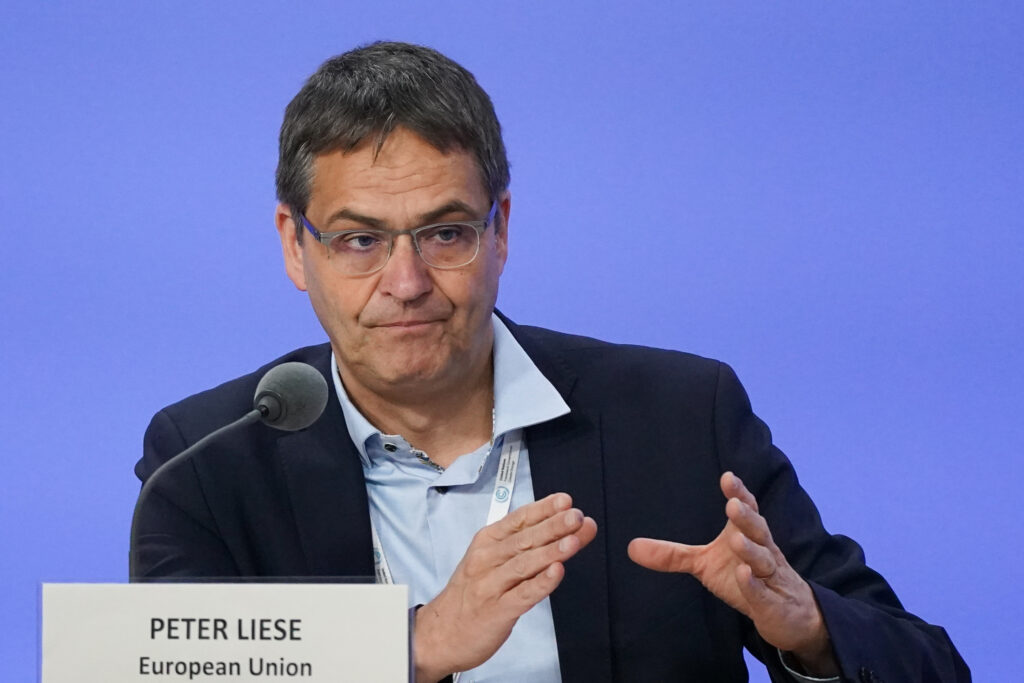
Some right-of-center MEPs also broadly agree. Peter Liese, from the European People’s Party, said the chemicals industry is the reason why the ETS debate is so difficult. “Chemical companies talk about their costs due to the ETS. However, they do not talk about how they intend to decarbonize. The purpose of the ETS is not to torment companies, but to encourage them to decarbonize.”
However, others in the EPP take a less sympathetic approach, and the group’s overall position has yet to be clarified.
Rob Ingram, head of the plastics division at British chemicals giant INEOS, insists the sector is dedicated to decarbonizing — just not as fast as current laws demand. “I’m convinced that all the peers in the industry absolutely know that we need to decarbonize and develop a second economy and want to do that,” Ingram told POLITICO. “The question is, how do we get there?”
He argues that if the EU over-regulates high-emitting sectors, those sectors will just go offshore to countries with weaker or no carbon controls. “De-industrialization of Europe is actually worse for the planet,” he says.
Leaking carbon
It was this risk — known as “carbon leakage” — that prompted the EU initially to grant free ETS allowances to industries most at risk of moving offshore. But Brussels has now attempted to address that by charging a carbon tax on imports, and is phasing out free allowances.
Chemicals, though, don’t fall under the new Carbon Border Adjustment Mechanism, giving extra force to their call for continued free allowances.
And they have evidence that the fear of leakage is being realized: While Europe debates how to keep its chemical plants alive, BASF is pressing ahead with its largest investment ever, a €10 billion fully integrated chemicals mega-plant — in China.
Tatiana Santos, head of chemicals policy at the European Environmental Bureau, says the EU’s response should not be to deregulate, arguing the EU’s selling point is precisely its higher environmental standards. “At the end of the day, we cannot compete with China or the U.S. in lower standards.”
But that argument doesn’t persuade Peter Huntsman, CEO of chemicals producer Huntsman.
“When is it time to step back and ask, are we accomplishing anything?” he asked, dismissing the argument that if you give the ETS time to work its magic, it will eventually force industry to find affordable, competitive, low-carbon means of production.
“The chemical industry does not have 10 years left,” he said.
Zia Weise and Francesca Micheletti contributed to this report.



Follow