



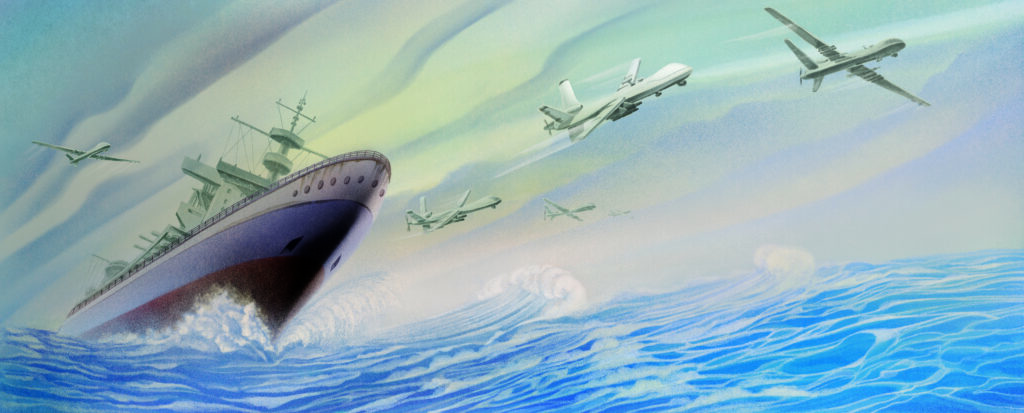
Illustration by Jiyeun Kang for POLITICO
Even with an ocean apart, there isn’t an industry in Europe that hasn’t been impacted by President Donald Trump’s actions.
Businesses and consumers alike are reeling from Trump’s tariffs. Climate advocates are reeling from the U.S. pulling out of major treaties, including the Paris Agreement. National budgets are being strained by Trump’s demand for more defense spending from European countries, while militaries are rebuilding their ranks and rethinking their strategies. Politicians are seizing the opportunity to stand out in this moment of crisis — some as protectors against Trump’s rampage and others as acolytes of MAGA-style populism.
It’s difficult to even track the impact of Trump 2.0 due to its scope, which is why POLITICO Magazine reached out to eight different thought leaders in Europe and the U.S. and asked: What’s the biggest way Trump has changed Europe? Answers varied from the demise of NATO to changing political identities to setbacks in climate action. A common sentiment, however, is that this is a sink-or-swim moment for Europe.
Here’s what they said.
‘The strategic holiday for Europe is over’
Attila Demkó is a security policy analyst and writer based in Hungary.
Trump shattered the illusion that what many believe to be “common values” in Europe are, indeed, common. As it turns out, some of these mostly liberal, left and far-left values are not shared by all. The emphasis on multiculturalism, Wilkommenskultur (the German term for a welcoming culture, especially toward refugees), excessive focus on political correctness and gender issues has created a rift, and the deep divide is not only between Europe and the U.S., but also within Europe itself. While smaller European countries (such as Hungary or Slovakia) and non-mainstream parties (such as France’s National Rally, Poland’s PiS and Germany’s AfD) that oppose Wilkommenskultur, European federalism, and propose a Europe of nations, could be ignored and quarantined as fringe, Trump and the American right cannot be ignored. The rift is real and goes through right in the middle of most Western societies.
Trump also made it clear that the strategic holiday for Europe is over. The continent must pay full price for its own defense, and almost full price for the support for Ukraine. So far, in both cases, the bloc has talked the talk but hasn’t walked the walk. Trump may finally teach Europe to walk — or if it can’t walk, at least get it to stop dreaming and preaching.
‘Trump may be doing Europe a favor’
Kay Bailey Hutchison is a former U.S. Ambassador to NATO.
By challenging Europe to do more in its own defense, President Trump may be doing Europe a favor. If Europeans can adopt a plan to work together to provide military equipment and technology, they will emerge stronger. Increasing defense capabilities, with each country contributing, will also enable significant economic benefits.
Since World War II, Europe has depended on the U.S. for many security guarantees. Like previous American presidents — Republican and Democrat — President Trump has said it is time to make security responsibility more evenly divided among our allies. For maximum results, a more equal share of security must also produce interoperable assets. Organized by NATO, all willing allies and trusted partners could share in building and manufacturing equipment and hardware, while military training and increased exercises could prepare all NATO countries and trusted partners for joint defense when there are attacks of varying severity.
If Europe wisely uses the 5 percent of GDP it promised for defense priorities and works in concert with the U.S. and trusted allies, the world will be safer for those who seek freedom — and Europe will be regarded as a significant and reliable global leader.
‘One of the strongest alliances in modern times has weakened’
Manfred Elsig is professor of international relations at the World Trade Institute of the University of Bern.
From an international relations perspective, the biggest way Trump has changed Europe is by destabilizing the U.S.–European partnership. Over the course of Trump’s two presidencies, the bloc has come to realize that the U.S. is no longer a reliable and close partner. Trump has eroded the most important political capital in the transatlantic cooperation: trust — the bedrock of the post-World War II partnership between the U.S. and Europe. The transregional security pact, with NATO at its core, has been badly weakened, denting Karl Deutsch’s infamous “security community” built on a shared sense of values and “we-ness.” And as a result, Europe must quickly rethink its security architecture and take more independent action.
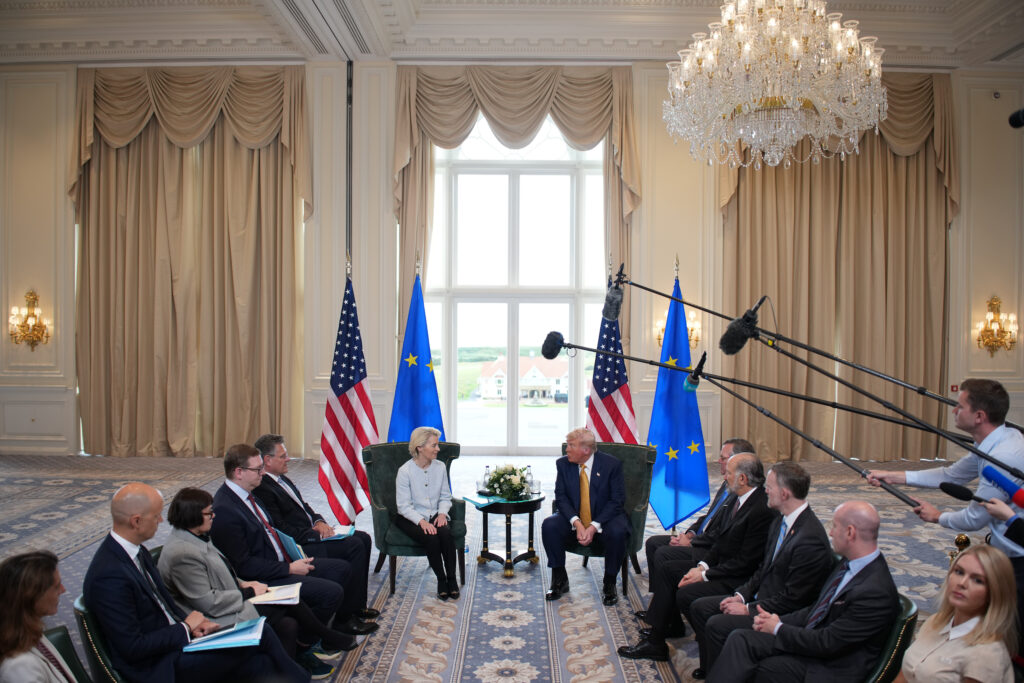
Another area where we’re witnessing negative effects of the Trump presidency is the transatlantic marketplace. Primarily, the “trade community” is no longer a model of relatively free, fair and stable trade, and investment relations are leading to less growth and innovation. The secondary effects are trade diversion and growing pressures to protect markets from foreign competition. As a result, Europe will look elsewhere for trade partners that believe in a rules-based system in an attempt to de-risk and secure its supply chains. Economic security considerations will be increasingly mainstreamed into Europe’s international economic agenda, and more stimulus for bloc-building can be expected as well.
Finally, Europe’s investments in climate diplomacy and development cooperation are suffering a setback due to the U.S. “withdrawal doctrine” that started in 2016. The U.S. is either bypassing or selectively instrumentalizing international law, eroding global solidarity and sidelining the ambitious policies the planet urgently needs. As a result, Europe will struggle to find partners at the global level, and will continue on its path to act unilaterally on both climate and development policies.
‘Europe needs to face the reality of being a resource-poor continent’
Heather Grabbe is a senior fellow at Bruegel, a Brussels-based economic think tank.
When it comes to climate and the environment, Trump has distracted Europe from addressing its long-term resource vulnerabilities by creating panic over defense and trade. By creating crises around U.S. military support against Russian aggression and tariffs that hit the trade-dependent European economy, Trump has Europe’s leaders on the defensive and has forced them to focus on short-term security. Of course, these are important issues, but they divert political attention and public budgets away from measures that would bring longer-term security from climate impacts, volatile commodity markets and fragile supply chains by investing in climate resilience and enhancing resource productivity. Russian President Vladimir Putin may or may not invade Europe, and Trump may or may not help protect us, but climate change and resource insecurity will certainly damage the European economy.
Europe needs to face the reality of being a resource-poor continent, not only in fossil fuels but also in many other raw materials. And while Trump is trying to maintain Europe’s dependence on U.S. LNG as a replacement for Russian gas, that is the most expensive way of fuelling the economy it also slows down our transition to true energy security. Fossil fuel subsidies of more than €100 billion a year keep Europe vulnerable to the U.S. and other exporters, rather than spending taxpayers’ money on electrification, enlarging renewable energy production and building the grids and interconnectors that would bring us independence.
‘The turbulence the U.S. has unleashed globally has forced many Europeans to grow up’
Aliona Hlivco is founder and CEO of St. James’s Foreign Policy Group and a former Ukrainian politician.
The turbulence the U.S. has unleashed globally has forced many Europeans to grow up. They have finally realized they can no longer rest in the comfort of predictable trade deals or rely on the continent’s famously slow but steady regulatory machinery to keep things ticking along. Europe has woken up to the fact that it must shift from the pace and mentality of an aircraft carrier — vast, heavy and resourceful, lumbering toward a destination set out years in advance — to that of a maritime drone: fast, agile, nimble and capable of striking with precision at exactly the right place and time.
This new agility is felt unevenly across the continent but is unmistakably emerging. Germany is finally, and understandably, overcoming its post-World War II paralysis, reclaiming its role as an economic power as well as the “Eastern flank of NATO,” as one Bundeswehr official put it to me earlier this year. France, long a champion of “strategic autonomy,” has at last found the space to act on it. The Northern European nations — Scandinavia and the Baltics — are leading Europe’s defence innovation, rearmament and the next generation of deterrence, including by taking the lead in supporting Ukraine. They also built a sustainable and crucial bridge with the U.K. through the Joint Expeditionary Force — keeping Europe’s only nuclear power other than France closely tied to the continent after Brexit. Military strength may well become the decisive factor determining who leads Europe in the next 50 years, and in that regard, Poland is rapidly emerging as one of the EU’s most powerful members.
Europe is changing. It can no longer afford inertia or the illusion that statements can substitute for action. While Brussels continues to grapple with Washington’s unpredictability — possibly beyond Trump’s second term — European countries are seizing the moment. In an era of uncertain geopolitical multilateralism, they are playing their best cards, hoping to secure the breakthroughs that redefine Europe’s future.
‘Trump’s presidency has had a profound and contradictory effect on European political identity’
Aleksandra Sojka is an associate professor of European politics at the University Carlos III in Madrid.
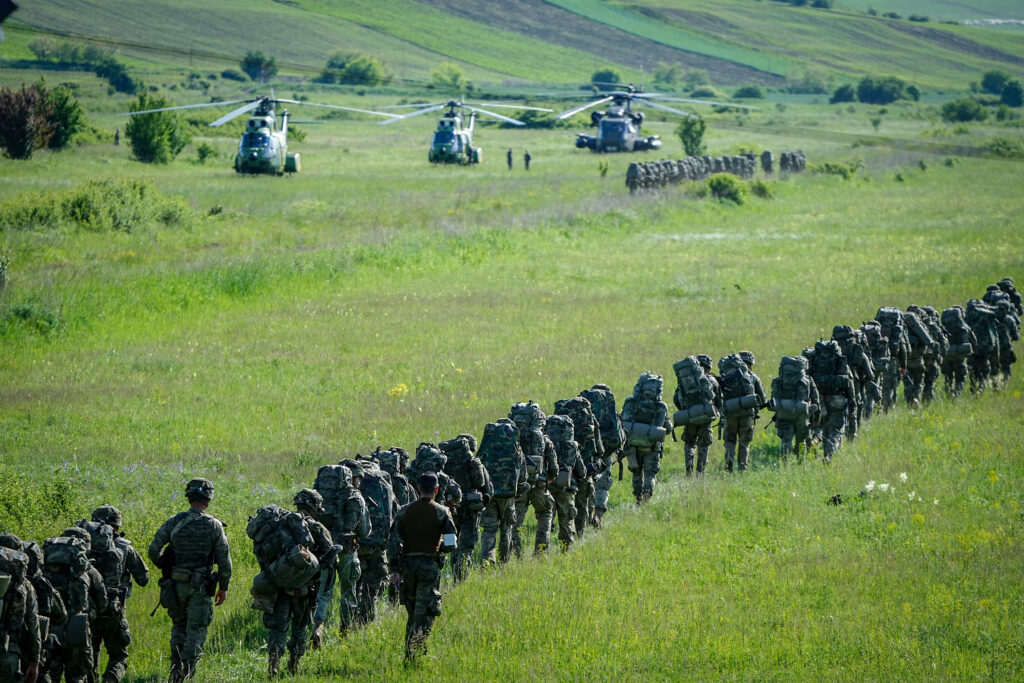
Trump’s biggest impact on Europe has been forcing the bloc to confront its strategic dependence on the U.S. His second presidency has fundamentally shaken the transatlantic alliance, exposing Europe’s critical weakness: the absence of genuine defense and security capabilities independent of American support. Trump’s wavering commitment to NATO and inconsistent support for Ukraine have made European rearmament an urgent necessity, shifting public opinion beyond the political elite. And this pressure has created remarkable convergence among European leaders, enabling decisions that were previously politically impossible — such as excluding defense spending from budget deficit calculations and allocating funds for coordinated European military procurement and shared defense initiatives. While disagreements remain over specific strategies, this fundamental shift is undeniable.
Beyond defense, I consider Trump’s presidency has had a profound and contradictory effect on European political identity. His administration’s divergence from traditional European support for multilateralism as well as the EU’s positions on climate, trade and democratic norms have energized both sides of Europe’s political conflict. On the one hand, it has emboldened Euroskeptic and populist parties, providing external validation for their narratives on issues like national sovereignty and migration. On the other hand, it has triggered a sort of rally-around-the-flag effect with Europeans who increasingly value the achievements of integration and the protections of their democracies. Trust in EU institutions has recovered to pre-crisis levels, and support for bloc-wide policies stands at an historic high. In essence, Trump could inadvertently become a catalyst for European unity and self-reliance, even as he amplifies divisions within European societies.
‘Giving us a different dystopian vision of one of our possible futures’
Sunder Katwala is director of British Future.
Trump may have changed Europe most by giving us a different dystopian vision of one of our possible futures. Our leaders and the public alike lack a mental map or language for this unfamiliar world in which an American government appears to present a new threat from the West to our peace, prosperity and democracy. While that persists, it means hard work rethinking our assumptions across foreign policy and defense, trade and economics, technology and democracy.
The most significant impact may be political. The Trump administration’s effort to export this particular vision of conflict and polarization has turned America’s traditional soft power to attract into a deterrent, as it is a form of populism unpopular enough to create a boomerang effect. By reframing the choices on offer in our domestic politics, the challenge has catalyzed the search for antidotes among the anti-Trump majorities of our societies, and an appetite among citizens to coalesce around the most viable anti-Trumpist choices when choosing our own governments in these fragmented times.
‘Trump’s era has highlighted the EU’s sovereignty crisis’
Thiemo Fetzer is an economist and professor at the University of Warwick and the University of Bonn.
Trump’s era has highlighted the EU’s sovereignty crisis, most visible in the digital and financial domains. Now is the time for Europe to choose how it will build out its economic future: Will it align with the U.S. or China, or is it capable of reimagining an even more ambitious but autonomous path forward?
By controlling key digital platforms and payment systems, the U.S. holds enormous power over global data and finance, being able to grant or deny access to entire countries or industries. This U.S. economic model — built on services, financialization, and energies like natural gas and crude oil — has powered innovation but also created deep inequality and social dysfunction. For Europe, aligning with this model promises access to capital and technology but risks dependence and division, as the U.S. may pit member states against one another. China offers an alternative model rooted in data sovereignty and a strong industrial base. Its strategy to electrify everything is an added bonus to addressing the shared climate crisis. Yet following Beijing’s path could weaken Europe’s manufacturing.
There is a third path, though: Europe can build its own economic and technological independence instead of choosing between Washington and Beijing. That would mean completing the single market so that goods, capital and digital services can move freely across borders — creating scale, cutting red tape and helping homegrown tech companies compete globally. A truly borderless European business environment would keep talent and investment within Europe, rather than letting it flow to the U.S. or Asia. Pooling defense resources could also make Europe stronger and more efficient, freeing up money and industrial capacity for new sectors such as clean energy and advanced manufacturing. Expanding the euro’s international role would also make Europe less dependent on the dollar and strengthen its financial influence abroad.
This path would tie Europe’s growth to its core values — dignity, privacy, data protection, accountability, and the rule of law — embedding them into its digital and economic systems. In doing so, Europe can continue work pragmatically with the U.S., China and others to set global rules. It is for Europeans to shape their own destiny.



Follow