



Mark Leonard is the director and co-founder of the European Council on Foreign Relations (ECFR) and author of “Surviving Chaos: Geopolitics when the Rules Fail” (Polity Press April 2026).
The international liberal order is ending. In fact, it may already be dead. White House Deputy Chief of Staff Stephen Miller said as much last week as he gloated over the U.S. intervention in Venezuela and the capture of dictator Nicolás Maduro: “We live in a world … that is governed by strength, that is governed by force, that is governed by power … These are the iron laws of the world.”
But America’s 47th president is equally responsible for another death — that of the united West.
And while Europe’s leaders have fallen over themselves to sugarcoat U.S. President Donald Trump’s illegal military operation in Venezuela and ignore his brazen demands on Greenland, Europeans themselves have already realized Washington is more foe than friend.
This is one of the key findings of a poll conducted in November 2025 by my colleagues at the European Council on Foreign Relations and Oxford University’s Europe in a Changing World research project, based on interviews with 26,000 individuals in 21 countries. Only one in six respondents considered the U.S. to be an ally, while a sobering one in five viewed it as a rival or adversary. In Germany, France and Spain that number approaches 30 percent, and in Switzerland — which Trump singled out for higher tariffs — it’s as high as 39 percent.
This decline in support for the U.S. has been precipitous across the continent. But as power shifts around the globe, perceptions of Europe have also started to change.
With Trump pursuing an America First foreign policy, which often leaves Europe out in the cold, other countries are now viewing the EU as a sovereign geopolitical actor in its own right. This shift has been most dramatic in Russia, where voters have grown less hostile toward the U.S. Two years ago, 64 percent of Russians viewed the U.S. as an adversary, whereas today that number sits at 37 percent. Instead, they have turned their ire toward Europe, which 72 percent now consider either an advisory or a rival — up from 69 percent a year ago.
Meanwhile, Washington’s policy shift toward Russia has also meant a shift in its Ukraine policy. And as a result, Ukrainians, who once saw the U.S. as their greatest ally, are now looking to Europe for protection. They’re distinguishing between U.S. and European policy, and nearly two-thirds expect their country’s relations with the EU to get stronger, while only one-third say the same about the U.S.
Even beyond Europe, however, the single biggest long-term impact of Trump’s first year in office is how he has driven people away from the U.S. and closer to China, with Beijing’s influence expected to grow across the board. From South Africa and Brazil to Turkey, majorities expect their country’s relationship with China to deepen over the next five years. And in these countries, more respondents see Beijing as an ally than Washington.
More specifically, in South Africa and India — two countries that have found themselves in Trump’s crosshairs recently — the change from a year ago is remarkable. At the end of 2024, a whopping 84 percent of Indians considered Trump’s victory to be a good thing for their country; now only 53 percent do.
Of course, this poll was conducted before Trump’s intervention in Venezuela and before his remarks about taking over Greenland. But with even the closest of allies now worried about falling victim to a predatory U.S., these trends — of countries pulling away from the U.S. and toward China, and a Europe isolated from its transatlantic partner — are likely to accelerate.
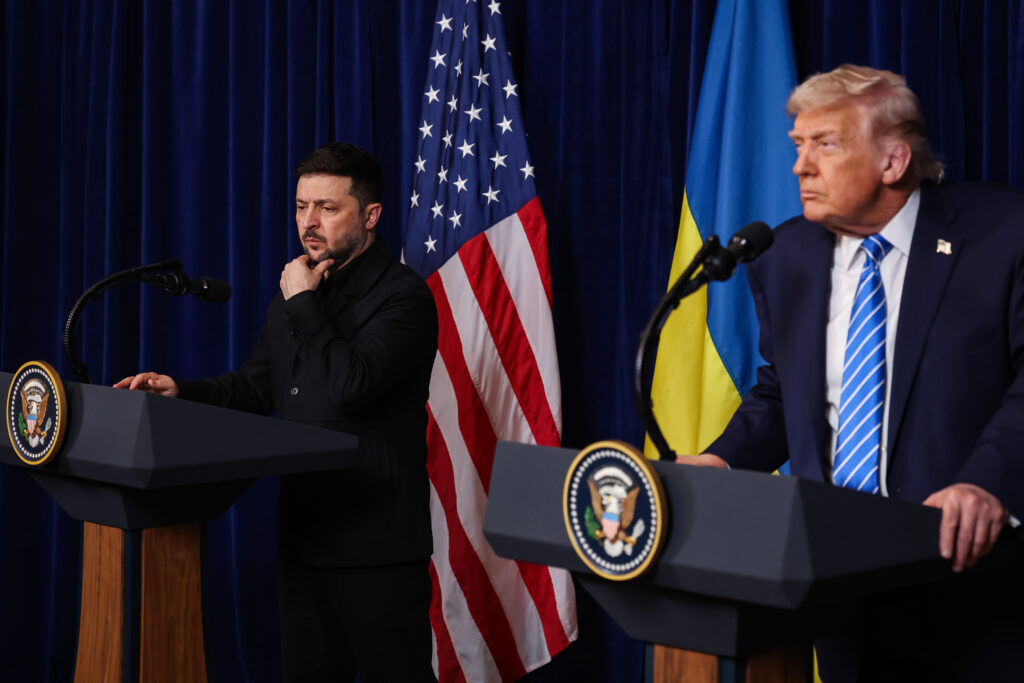
All the while, confronted with Trumpian aggression but constrained by their own lack of agency, European leaders are stuck dealing with an Atlantic-sized chasm between their private reactions and what they allow themselves to say in public.
The good news from our poll is that despite the reticence of their leaders, Europeans are both aware of the state of the world and in favor of a lot of what needs to be done to improve the continent’s position. As we have seen, they harbor no illusions about the U.S. under Trump. They realize they’re living in an increasingly dangerous, multipolar world. And majorities support boosting defense spending, reintroducing mandatory conscription, and even entertaining the prospect of a European nuclear deterrent.
The rules-based order is giving way to a world of spheres of influence, where might makes right and the West is split from within. In such a world, you are either a pole with your own sphere of influence or a bystander in someone else’s. European leaders should heed their voters and ensure the continent belongs in the first category — not the second.



Follow