



LONDON — Dorian Gerhold already had his doubts about plans for a Holocaust memorial in the heart of Westminster when he discovered something unexpected.
“I spent a morning at the London archives, and it was very easy to find that there was actually an act of Parliament that said that the southern part of Victoria Tower gardens could not be built on,” he recalled.
The retired parliamentary clerk, who for 33 years walked to work through the small strip of green on the north side of the River Thames, had begun researching the proposals for a memorial out of curiosity about how the site was chosen.
His discovery in 2018 proved a serious setback to an initiative begun four years earlier under David Cameron’s government, which set up a commission to plan a monument to ensure that “in 50 years’ time the memory and lessons of the Holocaust will be as strong and as vibrant as today.”
Twelve years and several changes of prime minister later, construction on the site, on the north side of the River Thames, has not yet begun. Ministers were forced to legislate to repeal the building ban discovered by Gerhold — and that bill is still crawling its way through parliament.
Far from commanding national consensus, the endeavor has driven a wedge between politicians, local residents and Jews in Britain.
Supporters believe the project has already been delayed for too long. They say its completion is all the more urgent because the Holocaust is receding further from living memory. But its vociferous critics fear the memorial will oversimplify the U.K.’s relationship with its past, and fudge questions about present-day antisemitism.
Martin Stern, who survived concentration camps at Westerbork and Theresienstadt, told POLITICO there is “parochialism” to the way the Holocaust is remembered today.
“I narrowly survived because, for some reason, my name and my sister’s name were not on the list when children were being loaded for the train to Auschwitz. It’s very close to me, but that doesn’t mean I want everybody just to be deeply immersed in only about me.”
‘Striking and prominent’
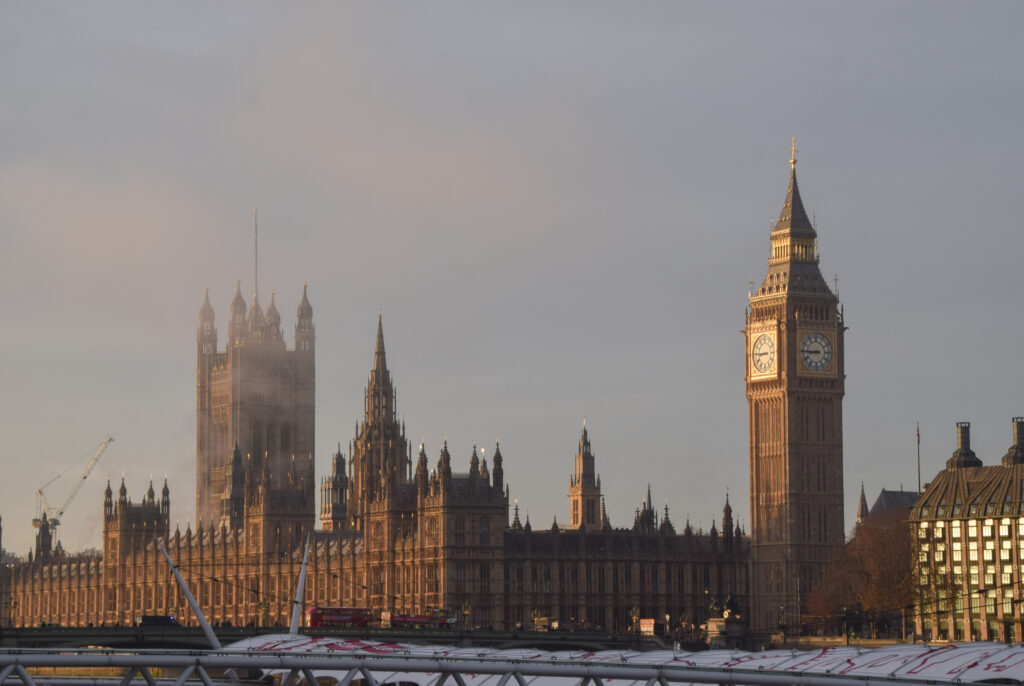
There is almost no aspect of the memorial, which will feature 23 large bronze fin structures and an underground learning center in the park next to the Palace of Westminster, which isn’t contested.
Most hotly debated of all is the location. A site was not specified in the original Commission report, which stated only that the new memorial should be “striking and prominent.”
A year after the report, Cameron announced it would be built in Victoria Tower Gardens to “show the importance Britain places on preserving the memory of the Holocaust.”
The choice sparked consternation among local residents and users of the park, who complained it would dominate the space and detract from its existing monuments, the Burghers of Calais and a memorial to the anti-slavery campaigner Richard Buxton.
After the government threw its weight behind the Westminster location, it was subject to several legal challenges, which were decided against the site and eventually necessitated legislation to override the relevant statute.
Others have criticised the placement on security grounds. Alex Carlile, a lawyer, crossbench peer and former reviewer of counter-terror legislation, has argued that placing it so close to parliament is a “lure to terrorists.”
The design and cost of the memorial have attracted further criticism. The fin-like structure was devised by David Adjaye, a renowned British-Ghanaian architect who has since faced allegations of sexual harassment, which he denies.
Ruth Deech, a crossbench peer whose father arrived in Britain after fleeing Poland at the start of the Second World War, said: “As soon I saw the design and the concept, I felt instinctively it did not do honor to my grandparents, my family, because the design is meaningless.”
“The Jewish tradition of remembering departed souls would be a light,” she added. “That’s what you do for people who die. You don’t build something that looks like a dinosaur’s rib cage.”
The memorial, which will be partly funded by the taxpayer with additional money from donations, has ballooned in cost from an estimated £50 million at its inception to £138.8 million in 2023.
How to remember
The concept of a “learning center” has also proved to be a fraught one.
Stern balked at the term, arguing: “The concept of education is much deeper than the concept of learning… If you’re having a center in London that is intended to teach people about these things, to provide a national resource, it needs to be much bigger.”
Deech warned that it will give “a very, very limited, almost misleading account of Britain and the Holocaust when what we really need is an overall exposition of a whole of Jewish life in Britain over 1,000 years.”
There was until recently a Jewish Museum based in north London, which closed its doors two years ago due to lack of funds.
Opponents have raised concerns about the contents and focus of the learning center — in particular, the prospect that it could become a more generalized exhibit about genocides, which does not treat the Holocaust as distinct.
Members of the House of Lords recently passed an amendment designed to ensure it would specifically commemorate the mass slaughter of Jews by the Nazis. Discussions about how to enact this requirement are ongoing, according to one person working on the bill, granted anonymity to speak freely — part of the reason it has not yet been scheduled to return to parliament.
But Deech’s more fundamental fear is that the effect of the Westminster memorial will be to “package the Holocaust in an airtight box — it was 80 years ago. It was German. It was nothing to do with us. Much better today. And that is simply not working anymore.”
At this point, the memorial’s historical focus smashes up against the present. Some argue it will make present-day antisemitism worse, locating it conveniently in the past while acting as a physical lightning rod for anti-Jewish hatred.
One lawyer, who has carried out research on legal challenges to the site and asked to remain anonymous due to his other public duties, claimed it would “protect the dead but not the living.”
Urgent case
Yet those who have been involved with the project from the beginning insist it is all the more needed in light of the October 7, 2022 attacks on Israel and the war in Gaza.
Eric Pickles, a Tory peer who until recently served as the U.K.’s special envoy for post-Holocaust issues, said that the objection the memorial would not engage with wider antisemitism “has no basis in reality.”
He told POLITICO the site would have “a great importance in terms of getting out a very solid message against antisemitism” and would “ensure that the narrative after the last survivor is gone is one that’s going to be built on truth and honesty and verifiable fact.”
Pickles defended Victoria Tower Gardens as “exactly the right location, right next to Parliament, because ultimately, the Holocaust shows you what happens when governments decide to use all the resources of the state to kill their citizens.”
He also stressed that opposition was not universal among local residents, and mostly amounted to “special pleading” by people “who didn’t want this memorial to be near their property.”
Olivia Marks-Woldman, chief executive of the Holocaust Memorial Day Trust, highlighted the link between the function of the memorial and its location.
She said that “to have a physical, tangible memorial in the heart of London will be a focal point for a lot of the learning and the commemorations and a reminder of how the Holocaust impacted in Britain.”
Marks-Woldman resisted the idea that it will paint Britain’s wartime record in a wholly positive light, pointing out that “while Kindertransportees have rebuilt their lives here… their parents weren’t allowed in, and mostly their parents were murdered.”
The long-running debate over the monument has perhaps touched on something wider about the British fondness for raising objections, particularly over building projects.
As Danny Finkelstein, a Conservative peer who has recently taken on American far-right commentator Nick Fuentes, has written: “Really you can find some sort of case against everything. Even against creating a small exhibition centre for people to learn how bad the Nazis were.”
Barring a massive volte-face, plans for the memorial will clear their legal hurdles this year and work will begin — but deep skepticism about the wisdom of the project is unlikely to fade.



Follow