



BRUSSELS — European governments have reached a difficult conclusion: The Americans are the baddies now.
As leaders of the EU’s 27 countries assemble in Brussels for an emergency summit Thursday, that assessment is predominant across almost all capitals in Europe, according to nine EU diplomats. These officials come from countries which have varying degrees of historic fondness of the U.S., and they made clear that this way of thinking is particularly stark in places that have previously had the strongest ties to Washington.
The sense of dread and skepticism remains, and the summit will still go ahead, despite Donald Trump declaring late Wednesday that he’s struck a deal on Greenland and won’t impose tariffs on European countries after all — underscoring how the gathering has become more than just about the latest blowup.
The U.S. president’s designs on Greenland, which he set out earlier in the day in Davos, Switzerland, demanding “immediate negotiations” to obtain the island, have come as a last straw for many leaders. Throughout the first year of his second term, they had clung to the hope that their worst fears about the country that has underpinned European security since 1945 wouldn’t be realized.
But the moment for making nice “has ended” and “the time has come to stand up against Trump,” Anders Fogh Rasmussen, former NATO secretary-general and ex-Danish prime minister, told BBC radio.
Several of the envoys that POLITICO spoke to for this article, all of whom were granted anonymity because of the sensitive nature of their work, said they felt personally betrayed, some having studied and worked in the U.S. or having advocated for closer transatlantic ties.
“Our American Dream is dead,” said an EU diplomat from a country that has been among the bloc’s transatlantic champions. “Donald Trump murdered it.”
Europe’s collective realization is likely to be in evidence at the summit ― not merely in potential decisions to prepare for retaliatory trade measures against the U.S., should Trump reverse course again and push ahead with his claims on Greenland.
It will also be apparent in the statements leaders are likely to make to each other in private and then publicly. French President Emmanuel Macron foreshadowed that in his own speech in Davos, saying Europe had “very strong tools” and “we have to use them when we are not respected, and when the rules of the game are not respected.”
Limited relief
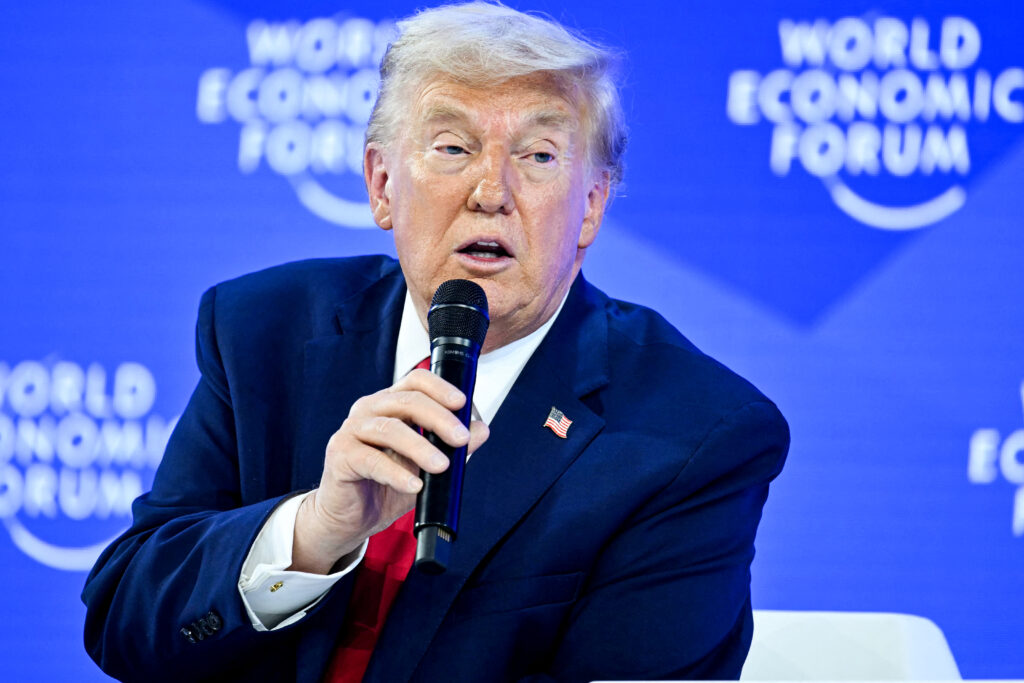
Trump’s speech at Davos, during which he called Denmark’s self-governing island “our territory,” did nothing to dial down the temperature 24 hours before the leaders’ hastily arranged gathering in the Belgian capital to discuss their next response to the disintegrating postwar order.
While Trump ruled out the use of military force to seize Greenland, EU governments didn’t regard this as a climbdown because of the harshness of his language about Europe in general and clear confirmation of his intentions, according to two EU diplomats.
Trump did eventually walk back his threat of issuing tariffs on the eight European countries which he considered to be standing in his way on Greenland, but by that point, things were already too far gone.
“After the back and forth of the last few days, we should now wait and see what substantive agreements are reached between [NATO Secretary-General] Mr. Rutte and Mr. Trump,” Germany’s Vice Chancellor Lars Klingbeil told German broadcaster ZDF. “No matter what solution is now found for Greenland, everyone must understand that we cannot sit back, relax, and be satisfied.”
The moment the U.S. president threatened those tariffs on Saturday was when the schism “became real,” said an EU diplomat.
“Maybe this push gets us a few months, maybe it’s a more permanent thing,” said another, referring to Trump’s about-face. “I think [Trump’s] speech earlier today will give food for thought in most if not all capitals, tariffs or not.”
European Commission President Ursula von der Leyen summed up the mood during her Davos speech Tuesday.
“The world has changed permanently,” she said. “We need to change with it.”
At their summit, EU leaders will discuss the state of the transatlantic relationship. Prior to Trump’s tariff climbdown, they were preparing to ask the Commission to ready its most powerful trade weapon against the U.S., the Anti-Coercion Instrument (ACI), as POLITICO reported on Tuesday.
The EU created its “trade bazooka” in 2023 to deal with the threat posed by what it perceived as hostile countries, most notably China, which it feared were using their markets and their economies to blackmail the EU into doing their bidding. The idea that Brussels would deploy it against the U.S. had previously been unthinkable.
“We are experiencing a great rupture of the world order,” said a senior envoy from a country that was seen in the EU as a key American ally. Leaders will discuss “de-risking” from the U.S., the diplomat said — a term that has previously been reserved for the EU’s relationship with Beijing. “Trust is lost,” they said.
The therapy summit
The summit will be akin to “therapy,” said one EU official familiar with the preparation for the European Council. It will provide an opportunity for the leaders to issue a concrete response to Trump’s Davos speech and subsequent claim of a deal.
The assessment that the U.S. is no longer a reliable ally has come gradually. The scales first fell from Europe’s leaders’ eyes when the Trump administration published its National Security Strategy in early December, in which it vowed to boost “patriotic European parties” to the detriment of the EU. (Which may go some way to explaining why some EU leaders, like Hungary’s Viktor Orbán, are still clinging to Trump.)
Then, Trump renewed his rhetoric about taking Greenland, the U.S. ambassador to Iceland called himself the governor of the 52nd U.S. state, and Trump sent a letter to Norwegian Prime Minister Jonas Gahr Støre, in which he said that his failure to be awarded the Nobel Peace meant he would “no longer feel an obligation to think purely of Peace.”
One senior EU envoy said they were convinced the letter was a fake. Its authenticity was then confirmed.
Two senior diplomats POLITICO spoke with separately compared the current state of the U.S. with the time leading up to World War II.
“I think we are past Munich now,” said one, referring to a 1938 meeting where Britain, France and Italy appeased Adolf Hitler by allowing him to annex Czechoslovakia. “We realize that appeasement is not the right policy anymore.”
The abrupt decline of U.S. standing has been particularly painful for Denmark, which Trump called “ungrateful” in Davos.
Copenhagen has been shocked by his behavior, having for decades been among America’s most friendly allies. Denmark deployed forces in support of the U.S. to some of the most dangerous combat zones in the Middle East, including Helmand Province in Afghanistan. The country suffered among the worst per-capita losses of life.
“So many of us have studied in the U.S., we all wanted to work there,” said one Danish official. “This is simply betrayal.”
Gabriel Gavin, Nicholas Vinocur, Tim Ross and Nette Nöstlinger contributed reporting.



Follow