



A futuristic EU soldier stands guard, laser blaster at the ready. European fighter jets zoom through the sky over thumping Eurodance beats. An imaginary map shows a vastly enlarged EU, swallowing everything from Greenland to the Caucasus.
Welcome to the wild world of pro-Europe online propaganda, where the EU isn’t a fractious club of 27 countries but a juiced-up superpower on par with China or the United States, only wiser and more cultured.
This type of content, which re-imagines the EU as a pan-European empire, a European Federation or the United States of Europe — take your pick — has flooded social media platforms over the past two years, garnering billions of views collectively on X, TikTok and Instagram as the EU has reeled from Russia’s invasion of Ukraine and a U.S.-EU trade deal decried as “humiliation” for Brussels in many parts of Europe.
In the face of withering attacks from U.S. President Donald Trump, who called European leaders “weak” in an interview with POLITICO, as well as anti-EU tirades from X owner Elon Musk, such pro-EU memes are flowing thicker and faster than ever.
Its mainstays are Soviet-style propaganda posters featuring the EU’s ring of stars emblem, video montages with soaring drone shots of European monuments and memes where the EU’s strengths — from its laid-back work culture to rich cultural heritage — are favorably compared to other parts of the world, namely Donald Trump’s America.
Scrolling through these posts, it can be tempting to shrug off the entire trend as meaningless “AI slopaganda” (AI-generated content does loom large). Indeed the hyper-confident Europe envisioned by accounts with names like “European propagandist” or “Ave Europa” bears little resemblance to the actual EU, where leaders remain divided over everything from how to finance Ukraine’s war next year to what reforms should be undertaken to reverse a long trend of economic decline.
But for the people behind these accounts, the point isn’t to stick too closely to the day-to-day reality of EU politics. It’s to generate a sense of agency, vision and possibility at a time when bullying from Trump, expansionism from Russia and competition between U.S. and China have left young Europeans feeling powerless. POLITICO reached out to 11 of the users behind the accounts and learned that they were real people with widely differing political views ranging from left-wing to the hard-right, and used different terms to describe where they stood on Europe. Some called their beliefs “Eurofed,” short for European federalist. Others described themselves as pan-European imperialist, emphasizing the notion of a European “civilization” to defend rather than any existing political setup.
One thing they all had in common: They were under the age of 35. “People are looking to escape powerlessness… to regain action and sovereignty and act on things,” said Christelle Savall, president of the Young Federalists Association Europe, a non-profit advocacy group that has existed since 1972 but has recently seen a surge in membership
For years, Europe’s dominant political narrative has been that the far right is ascendant and the only question is how much further it will rise and how much more it will corrode the eighty-year-old project that grew out of the ashes of World War II to become the European Union. These online warriors believe that is flat-out wrong and that the future lies with a stronger Europe, a view reflected in a growing swell of opinion in the real world. Just as the MAGA online movement mirrored and fueled the rise of Trump before the 2016 presidential election, Europe’s online glowup is reflected in polls showing support for the EU at an all-time high.
Strong majorities of Europeans across all age groups now favor more deeply integrated security and defense, according to the 2025 Eurobarometer survey. Another poll across nine European countries showed that most Germans — 69 percent — favor the creation of an EU army, a prospect often scoffed at by sitting leaders as a pipe dream.
And there are hints that, far from existing in an online vacuum, this youth-driven burst in pro-EU feelings can also help to win elections. Rob Jettens, the 38-year-old centrist who recently won the most votes in Dutch elections, is one of the gang as far as some young federalists are concerned. A pan-European party called Volt Europa, which defines itself as centrist or center-left, has grown its footprint significantly since its launch in 2017, including a foothold in the European Parliament.
“The center right Eurofed group is more and more turning from an online phenomenon to a real-life movement… They try to create something akin to a centrist to right-wing alternative to Volt,” wrote the holder of the X account European Challenges, who described himself as a 25–35-year-old STEM graduate in high-tech. I agreed to grant him anonymity due to concern about being “doxxed” or harassed by other social media users and not wanting users to focus on his nationality, which would be evident from his name.
For Joseph de Weck, a foreign policy analyst and author of a biography on French President Emmanuel Macron, this surge in youthful patriotism is being missed by leaders and many media outlets who are obsessively focused on the far-right. “It’s a fundamental mistake… Public opinion has changed,” he said.
The reality, he argues, is that Europe’s far-right itself is no longer, for the most part, anti-European but merely critical of certain policies emanating from Brussels, like its push for net zero carbon emissions. The big political fight in coming years won’t be over whether to dismantle the European Union, he argues, but over which version of a more federalist bloc will prevail. “No one is putting into question the existence of the EU anymore, but they fundamentally disagree [on] what they should do,” he added.
A fragile union
The idea that Europe — ground zero for two world wars — should abolish national borders and form up into a unified polity isn’t new. In 1849, speaking to the International Peace Congress in Paris, French author Victor Hugo predicted that “a day will come when you France, you Russia, you Italy, you England, you Germany, you all, nations of the continent, without losing your distinct qualities and your glorious individuality will be merged closely within a superior unit and you will form the European brotherhood.”
That idea was forgotten at the outset of a 20th century marked by savage nationalism. But it reemerged forcefully in the aftermath of World War II, when a group of European countries formed the European Economic Community in 1957. Six years later, in a speech to the Irish Dáil, former U.S. President John F. Kennedy called for a “United States of Europe,” urging leaders to form a “political federation of Europe, not as a rival to the United States but as a partner.”
In subsequent decades the European Union, which was formally created in 1992, massively expanded its membership to 28 countries and more than 500 million citizens, and even after Brexit it has 27 countries and 450 million citizens. The union made the huge leap of abolishing border controls between some countries in 1995, introduced a single currency, the euro, in 1999, and over time created the Schengen free travel zone.
But that’s about as far as things got. Kennedy’s vision of a “United States of Europe” ran headlong into the nationalism of leaders like France’s Charles de Gaulle, who famously poured cold water on the prospect of a European federalism. “States, once created, have their own existence that cannot be dissolved. They are irreversibly individual,” he wrote in his “Memoir of Hope” published in 1970.
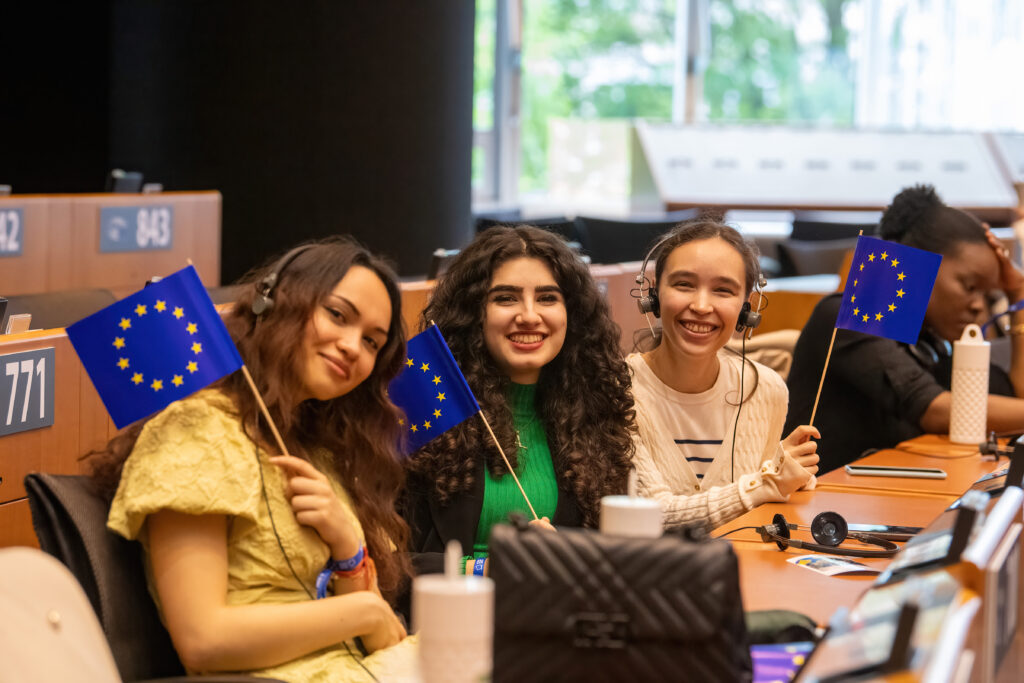
While endorsing expansion, European leaders have consistently resisted taking any steps that would turn the EU into a real federation — namely an integrated army and a fiscal transfer union where tax resources are seamlessly redistributed. Even after the Covid-19 pandemic, which saw EU capitals centralize aspects of health policy in Brussels, and Russia’s full-scale invasion of Ukraine, which has led to some centralization of defense policy, the mood that now prevails among Europe’s leaders is one of “euro-realism” — code for, don’t try anything crazy, it will only help the far-right.
Even Macron, who swept to power in 2017 in France with a staunchly pro-European campaign, seems to have given in to the prevailing mood.
Mario Draghi, a former Italian prime minister and ex-central bank chief whom many federalists hold up as their mascot, has acknowledged as much. Given widespread reluctance to rock the boat, he argued in an October speech that Europe should embrace “pragmatic federalism,” i.e. coalitions of like-minded countries acting in concert on specific areas of interest instead of any big leaps forward.
Czechia’s outgoing foreign minister, Jan Lipavsky, described the current attitude among EU leaders as “not idealistic” in a recent POLITICO interview. A few days later, Belgium’s defense minister brushed off the idea of a European army. “Anyone who believes in a European army is selling castles in the air,” he told local outlet Humo.
Reddit sub-group battles
Yet it so happens that castles in the air — i.e. big jumps forward — is exactly what Europe’s young boosters want, and they’re tired of hearing that they’re too idealistic. “A direct election of the commission president… is absolutely necessary. As long as that doesn’t happen, the EU will not get more trust,” the European Challenges account holder wrote to me in a DM.
Savall says young Europeans yearn for politicians who can articulate a strategic view of where Europe is headed, rather than fighting out the domestic political battle of the day. “There’s long-term [vision], but no one is selling it,” she said, noting that membership in her group grew 6 percent in 2024 to 10,000. In October, with other pro-federalist groups, it relaunched the Action Committee for a United States of Europe which had been dormant for decades. A key driver for new adherents was the EU-U.S. trade deal inked by European Commission President Ursula von der Leyen in Turnberry, Scotland, which was widely panned as a humiliation for the bloc. “It was disappointing because Europe’s power was its trade mandate. Soft power was commerce,” said Savall.
Other pro-federalist or pan-European groups report a similar jump in membership. Membership in Ave Europa, a federalist group founded in March of this year which describes itself as “center-right”, has gained 400–500 members since its launch. Board member Nikodem Skrobisz wrote that the tense Oval Office meeting last February between Ukrainian President Volodymyr Zelenskyy and Trump, in which Trump and Vice President JD Vance berated their guest, had spurred the group’s launch. “A wave of Europatriotism swept the continent in defiance to the Trumpist attempts to humiliate our continent,” he wrote in a message to me. “The subsequent trade and tariff disputes further demonstrated that Europe can no longer rely on others to defend its interests; and with every MAGA attack against Europe, we saw a new wave of recruits boost our ranks.”
Not all pro-Europeans share the same roadmap, however. “I think the term ‘European federalism’ is just misplaced for this day and age… Europe will probably head towards greater centralization and will more closely resemble a confederation of some sorts,” said Alex Asgari, a Czech-American 25-year-old lobbyist in Washington, D.C., who previously worked as a Republican aide in the U.S. House of Representatives.
Indeed, federalists are far from being a politically homogenous group. Several meme warriors told me that there is an ideological battle ongoing in the dank recesses of federalist Reddit subgroups and chatrooms between broadly centrist people who believe in boosting the power of existing Brussels institutions, and far-right people who hate Brussels but nonetheless want Europe to assert itself on the world stage. The big divider is identity politics and migration policy: far-right groups tend to envision Europe as a culturally and ethnically homogenous “empire” — read, white and Christian, preferably Catholic — that keeps foreigners out.
“I limit potential membership to countries that have a Latin-European model of social life… only a Civilisationally homogeneous state has the right to function stably,” said the user of an account named Sacrum Imperium, a 30-year-old law student whom I agreed not to identify by name because they said expressing political views in public could be detrimental to their career. The user also voiced skepticism about Brussels, advocating limited competences for EU institutions. “The optimal division of competences… should provide for tasks at European level only those that are necessary and cannot be carried out at national level,” they added.
Europe or bust
For de Weck, the point is not that these young Europeans don’t see eye to eye, but that their frame of reference is Europe — not the domestic political debate of France, Germany or any other EU member country. This marks a profound shift compared to 2016, when Britain’s vote to leave the European Union was widely seen as heralding other EU exits, and euroskeptic politicians ranging from France’s Marine Le Pen to Austria’s Sebastian Kurk and the Netherlands’ Geert Wilders dominated headlines.
Indeed, a big factor linking pro-Europe online users is their youth. With all reporting their age as under 35, these Europeans may or may not have witnessed the last big surge of euro-idealism around the turn of the century, when the euro currency was introduced in several countries and the overtly pro-EU movie “The Spanish Apartment” (L’Auberge Espagnole” originally) promoted Europe’s Erasmus student program as an ideal way to find love. But they have all been through what came after this period of optimism: terrorism, a surge in migration, the rise of far-right parties across Europe and, more recently, Russia’s aggressive expansionism and the collapse of a U.S.-led post-World War II order.
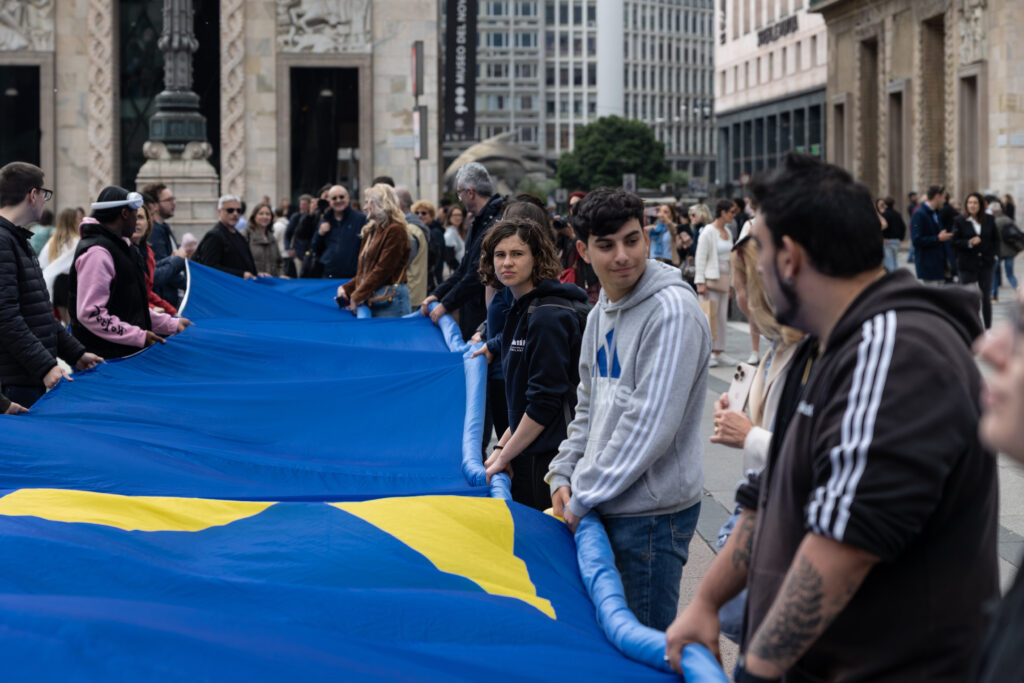
Such upheavals, combined with other problems — like grinding economic decline and an ageing population — have painted Europe as a victim, or at least a losing party, in the minds of many youths. It’s a feeling that these people are rebelling against — and one that may well fuel the rise of a new generation of much more Europe-minded, if not overtly federalist, politicians in coming years.
For now, it’s still populists and their favorite rivals, centrists such as France’s Macron, who continue to occupy headlines. In the past decade hard-right leaders have won elections, becoming prime ministers in Austria and Italy, or political kingmakers, as was the case with Dutch far-right leader Geert Wilders in 2023. The prime minister of Hungary, Viktor Orbán, has been in power since 2010, positioning himself as an arch-opponent of Brussels-based EU institutions.
But the reality is that, unlike in 2016 when Europe feared a wave of Brexit-style “-exits,” none of these leaders now advocates pulling their country out of the bloc. In a recent chat with POLITICO, Orbán’s political director said that despite virulent criticism of the EU as currently configured, Budapest still sees its place firmly within the EU. “We want to be inside. We are part of the club,” said the aide, Balasz Orbán (no relation). Similarly, Czechia’s populist incoming prime minister Andrej Babiš, though no fan of Brussels, has gone so far as to rule out a referendum on his country’s membership in the EU or NATO in his government manifesto.
Could this be the first hint of a tectonic shift in European politics? Ave Europa, the group founded in March, plans to run candidates in the next EU elections. Volt Europa, a pan-European, federalist party, won five seats in the most recent European Parliament elections, and now has 30 national chapters both inside and outside the EU. To grow much bigger, such parties would benefit from a change to the European Parliament’s rules that would allow candidates to compete for a number of EU-wide seats in transnational campaigns, versus the current system whereby campaigns are nationally bound — a change that Savall of the Young Federalists points to as her group’s “No. 1” policy priority.
But to become a reality, it would have to be embraced by the EU’s current leaders, who haven’t shown much interest in recent years. The United States of Europe may not become a reality in the next few months, or even years. But its online cheerleaders are determined to bring that horizon closer — one “EU soldier” meme at a time.



Follow