



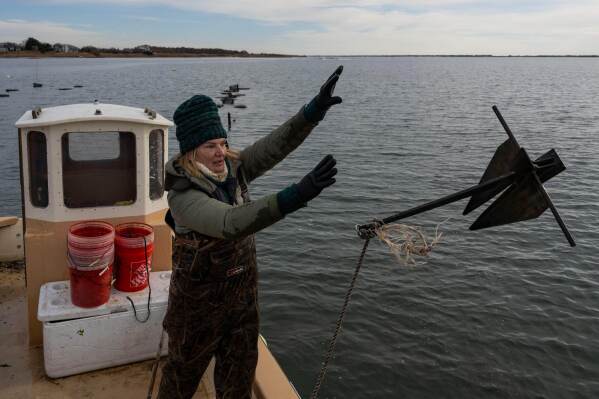
After seven days of wind, the morning is finally calm enough on New York’s East Moriches Bay for Sue Wicks to jetty her boat to check on her oysters. Hundreds of cages pop out at odd angles from their lines, and a few float away.
The retired WNBA star and Hall of Famer admits that the aquaculture farm she started at age 50 can be anxiety-inducing and compares it to her time playing basketball.
Retired WNBA star and Hall of Famer Sue Wicks throws an anchor from her boat in Moriches Bay in New York, Thursday, Nov. 20, 2025. (AP Photo/Yuki Iwamura)
“Some days you’re like, ‘Why am I doing this?’ You’re injured, you’re hurt, you are losing, things are going bad. And then the next day you go back and do it again because you love it,” she said.
Wicks, 59, has worked as a commentator, college basketball coach and at a fitness start-up since retiring from the WNBA in 2002, and says she feels lucky to again find a career “that works for my soul.” But the reality is that even a successful run as one of the world’s best basketball players didn’t earn her enough to fully retire.
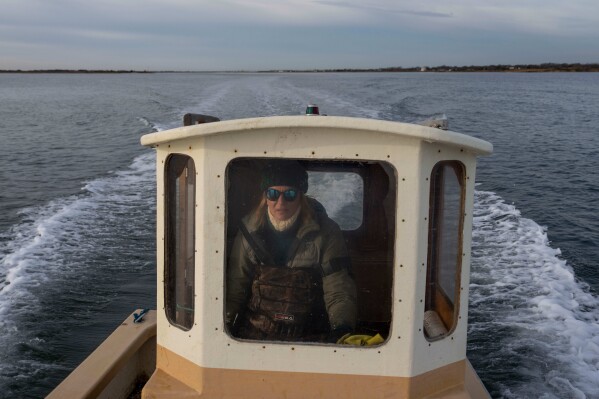
Retired WNBA star and Hall of Famer Sue Wicks rides her boat to check on her oysters in Moriches Bay in New York, Thursday, Nov. 20, 2025. (AP Photo/Yuki Iwamura)
Although the WNBA is bringing in more than ever from sponsors and ticket sales, many players still find themselves financially unsteady when the final whistle blows.
“The choice is what they do as their second career, not whether they have a second career,” said Risa Isard, director of research and insights at women’s sports marketing platform Parity. Since “women athletes get paid a fraction of what men do while they’re playing,” Isard said their next acts tend to look more like traditional career paths rather than managing substantial investment portfolios.
1 MIN READ
1 MIN READ
1 MIN READ
The average NBA salary is around $11.9 million, according to data reviewed by The Associated Press. That’s nearly 100 times what the WNBA says is the average salary of $120,000 for its players — although major differences in league size, age, profit margins and media contracts account for part of that gap.
For 2009 second overall draft pick and 2015 WNBA All-Star Marissa Coleman, the main difference between post-playing careers between WNBA and NBA players is that “most NBA guys are sitting on tens, sometimes hundreds of million dollars.” And for those who are financially savvy, working after the game is “more so curing boredom versus a necessity.”
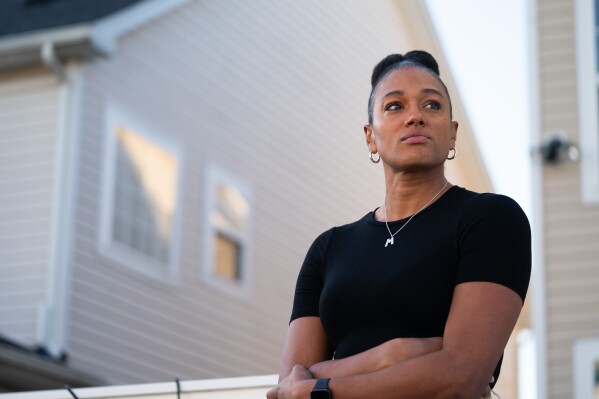
Retired WNBA All-Star Marissa Coleman poses for a photo in Mitchellville, Md., Tuesday, Dec. 9, 2025. (AP Photo/Allison Robbert)
“Most women athletes across the board have to find a career after basketball out of necessity,” Coleman said.
All this is happening against a backdrop of unresolved questions about the future of WNBA player compensation. Tensions have run high in the ongoing labor battle between the WNBA and the players’ union, although it is unclear how far apart the sides are in terms of compensation. Both parties agreed on Nov. 30 to an extension of the current collective bargaining agreement to Jan. 9 while negotiations continue.
A major sticking point has been revenue sharing: As the WNBA booms, players are looking for a larger share in that growth. They currently earn a significantly smaller fraction of the league’s revenue compared with NBA players.
When former Minnesota Lynx forward Devereaux Peters transitioned from basketball to real estate development in 2019, she said the hardest lesson was learning that working hard in her new career may not be enough to yield results quickly, or at all. After a tough game during her playing days, she could “go in the gym and shoot and work on my shot. And you’re going to see a result if you’re putting in the work.”
“That is not necessarily true in the real world,” said the 36-year-old. “You can put in a ton of work and do a lot right and not get anywhere.”

Former Minnesota Lynx forward Devereaux Peters, transitioned from basketball to real estate development, poses for a photo at her office in Chicago, Monday, Nov. 24, 2025. (AP Photo/Erin Hooley)
The shift away from basketball also came as a financial shock: “That transition was a little bit difficult in that I had to cut back significantly,” she said. “There was a lot of learning very quickly” given the “big gap in what I was making then and what I make now.”
For the last six years, Peters has shepherded an affordable housing project in South Bend, Indiana — home to her alma mater, Notre Dame. Red tape, politics, and myriad other logistical challenges have made the project “the hardest thing I’ve ever done in my life,” Peters said.
But she says it’s also the best: “Helping people that truly, genuinely need it” makes it all worth it. Her affordable apartment building is slated to break ground next month, and open its doors in August 2027.
For 38-year-old Coleman, the next phase of her career also unfolded far outside the paint. Alongside former teammate Alana Beard, Coleman franchised a Mellow Mushroom — a psychedelic-themed pizza chain — in Roanoke, Virginia. She also chaired a campaign to legalize sports betting in Maryland, and now leads strategy and growth for the VIP team at fantasy sports platform Underdog, with the aim of carving space for more women and people of color to access the industry.
“I knew from a very early age entrepreneurship and business were something that I was really, really passionate about,” Coleman said.
She added that she feels grateful to her parents for emphasizing the importance of education and long-term career planning. Thanks to their wisdom, she made sure to seek out mentors and explore industries that interested her throughout her basketball career.
“I knew I didn’t want to be one of those players that retired, and it was like, ‘Oh gosh, what now?’” Coleman said.
Many former athletes land in sports-related roles, such as coaching or sports broadcasting. But not all are surefooted in finding their next calling.
Jayne Appel Marinelli, SVP of player relations for the league’s union and a former center for the San Antonio Stars, counsels players on their post-basketball career path. She explained the transition remains challenging for many, even with the WNBA and union’s joint tuition assistance and internship program, and semester-long opportunity with Harvard Business School, which Coleman completed.
The players’ union has worked to further expand opportunities by adding player internship slots to licensee contracts, partnering with universities and more, according to Appel Marinelli. Athletes “sometimes need help recognizing that the skills that they have built are so easily transferable over to any role that they’re going to take on next,” she said.
That kind of support didn’t exist for Wicks’ generation at the league’s inception in 1997. There “was no stability in women’s sports,” she said. “Our victory was, we got our next paycheck, and that the lights were on and that the bus was waiting there still.”
Back then, “my dream was that the league would exist,” Wicks said. Almost 30 years later, her new dream is that players “are compensated in a way that gives them freedom to do what they want in life.”
Despite her own post-WNBA success, Peters says players could use more guidance to help them understand how to plan, save and prepare for the future.
“The general lifespan of a basketball player is not long,” she said. “You have to be prepared to not be here tomorrow or the next year.”
________
AP Sports Writers Doug Feinberg in New York and Tim Reynolds in Miami contributed to this report.
The Associated Press’ women in the workforce and state government coverage receives financial support from Pivotal Ventures. AP is solely responsible for all content. Find AP’s standards for working with philanthropies, a list of supporters and funded coverage areas at AP.org.



Follow