



BERLIN — Germany’s far-right Alternative for Germany (AfD) is heading back to the Munich Security Conference (MSC) — reclaiming a seat at one of the world’s most prestigious security forums after being banished for three straight years.
The decision to invite AfD lawmakers to the mid-February gathering marks a significant reversal for the conference and a symbolic win for a party eager to shed its pariah status by rubbing shoulders with global leaders.
The AfD mounted an aggressive campaign beginning late last year to regain access to the MSC, including legal action against conference organizers and attempts to capitalize on relationships with Trump administration officials.
That effort appears to have paid off, at least in part. MSC organizers have invited three AfD parliamentarians to attend this year’s conference, though the party has pushed for more prominent figures — including national co-chair Alice Weidel — to be included.
“The invitations were issued because we made an impression with our contacts to the Americans,” Heinrich Koch, one of three AfD parliamentarians who received an invite, told POLITICO.
Koch, by his own account and that of one of the AfD’s legal representatives, was deployed by the party to gain access to the MSC.
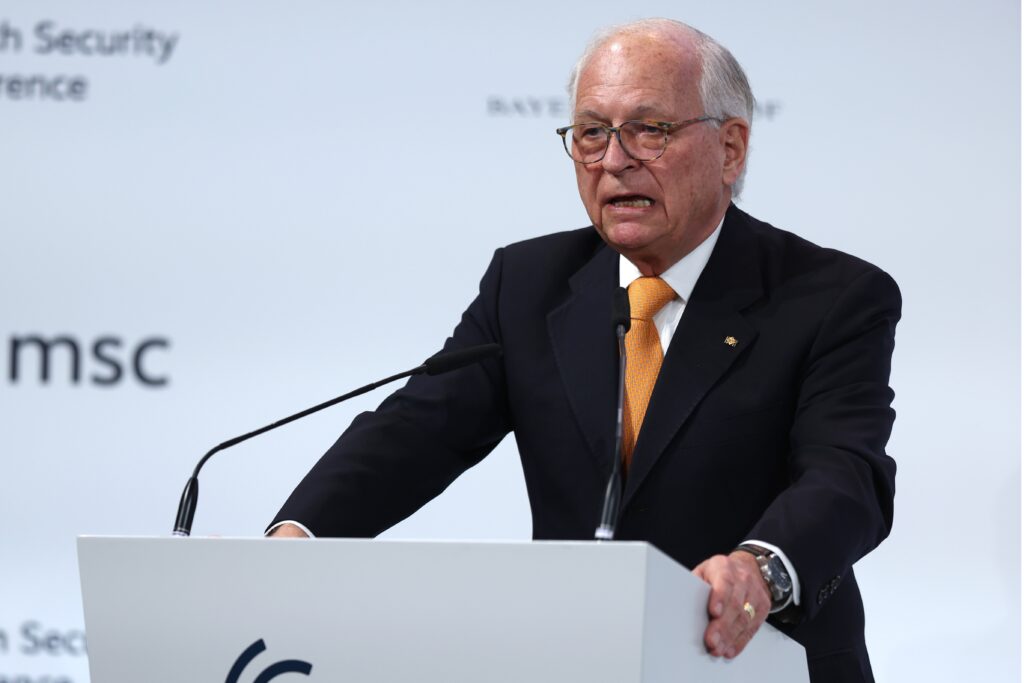
Wolfgang Ischinger, the prominent German diplomat acting as MSC chair this year, denied that conference organizers invited the AfD due to a pressure campaign, framing the decision rather as one that acknowledges a simple political reality: that the AfD is the largest opposition force in Germany.
“It is a decision that we took on our own conscience, if you wish, trying to do the right thing in order to make sure that we would be able to reflect the current reality,” he told POLITICO. “It would be very difficult for the Munich Security Conference — which brings together so many opposing views, adversaries, people who accuse each other [of being] murderers or genocidal people — for us to justify categorically excluding the largest German opposition party.”
Legacy of Nazi resistance
This year won’t be the first time AfD politicians have attended the MSC. During Ischinger’s previous tenure as head of the conference, which lasted from 2008 to 2022, AfD politicians with a focus on defense were invited to the conference.
But since that time, the AfD has come under the increasing scrutiny of national and state domestic intelligence agencies tasked with monitoring groups deemed anti-constitutional, culminating last year in the party’s federal classification as a right-wing extremist organization.
Ischinger’s successor, career diplomat Christoph Heusgen, refused to invite AfD leaders for the past three conferences, arguing that a party deemed at that point to have been at least partly right-wing extremist by intelligence authorities had no place at the event. After all, he argued, the conference was founded after World War II by Ewald von Kleist, one of the aristocratic Wehrmacht officers now revered in Germany for having partaken in the failed 1944 plot to assassinate Adolf Hitler.
“I can well imagine that Ewald von Kleist would have supported my decision against the AfD,” Heusgen told German newspaper Tagesspiegel.
Heusgen stepped aside after last year’s conference, and this year Ischinger is back at the helm. But it was in response to Heusgen’s rejection of the party that the AfD sued late last year to get into the conference this February. The AfD said it was a victim of “targeted exclusion,” according to documents from the Munich regional court seen by POLITICO.
“The plaintiff wishes to be involved in foreign policy and security policy issues in order to have a say as an opposition faction,” the court said. But the court ultimately rejected the AfD’s argument, ruling last December that the MSC, as a private organization, is free to choose whom to invite.
Koch, who was in court on behalf of the AfD parliamentary group, says he pressured the MSC side during the proceeding to invite party members by threatening to come to the conference anyway as guests of the American delegation. Soon after, his party received three invitations, he said.
The MSC denied in emailed comments to POLITICO that such threats had led to the invites.
Empty threats?
The AfD’s threats appear to have consisted mostly of bluster. Koch said he reached out to the office of U.S. Senator Lindsey Graham, who is set to attend the conference, but never heard back from the Republican lawmaker. Graham did not respond to three requests for comment.
The threat nevertheless illustrates how the AfD has sought to utilize past support from the Trump administration to pressure the MSC and, more broadly, to end its domestic political ostracization. The AfD’s effort to get into the MSC can be seen as part of a larger push to knock down the so-called firewall mainstream forces have erected around the far right, precluding close cooperation with the party despite its rising popularity.
In that effort, the AfD has received support from the highest rungs of the Trump administration. At last year’s MSC, U.S. Vice President JD Vance sharply criticized European centrists for excluding the far right, declaring “there’s no room for firewalls.” Following his speech, JD Vance met with AfD national co-leader Alice Weidel in a Munich hotel.
Koch said the AfD would attempt to organize a similar high-level meeting this year, though it’s not clear Vance will attend the February conference. Koch said he has also sought an invitation for Weidel, but the MSC had denied it. The MSC’s Ischinger said he and his team would not issue any further invitations to AfD politicians.
Weidel’s spokesperson, Daniel Tapp, denied that the AfD had used the prospect of another meeting with a high-level Trump administration official to press for invites to the MSC, but said a “certain pressure” had led to three of its lawmakers being invited.
Weidel’s plans for the conference remain unclear. “We will wait and see over the next few days whether anything else develops in this matter,” said Tapp late last month. As of Friday, no meeting involving Weidel and U.S. officials during the MSC had been planned, according to Tapp.
Ischinger said any AfD events occurring outside the confines of the MSC are irrelevant to the conference.
“They can organize a huge conference, you know, if you ask me,” he said. “And it’s not my business to stop them or discuss this with them. It’s their business, but it has nothing to do with the Munich Security Conference.”
POLITICO is an official media partner of this year’s Munich Security Conference.



Follow