



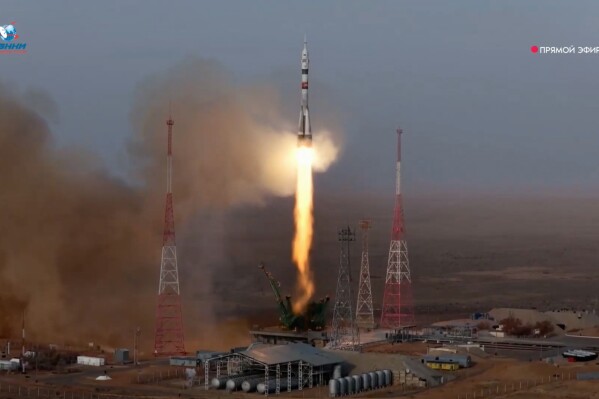
TOKYO (AP) — Japan’s space agency said its H3 rocket carrying a navigation satellite failed to put the payload into a planned orbit, a setback for the country’s new flagship rocket and its space launch program.
Monday’s failure is the second for Japan’s new flagship rocket after its botched 2023 debut flight and six successful flights.
The Japan Aerospace Exploration Agency said the H3 rocket carrying the Michibiki 5 satellite took off from the Tanegashima Space Center on a southwestern Japanese island Monday as part of Japan’s plans to have a more precise location positioning system of its own.
The rocket’s second-stage engine burn unexpectedly had a premature cutoff and a subsequent separation of the satellite from the rocket could not be confirmed, Masashi Okada, a JAXA executive and launch director, told a news conference.
Whether the satellite was released into space or where it ended up is unknown, and that JAXA is investigating the data to determine the cause and other details, Okada said.
Jun Kondo, an official at the Ministry of Education, Culture, Sports, Science and Technology, told reporters that the failure was “extremely regrettable” and that the government set up a task force to investigate the cause and take necessary measures as soon as possible to “regain credibility.”
1 MIN READ
2 MIN READ
1 MIN READ
Monday’s failure is a setback for Japan’s new flagship that replaced the earlier mainstay H-2A which had near-perfect success record. It also delays Japan’s satellite launch plans, including one to have a more independent geolocation system for smartphones, maritime navigation and drones without relying on the U.S. GPS system.
The H3 rocket is designed to be more cost-competitive in the global space market. Japan sees a stable, commercially competitive space transport capability as key to its space program and national security.
JAXA’s H3 project manager, Makoto Arita, said the new flagship is still in the early stages of operation but can be globally competitive. “We will pull ourselves together so that we won’t fall behind rivals. We’ll fully investigate the cause and put H3 back on track.”
Monday’s launch came five days after JAXA aborted just 17 seconds before liftoff, citing an abnormality of a water spray system at the launch facility, following an earlier problem with the rocket.
In its debut flight in March 2023, H3 failed to ignite the second-stage engine.
Japan currently has the quasi-zenith satellite system, or QZSS, with five satellites for a regional navigation system that first went into operation in 2018. The Michibiki 5 was to be the sixth of its network.
Japan currently relies partially on American GPS and wants to have a seven-satellite network system by March 2026 and an 11-satellite network by the late 2030s.



Follow