



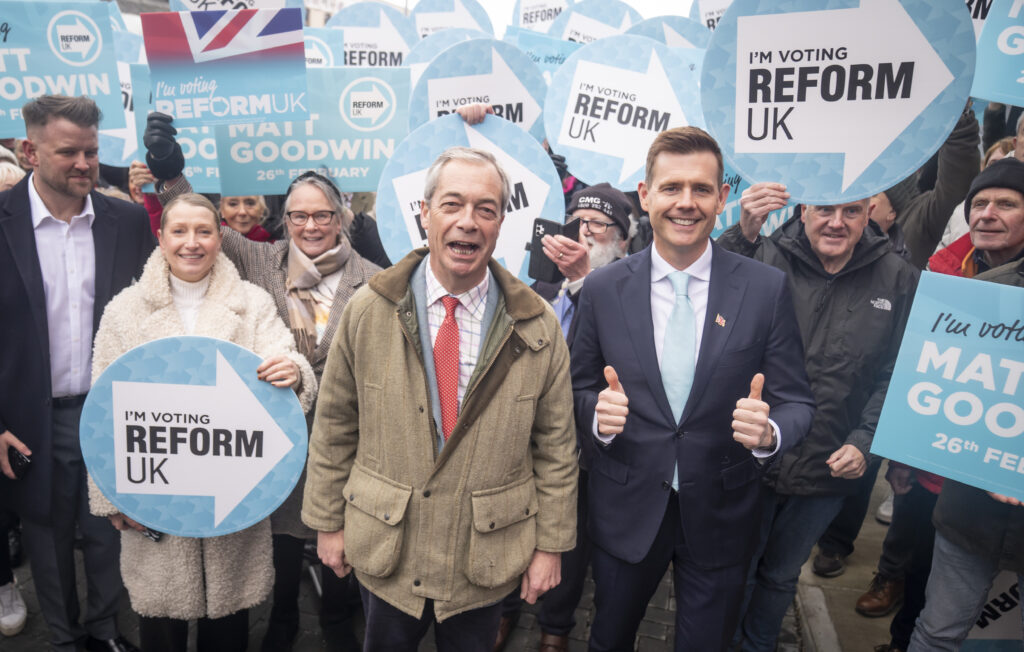
LONDON — Until recently, Reform UK’s foreign policy had been whatever Nigel Farage said it was.
But the party is now attempting to flesh out what position it would take on the world stage should it win power in the next election. And they are starting with the areas where Farage knows he’s vulnerable: Russia and Donald Trump.
Farage has been haunted by comments made in 2014, when he said he “admired” Russian President Vladimir Putin as an “operator” — a stance his supporters insist is out of date and was taken out of context. A decade later he sparked fury by saying the West had “provoked” Russia to invade Ukraine by pushing NATO to expand eastward.
More recently, however, Farage has tried to distance himself from such statements by calling Putin “a very bad dude” and saying the U.K. should shoot down Russian jets in British airspace. His deputy Richard Tice has referred to “the monstrous tyranny of that most evil villain, Putin.”
Farage has also sought to turn the page on one of the most damaging episodes in Reform’s history by naming a new leader for the party in Wales last week, following the imprisonment of ex-Wales leader Nathan Gill for taking Russian bribes.
Damage control
Farage prides himself on being keenly attuned to the pulse of the British people. Lately he has conspicuously tried to pivot away from personal approaches that could turn off voters: namely his perceived ambivalence toward (or even admiration of) Russia.
Tim Montgomerie, a longtime Conservative aide and activist who quit the party for Reform in 2024, told POLITICO: “Yes, Farage has a Russia problem. I think it’s a great lie — but it’s sunk into the consciousness.”
A poll carried out by More in Common last year found that while every voter group in Britain overwhelmingly backed Ukraine over Russia, just 26 percent thought Farage shared their views, and 29 percent said they didn’t know. By comparison, 64 percent thought U.K. Prime Minister Keir Starmer backed Ukraine while 17 percent said they didn’t know.
Behind the scenes the party is making a concerted effort to reassure other European countries about its intentions and worldview should it win power. Reform aides have been holding meetings with foreign diplomats for at least the last six months, five people familiar with the discussions told POLITICO.
The party has also made a point of meeting representatives from Ukraine, according to two people involved, to express their support for Kyiv’s war effort.
In private, however, European diplomats continue to harbor doubts about Reform’s intentions — suggesting Farage still has a mountain to climb.
Three senior officials from Eastern European countries, granted anonymity to speak candidly, said they were concerned by Reform’s stance on Russia — not because they believed Reform was supportive of Russia, but because they found its position unclear.
“Most of the political parties apart from Reform UK have a very strong view,” said one diplomat. “So far Reform UK has not expressed very strong messages of support … We don’t have clarity of what their position on Ukraine is, to be honest.”
A Reform UK spokesperson said: “Nigel Farage has been very clear that Reform fully supports the Ukrainian people and the territorial sovereignty of Ukraine,” adding that a Reform government would defend NATO airspace from Russian aggression and any peace deal between Moscow and Kyiv “should not turn Putin into a winner.”
New right vs. old right
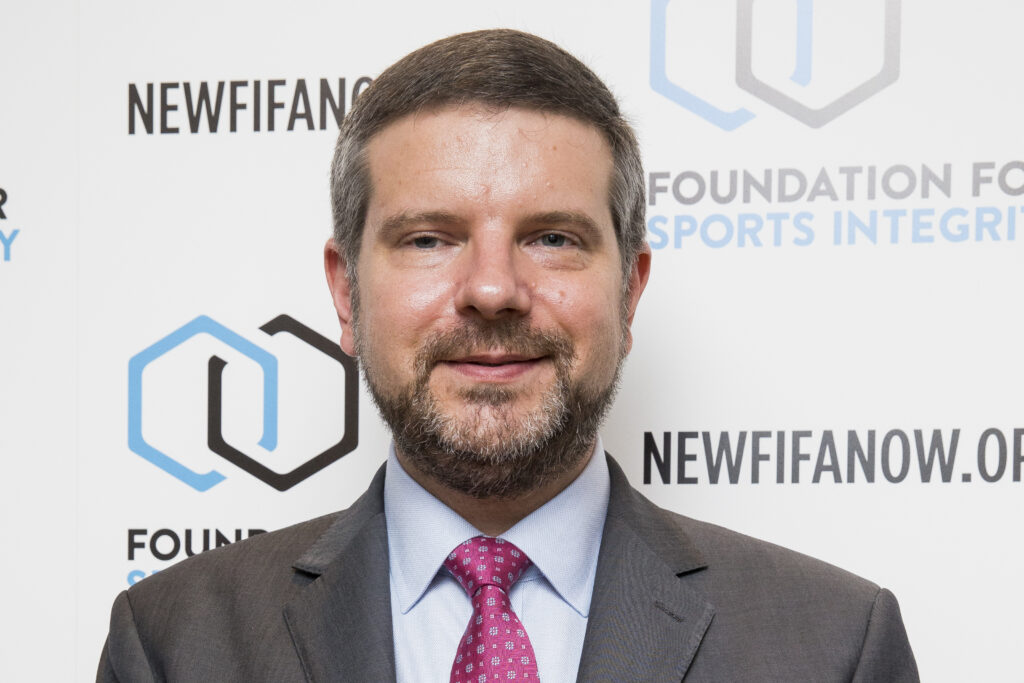
Reform has attempted to steady the ship by recruiting Alan Mendoza, the head of center-right think tank the Henry Jackson Society, as an adviser on foreign affairs.
Yet the appointment highlights a wider tension in the party, between those with more traditional conservative instincts and others who call for a new kind of right-wing radicalism.
Mendoza is hawkish on Russia and is seen by many as a neo-conservative. He is currently trying to build Reform’s foreign policy manifesto for 2029, consulting a council of regional experts.
An ally of Farage, granted anonymity to speak candidly, said: “Alan is quite neocon. And that’s not where the bulk of Reform is — they’re more of a ‘Britain first’ mindset.”
“Britain First” references the Make America Great Again (MAGA) philosophy of more assertive U.S. self-interest espoused by acolytes of Trump and Vice President JD Vance. (Don’t expect that handle to catch on, however — it’s also the name of a fringe far-right party in the U.K.)
While Mendoza has been handed a formal role on foreign policy, he will compete for influence with James Orr, a Cambridge theologian and adviser to Farage. Orr is a friend of Vance and has previously described Russia’s invasion of Ukraine as a “regional Slavic conflict”.
The party insider quoted above said there was a gap between Reform’s leadership, which tends to believe in free trade, and voters who would like to see a more protectionist approach toward both the economy and free speech on social media.
Joshua Treviño, a senior fellow at the America First Policy Institute, said he recognized there were individuals in Britain who “are doing their best to reclaim the Britain to which they’re entitled by birthright. And I think we can only offer them friendship.”
He rejected the idea that MAGA is being “transposed to the U.K.” but said “what unites [European right-wing movements] is also what differentiates them all, which is that they really are focused on their peculiar national interests.”
Facing both ways on Trump
Farage’s relationship with Trump is equally complicated.
Montgomerie said that “Nigel knows that his relationship with Trump is a problem with voters,” as suggested by a recent focus group conducted by More in Common and shared with POLITICO.
Farage’s close links to Trump are well known, and the Reform leader has recently put distance between himself and his old friend by condemning his ambitions to acquire Greenland outright and calling his latest tariff threats “wrong.”
Yet the Reform leader was keen to claim credit for lobbying the Trump administration over Starmer’s beleaguered deal to hand sovereignty of the Chagos Islands to Mauritius.
His allies say Farage still has good lines into the White House, with one noting: “It’s not like he picks up the phone to Trump constantly. But he knows who to speak to to get to Susie Wiles or Scott Bessent, and he does it sparingly.”
A U.S. official acknowledged there was now a twin-track diplomacy within the transatlantic relationship, with “differing U.K. interests pushing their sides” in conversations with the White House.
For now it suits Reform to have it both ways — criticizing individual statements by Trump, while keeping channels of communication open.
Party insiders recognize, however, that a course correction on Russia and America is only part of the picture. Farage has weighed in on Starmer’s efforts to reset relations with China, and has toured Davos, the UAE, the U.S. and Dubai to drum up financial support.
Reform board member Gawain Towler, who has been touring Australia and New Zealand to meet likeminded politicians there, predicted Farage would only become more visible on the world stage.
“What you’re seeing is an outreach,” he said. “Because if we are in a position of winning, if we do end up as a government, we need to be talking to people. We need to have spoken to them beforehand — we can’t go in completely blind.”
Dan Bloom and Eli Stokols contributed to this report.



Follow