



As a frontline NATO heavyweight, Poland is seething at being relegated to the diplomatic sidelines on a potential peace deal in Ukraine.
When leaders from the U.K., France, Germany and Ukraine gathered in London this week to align their stances on Washington’s fast-moving push for a peace deal, Poland wasn’t to be found on the guest list. It was the second snub in as many months, after Warsaw also missed an invitation to a crunch peace summit in Geneva on Nov. 23.
Poland’s exclusion from the top table is a bitter blow for a country that has taken one of the EU’s most active positions on Ukraine — and the right-wing nationalist camp around President Karol Nawrocki has wasted no time in blaming liberal Prime Minister Donald Tusk for the flop.
“Poland’s absence in London is yet another example of Donald Tusk’s incompetence,” Marek Pęk, a senator from the nationalist Law and Justice party, raged after the Downing Street meeting, calling Tusk “a second-tier politician in Europe.”
The reasons for Polish frustration are clear. Poland not only hosts 1 million Ukrainian refugees and acts as the key supply hub for Ukraine, but Warsaw also plays a pivotal role in pressing Europe toward rearmament. Poland is NATO’s highest per capita spender on defense and wants to more than double its military — already the alliance’s third biggest — to 500,000 personnel.
Tusk on the margins
Tusk has also betrayed some frustration at Poland’s exile to the diplomatic margins. After the meeting in Geneva, he asked to be added to the joint European communiqué — a face-saving request that Warsaw commentators said merely underlined Poland’s absence.
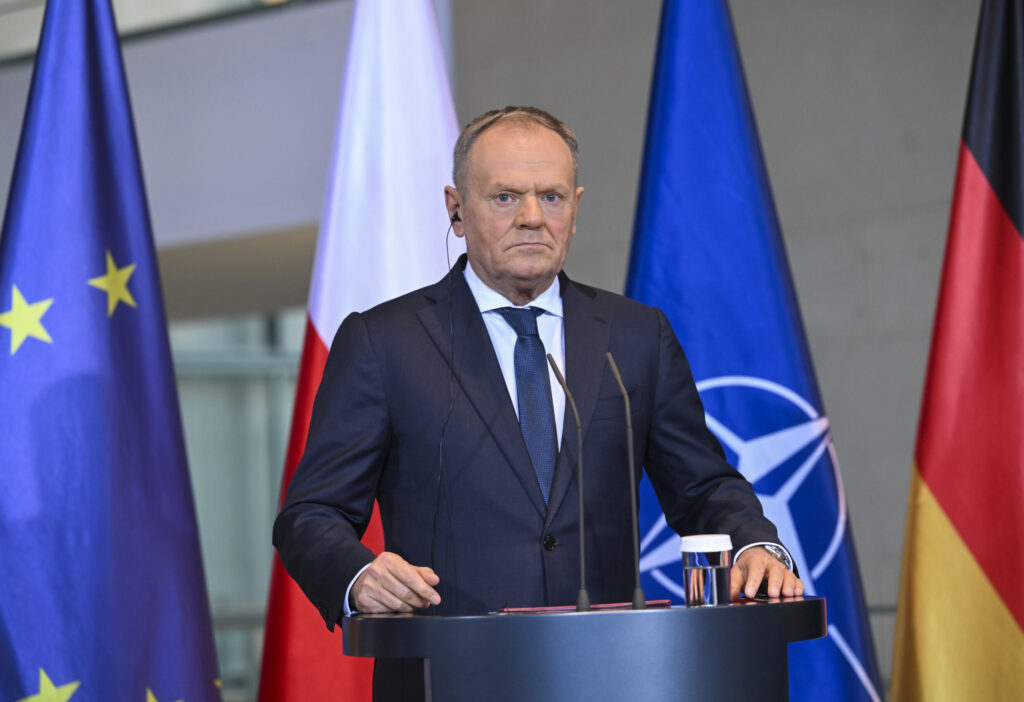
In Berlin last week, standing beside German Chancellor Friedrich Merz, Tusk tried to defuse the awkwardness over the diplomatic rebuff to Poland with a touch of irony.
“I don’t want to stir emotions, but let’s say this plainly: Not everyone in Washington — and certainly no one in Moscow — wants Poland to be present everywhere,” he said, before adding that he took this banishment — presumably a reflection of Poland’s dogged defense of Ukraine — “as a compliment.”
The government insists nothing unusual occurred in London. The format “was proposed by Prime Minister [Keir] Starmer,” government spokesperson Adam Szłapka said, arguing that “there are dozens of such formats, and they change constantly. Not every format produces results, and Poland does not have to — and should not — participate in all of them.”
He noted that Foreign Minister Radosław Sikorski had joined a call with Ukrainian President Volodymyr Zelenskyy and Starmer after the meeting — proof, he said, that Poland “remains fully engaged.”
Polish officials are also quick to point out there are no actual peace negotiations with Russia, at least for now. “These are snapshots, not the architecture,” one diplomat said of Warsaw’s absences. “It’s too early for hysteria.” The diplomat, like others in this story, was granted anonymity to speak freely on a topic of political sensitivity.
From playmaker to bystander
In the early years of the war, Poland was impossible to ignore. It sent much of its arsenal to Ukraine, cajoled Berlin into sending Leopard tanks to Kyiv, and served as NATO’s indispensable logistics hub, most notably from an airbase near the city of Rzeszów.
But much of that leverage has faded.
Poland’s Soviet-era weapons stocks are depleted and its vast rearmament drive won’t free up anything it can spare abroad for years.
Meanwhile, France, Germany and the U.K. are now promising new air-defense systems, long-range missiles and — crucially — are willing to contribute troops to any future monitoring or peacekeeping mission in Ukraine. Even if they are just that — promises — Poland has already ruled that out.
In discussions now centered on cease-fire enforcement and security guarantees, past support matters less than deployable assets, and Kyiv has adjusted accordingly. Zelenskyy is now leaning heavily on capitals that can bring something new to the table.
“Americans don’t want us, European leaders don’t want us, Kyiv doesn’t want us — so who does?” former Prime Minister Leszek Miller said after the London talks. “Something unpleasant is happening, and we should stop pretending otherwise.”
Former President Bronisław Komorowski, a political ally of Tusk, argued that Poland’s absence reflected geopolitical realities, not diplomatic failure.
London brought together “the three strongest European countries” — politically, militarily and economically — the ones contributing the most to Ukraine’s war effort, he said. Poland, he added, “is simply weaker,” and while Europe values Warsaw’s role, it must be “in line with its real weight.”
Split-screen diplomacy
Poland’s quest for diplomatic heft is hardly helped by its difficulties speaking with one voice abroad.
As Tusk focuses on European coordination efforts, nationalist opposition-backed President Nawrocki has been busy building up his own foreign-policy credentials, jetting off to Washington, cultivating contacts around Donald Trump’s administration, and speaking publicly about Poland’s “independent voice.”
The two sides exchange frequent jabs. Tusk recently reminded Nawrocki that the Polish constitution entrusts foreign policy to the government, not to the presidency. Despite the theatrics, both camps share the same hard line on Russia.
What they don’t share is a strategy for navigating Washington.
Government officials acknowledge Nawrocki currently has more direct access to the White House.
His senior foreign policy adviser, Jacek Saryusz-Wolski, puts it bluntly: “Trump will never meet Tusk. He will meet the president. Thanks to him, Poland still has a channel to Washington.”
Nawrocki’s circle argues this gives him leverage Tusk can’t match. Without access to Trump, Tusk “adds nothing distinctive” to high-level Western conversations, Saryusz-Wolski told POLITICO. In his view, unless someone with the president’s standing asserts Poland’s interests at the highest level, the country will simply follow whatever compromise Paris, Berlin and London shape with Washington.
Officials concede privately that a channel to Washington matters — and for now, Nawrocki has it.
Still, they also warn that betting everything on a single, unpredictable U.S. president is risky, especially after the new U.S. security strategy openly signaled that Europe must take far greater responsibility for its own defense.
The consequence of Nawrocki handling diplomacy with Trump while Tusk deals with Europe is that it can look like two foreign policies at once.
“The problem is not Poland’s position,” said a senior Western European diplomat, referring to the country’s pro-Ukraine stance. “The problem is knowing who speaks for Poland.”
If it’s any consolation to Tusk, Germany’s Merz insists that he is taking Warsaw’s position into account.
“My position toward Poland is very clear: We do nothing without close coordination with Poland,” the chancellor told Tusk last week.



Follow