



ROME — Italian Deputy Prime Minister Matteo Salvini faces a battle to save his far-right League party from electoral oblivion.
The party’s internal crisis exploded into public view last week after Salvini’s maverick deputy, Roberto Vannacci, an ex-general and defender of fascist dictator Benito Mussolini, threatened to form a splinter party to the right of the League called National Future.
Salvini seeks to play down the split with his No. 2, but Vannacci’s move revealed starkly how the League — a key part of Prime Minister Giorgia Meloni’s right-wing ruling coalition — risks disintegrating as a political force before next year’s elections.
Current and former party members told POLITICO that Salvini’s rift with Vannacci had exposed a deeper and potentially devastating factional struggle at the heart of the party — between moderates and extremists, and over whether the League should return to its roots ad seek northern autonomy from Rome.
In the short term, weakness in the League could bring some relief to the Atlanticist, pro-NATO Meloni, who is prone to irritation at the anti-Ukrainian, Kremlin-aligned outbursts of Salvini and Vannacci, who are supposed to be her allies. In the longer term, however, the party’s full implosion would potentially make it harder for her to build coalitions and to maintain Italy’s unusually stable government.
Public feud
The tensions between Salvini and Vannacci became impossible to disguise last month.
On Jan. 24 Vannacci registered a trademark for his new National Future party. He later distanced himself from an Instagram account announcing the party’s launch, but hinted on X that he could still turn to social media to launch a party when the time was ripe. “If I decide to open such channels, I will be sure to inform you,” he said.
By Jan. 29 Salvini was in full firefighting mode. Speaking before the stately tapestries of the Sala della Regina in Italy’s parliament, he insisted there was “no problem.”
“There is space for different sensibilities in the League … we want to build and grow, not fight,” he added, vowing to hold a meeting with Vannacci to set the relationship back on course.
Many in the League are more hostile to Vannacci, however, particularly those alarmed by the former paratrooper’s placatory language about Mussolini and Russian leader Vladimir Putin. A powerful bloc in the League that is more socially moderate — and deeply committed to northern autonomy — is pressing for Salvini to take the initiative and fire Vannacci, according to two people involved in the party discussions.
Daniele Albertazzi, a politics professor and expert on populism at the University of Surrey, said a schism looked imminent. “[Vannacci] is not going to spend years building someone else’s party,” Albertazzi said. “It’s clear he doesn’t want to play second fiddle to Salvini.”
From asset to liability
Vannacci emerged from obscurity in 2023 with a self-published bestseller “The World Back to Front.” It espoused the Great Replacement Theory — a conspiracy that white populations are being deliberately replaced by non-whites — and branded gay people “not normal.” More recently he has stated he prefers Putin to Ukrainian President Volodymyr Zelenskyy.
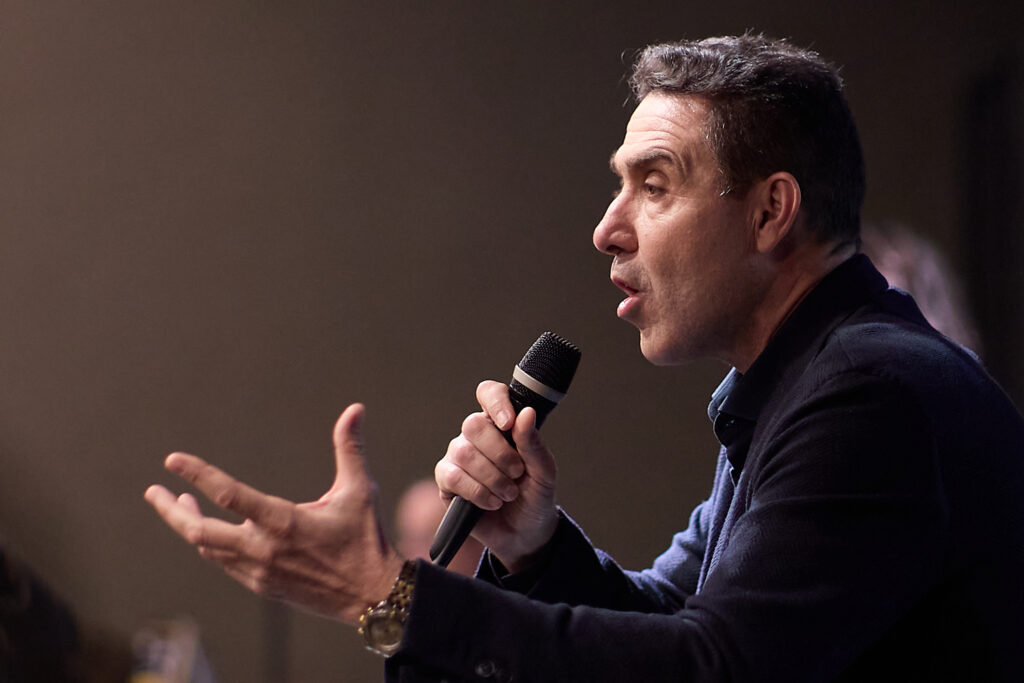
Albertazzi said Vannacci was positioning himself on the extreme right. “You can see it even in the typography of his symbol [for National Future], which evokes the fascist era,” he said.
Salvini originally identified the military veteran as a lifeline who could reverse the League’s flagging fortunes.
Salvini had early success in transforming the League from a regional party “of the north” into a national force, and it won a record 34 percent of the Italian vote in the 2019 European elections. But by 2022 things were souring, and support collapsed to about 8 percent in the general election. Vannacci was brought in to broaden the party’s appeal and shore up his own leadership.
The gamble initially paid off. In the 2024 European elections, Vannacci personally received more than 500,000 preference votes — roughly 1.5 percent of the national total —validating Salvini’s strategy.
But Vannacci has since become a liability. He was responsible for a failed regional campaign in his native Tuscany in October and has flouted party discipline, building his own internal group, opening local branches and organizing rallies outside the League’s control, operating as “a party within a party.” In recent interviews Vannacci has increasingly flirted with the idea of going solo with his own party.
For the traditional northern separatist camp in the League, Vannacci has gone too far. Luca Zaia, head of the Veneto regional assembly, a towering figure in northern politics, and three other major northern leaders are now demanding privately that he be expelled, according to two League insiders.
“His ideas are nationalist and fascist, and have never been compatible with the League,” said a party member, who was granted anonymity to discuss sensitive internal disputes. “The writing is on the page. Since the first provocation it has been clear that it is only a matter of when, not if, he starts his own party.”
An elected League official added: “Now if he gets votes it’s Salvini’s fault for giving him a ton of publicity. No one had heard of him before. He basically won the lottery.”
Attilio Fontana, a senior League official who is president of the Lombardy region, said Vannacci’s actions raised questions for Salvini.
“I think that if inside the party there are differences, that can enrich the party. But creating local branches, holding demonstrations outside the party, registering a new logo and website, this is an anomaly … these are issues that [Salvini] will be looking at,” he told reporters in Milan on Friday.
Every vote counts
There’s no guarantee any party Vannacci launches will be a success. Three leaders in his “World Back to Front” movement — seen as a precursor to his National Future party — quit on Friday, issuing a statement that described a lack of leadership and “permanent chaos.”
But his party could upset the political landscape, even if he only peels off relatively minor support from the League. Meloni will have a close eye on the arithmetic of potential alliances in the run-up to next year’s election, particularly if left-wing parties team up against her.
Polling expert Lorenzo Pregliasco of You Trend, which is canvassing a potential new party led by Vannacci, said it had a potential electorate on the right of the coalition of about 2 per cent, among voters who had supported [Meloni’s] Brothers of Italy, League voters and non-voters with an anti immigrant, anti-political correctness stance, who are attracted by Vannacci’s outspokenness.
The potential party “poses some risks for Meloni and the coalition … It’s not a huge electorate but in national elections two points could make the difference between winning and not winning, or winning but with a very narrow majority that could mean you were not able to form a government.”
Vannacci “has been clever in putting himself forward as a provocative opinion leader and converted this into electoral success … He has the potential to be a strong media presence and central to political debate.”
The northern separatist Pact for the North movement, led by former League MP Paolo Grimoldi, said Salvini’s reputation was now damaged because of the faith he put in Vannacci.
While Salvini could resign and support an alternative figure such Zaia as League leader, this was extremely unlikely, Grimoldi told POLITICO. “If not, there aren’t tools to get rid of him before the next election,” he added.
“The result will be political irrelevance and electoral defeat [for the League].”



Follow