



HONG KONG (AP) — Low-priced Chinese electric vehicles and cheap e-commerce goods are gaining ground in Latin American countries like Brazil and Mexico and local governments and industries are growing alarmed.
Latin America plays a strategically important role for China as Beijing forges closer ties with fast growing markets like Brazil and Chile.
Chinese automakers and other manufacturers facing sluggish demand as the economy slows are targeting customers abroad. Mexico, Brazil and Chile are among countries which have rolled out measures to curb some cheap Chinese imports, looking to protect their own industries.
Here are the main takeaways from AP’s report:
Chinese imports flood Latin American markets
With prices lower than their competitors thanks to massive government subsidies and support and low production costs, Chinese car brands are zooming into Latin America.
More than 80% of the over 61,000 EVs sold in 2024 in Brazil were Chinese brands, predominantly BYD and GWM. In Mexico, sales of Chinese-made cars accounted for about 15% of the domestic market last year, according to a Mexican automotive industry group, a stark contrast to how the U.S. has been keeping Chinese cars out of its market with hefty tariffs.
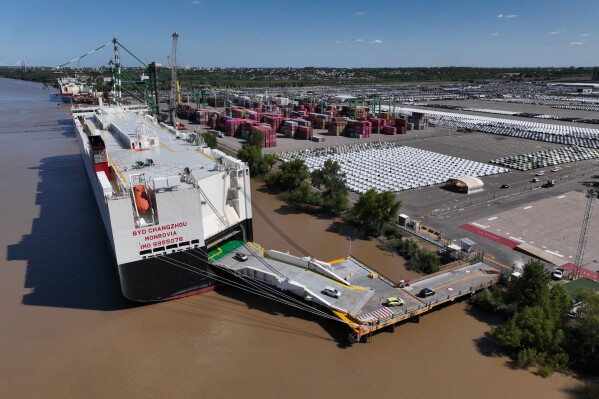
Chinese carmaker BYD, which overtook Tesla as the world’s biggest EV maker, recently unloaded from its vessel more than 5,800 EVs and hybrid vehicles in Argentina, racing to profit from a policy allowing up to 50,000 electric and hybrid vehicles to be imported tariff-free.
7 MIN READ
5 MIN READ
2 MIN READ
Low-priced goods from Chinese e-commerce platforms, led by Temu and Shein, also are flooding Latin American markets.
China is catching up fast in technologies and innovation in products such as EVs, said José Manuel Salazar-Xirinachs, executive secretary of the Economic Commission for Latin America and the Caribbean which is headquartered in Chile. “You can’t think of China as an exporter of anything that’s, let’s say, basic anymore,” he said.
Mexico, Brazil are hitting back to protect their industries
China needs Latin America’s vast natural resources for its hungry industries, from lithium in Brazil to copper in Chile and fishmeal in Peru. But trade deficits with China have been growing across the region as its global surplus rose to a record $1.2 trillion last year.
Mexico’s trade deficit with China was $101 billion between January and October 2025, while Argentina’s trade deficit with China rose to nearly $8.2 billion last year.
China’s exports to Mexico surged roughly 150% between 2017 and 2024, according to research from ING Bank, as shipments of autos and auto parts more than tripled.
To protect local industries, Mexico has imposed tariffs of up to 50% on imports from China, including autos, appliances and clothing. Brazil is eliminating or phasing out “de minimis” import tax exemptions for overseas parcels costing less than $50, in part to target cheap imports from China. It also is increasing tariffs on EV imports. Chile has raised tariffs and began charging a 19% value-added tax on low-value parcels starting in October.
Latin America has limited leverage on China
In most cases, China exports mostly manufactured goods from Latin America and imports raw materials. But the relationship goes far beyond those basics.
China provided loans and grants to countries in Latin America and the Caribbean in 2014-2023 worth roughly $153 billion — the largest source of official sector financing for the region — compared to approximately $50.7 billion that the U.S. provided, according to AidData, a research lab at William & Mary, a public university in Virginia.
That means for every dollar donated or lent by Washington, Beijing provides $3.
State-backed Chinese companies also have made massive investments in dams, mines and other infrastructure across the region.
“There may be deep concern about competitiveness, but politically, many countries don’t feel they have the space to resist China’s export surge,” said Margaret Myers, director of the Asia and Latin America program at the Inter-American Dialogue think tank in Washington. “The relationship has become too important economically.”
___
Sá Pessoa reported from Sao Paulo, Brazil. Janetsky reported from Mexico City. AP journalists Isabel DeBre in Buenos Aires, Argentina, Nayara Batschke in Santiago, Chile, Tatiana Pollastri in Sao Paulo, Brazil and Fabiola Sánchez in Mexico City also contributed.



Follow