


DAVOS, Switzerland — The European leaders gathered for Donald Trump’s speech to the World Economic Forum, Wednesday, were once again reminded of the key principle that has guided the U.S. president’s foreign policy: “It’s important to make me happy.”
That was the rationale Trump gave for ordering the capture of Venezuelan strongman Nicolás Maduro earlier this month, and it formed the throughline of his address in Davos as well.
Despite their best efforts to get in his good books, they have struggled to dissuade him from his attempt to take over Greenland or to keep him focused on helping Ukraine. His highly anticipated speech in Davos will likely have done little to ease their alarm and confusion about how to play him.
Unlike his predecessors, Trump doesn’t observe the courteous fiction that the transatlantic alliance is one of equals. He has stripped all that away; his approach to diplomacy is that he is the boss and his allies need to understand their places.
Time and again, he has put Washington’s transatlantic allies on the spot — from last April’s “Liberation Day” global tariffs to the roughing up of Ukraine’s Volodymyr Zelenskyy in the Oval Office, from his red-carpet Alaska summit with Vladimir Putin to his recent threats to annex mineral-rich Greenland come what may.
The one reassuring takeaway in his hour-and-twelve-minute-long speech in Davos, sections of which reprised his White House press conference on Tuesday night, was that he ruled out taking Greenland by force. “We would be frankly unstoppable. But I won’t do that,” Trump told world leaders at Davos, adding: “I don’t want to use force, I won’t use force.”
That will have come as a relief, as he has several times previously declined to rule out invading the Arctic island.
His bid to wrest Greenland from Denmark, a fellow NATO member, on the grounds of countering Russia and China has left the U.S.’s traditional European allies fearing an immediate rupture in transatlantic relations.
Earlier this month Mette Frederiksen, the Danish prime minister, had warned that an American invasion of Greenland would mark the end of NATO and “therefore post-Second World War security.” The American military intervention in Venezuela only added to the panic, especially after Trump followed it with a threat to impose punitive tariffs on the countries that opposed him.
Aside from taking force off the table, there was little else in the speech that European leaders will find reassuring. From the beginning, he used the occasion to bash Europe.
“I love Europe, and I want to see Europe go good, but it’s not heading in the right direction,” he said. In citing mass migration as the cause, he echoed the criticism contained in the recently released U.S. National Security Strategy as well as the blistering assault his vice president, JD Vance, delivered at the Munich Security Conference last year.
“Certain places in Europe are not even recognizable anymore,” Trump said. He also complained about NATO, saying that the alliance offers “little in return” for U.S. support and that the institution should be grateful to him: “You wouldn’t have NATO, if I didn’t get involved in my first term.”
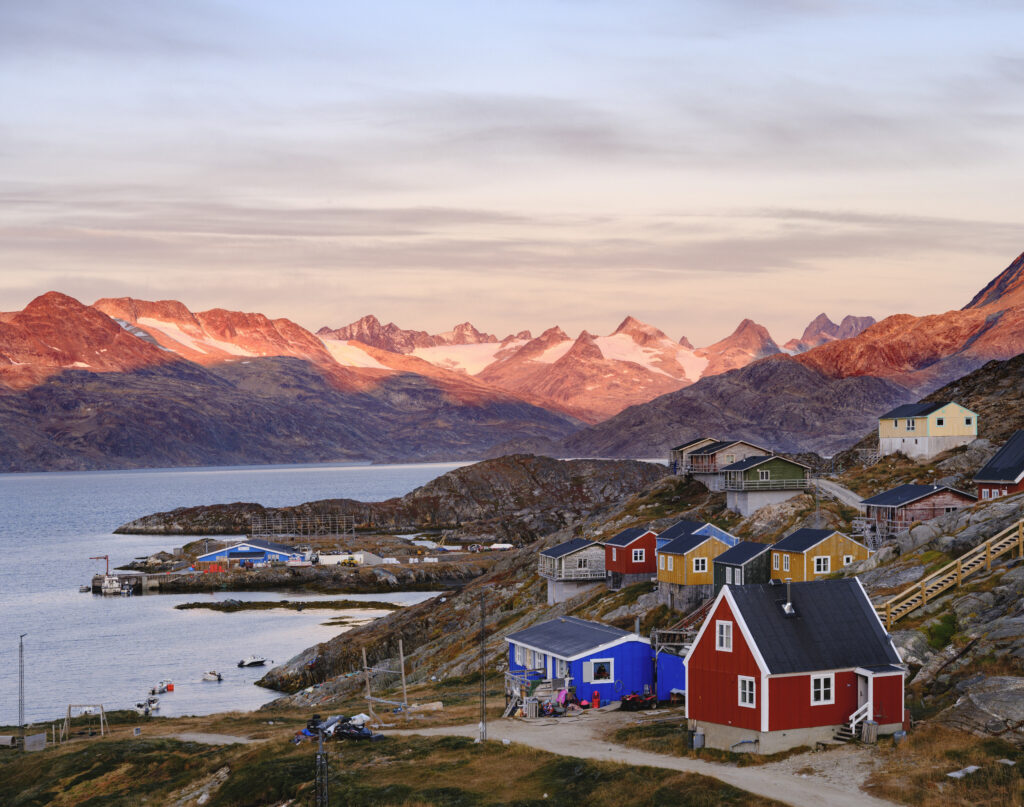
On Greenland, Trump argued Denmark doesn’t have the capacity to protect the island. “It’s costing Denmark hundreds of millions a year to run it. Denmark is a small country.”
“[Greenland] is very expensive,” he added. “It’s a very big piece of ice. It’s very important that we use that for national and international security. That can create a power that will make it impossible for the bad guys to do anything against the perceived good ones.”
He went on to demand “immediate negotiations” to begin the acquisition of the Arctic island, and concluded darkly: “You can say yes and we will be very appreciative, or you can say no, and we will remember.”
He didn’t mention the tariffs he threatened last weekend to impose but concluded with a long tale about tariffs he imposed on Switzerland in the past, possibly as a warning.
That leaves Europeans faced with a question: Whether to hit back with tough economic countermeasures, as France’s Emmanuel Macron has urged, and risk Trumpian escalation, or contort themselves as much as they can and try to distract and deflect him, their usual strategy.
Despite tough rhetorical push-back by Macron and Canada’s Mark Carney, and European Commission President Ursula von der Leyen’s call for a “new form of European independence,” some leaders still hold out hope that while the transatlantic alliance is now fractured, a full rupture can still be avoided.
One of the sessions at Davos this year was entitled “How to tackle fear as a leader.” The more important behind-the-scenes discussions involving leaders of America’s allies this week could be accurately titled: How to tackle a fearsome leader. And those discussions will continue long after the World Economic Forum is over.


Follow