



The Netherlands’ Queen Maxima has joined her country’s army as a reservist, voicing concern about national security.
Maxima, 54, “has chosen to register now because our safety can no longer be taken for granted,” according to a statement released Wednesday by the Dutch royal family, “and she, like many others, wants to contribute to that safety.”
After training with the Royal Netherlands Army, the Argentinian-born Dutch queen will be promoted to the rank of Lieutenant Colonel, and “like other reservists, she will deploy where needed,” the royal family’s statement said.
Netherlands Ministry of Defense 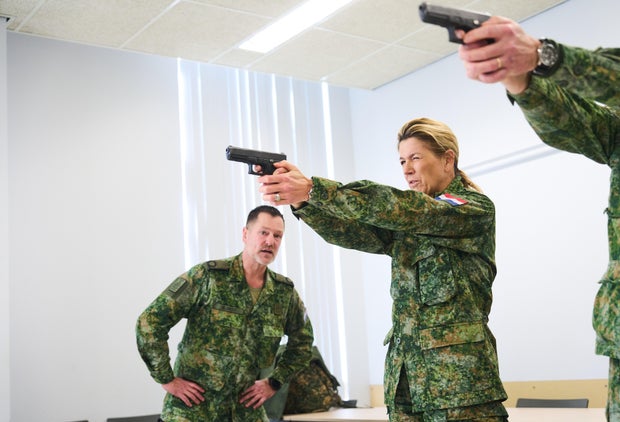
Photographs released by the family show the queen taking part in “Mental Skills” training at the Dutch Royal Military Academy in Breda, in the south of the country, taking part in various exercises. In one she is seen aiming a handgun.
An accompanying video set to high-energy rock-dance music shows Maxima smiling in green army fatigues before jumping into a pool, then rock climbing in a helmet.
Queen Maxima is not the first member of a European royal family to serve in their respective country’s armed forces. Her own daughter Princess Catharina-Amalia recently finished her military training and was promoted to corporal.
Netherlands Ministry of Defense 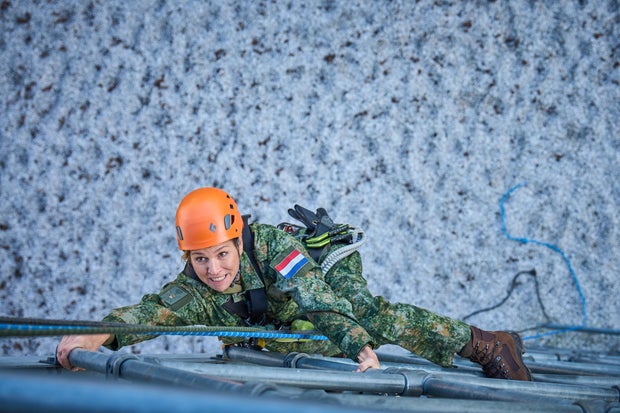
Last year, Norway’s Princess Ingrid Alexandria finished 15-months of service as a gunner in an engineering battalion. And Princess Leonor of Spain is in the last of three years of training across the Army, Navy and Air Force.
Many members of Britain’s royal family, living and dead, have also served in the forces – including King Charles II, his son Prince William and his younger son Prince Harry, who served two tours in Afghanistan.
A European army?
Russia’s invasion of Ukraine, and the perceived unpredictability of the U.S. as a staunch NATO ally, have shaken Europe’s sense of security in recent years.
President Trump has pushed European countries to dramatically boost their domestic defense spending and reduce what he sees as their reliance on U.S. forces in NATO. He also recently tried to wrestle Greenland away from Denmark, causing a rift in the alliance, and even threatening allies with tariffs before backing down.
In January, European Union Defense Commissioner Andrius Kubilius said the EU should consider having a 100,000-strong joint military force, separate from NATO.
“We need to start to invest our money in such a way that we would be able to fight as Europe, not just as collection of 27 national ‘bonsai armies,'” he said.
Conscription across Europe
“We refuse to remain dependent on others for our protection,” the Netherlands’ newly formed coalition government said last week, adding that it will require young people to complete a mandatory survey about military service.
“If this does not yield sufficient results,” the government said, “we will consider other steps, such as reintroducing selective compulsory attendance.”
Nine European NATO member states already have some form of conscription: Denmark, Estonia, Finland, Greece, Latvia, Lithuania, Norway, Sweden and Turkey.
Croatia plans to reintroduce mandatory military service this year, compelling men between the ages of 19 and 29 to undergo two months of basic training, and several other countries – including France and Germany – have recently introduced schemes to incentivise young people to serve.



Follow