



LONDON — Prime Minister Keir Starmer usually goes out of his way not to annoy Donald Trump. So he better hope the windmill-hating U.S. president doesn’t notice what the U.K. just did.
In a fillip for the global offshore wind industry, Starmer’s government on Wednesday announced its biggest-ever down payment on the technology.
It agreed to price guarantees, funded by billpayers to the tune of up to £1.8 billion (€2.08 billion) a year, for eight major projects in England, Scotland and Wales.
The schemes have the capacity to generate 8.4 gigawatts of electricity, the U.K. energy department said — enough to power 12 million homes. It represented the biggest “wind auction in Europe to date,” said industry group WindEurope.
It’s also an energy strategy that could have been tailor-made to rankle Trump.
The U.S. president has repeatedly expressed a profound loathing for wind turbines and has tried to use his powers to halt construction on projects already underway in the U.S. — sending shockwaves across the global industry.
Even when appearing alongside Starmer at press conferences, Trump has been unable to hide his disgust at the very sight of windmills.
“You are paying in Scotland and in the U.K. … to have these ugly monsters all over the place,” he said, sitting next to Starmer during a visit to his Turnberry golf course last year.
The spinning blades, Trump complained, would “kill all your birds.”
At the time, the prime minister explained meekly that the U.K. was seeking a “mix” of energy sources. But this week’s investments speak far louder about his government’s priorities.
The U.K.’s strategy — part of a plan to run the British power grid on 95 percent clean electricity by 2030 — is a clear signal that for all Starmer’s attempts to appease Trump, the U.K. will not heed Washington’s assertions that fossil fuels are the only way to deliver affordable bills and secure supply.
“With these results, Britain is taking back control of our energy sovereignty,” said Starmer’s Energy Secretary Ed Miliband, a former leader of the Labour party.
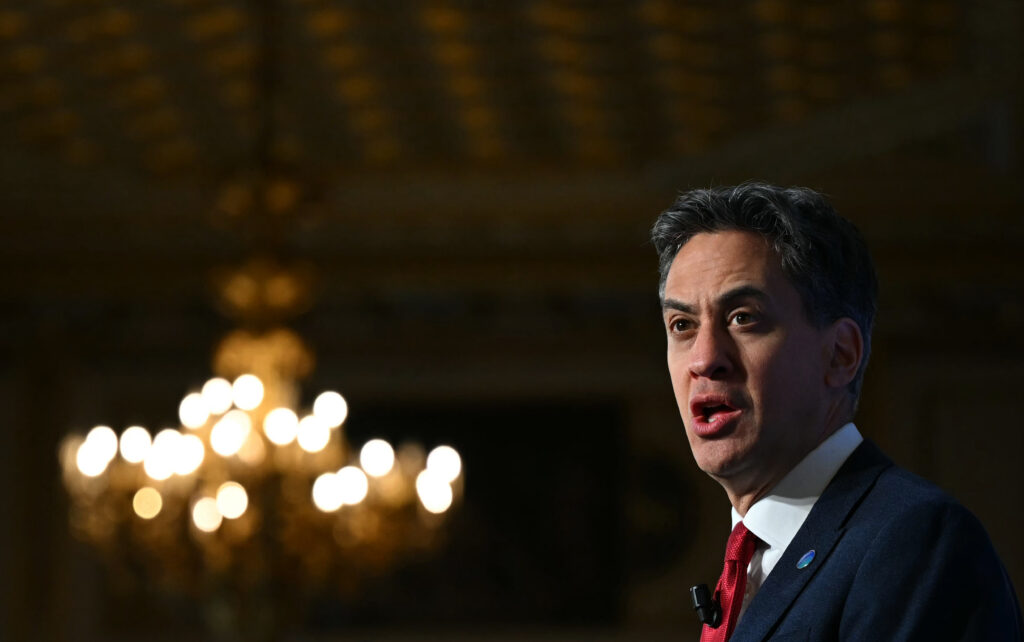
While not mentioning Trump or the U.S., he said the U.K. wanted to “stand on our two feet” and not depend on “markets controlled by petrostates and dictators.”
Wind vs. gas
The goal of the U.K.’s offshore wind drive is to reduce reliance on gas for electricity generation.
One of the most gas-dependent countries in Europe, the U.K. was hit hard in 2022 by the regional gas price spike that followed Russia’s invasion of Ukraine. The government ended up spending tens of billions of pounds to pay a portion of every household energy bill in the country to fend off widespread hardship.
It’s a scenario that Miliband and Starmer want to avoid in future by focusing on producing electricity from domestic sources like offshore wind that are not subject to the ups and downs of global fossil fuel markets.
Trump, by contrast, wants to keep Europe hooked on gas — specifically, American gas.
The U.S. National Security Strategy, updated late last year, states Trump’s desire to use American fossil fuel exports to “project power.” Trump has already strong-armed the European Union into committing to buy $750 billion worth of American liquefied natural gas (LNG) as a quid pro quo for tariff relief.
No one in Starmer’s government explicitly named Trump or the U.S. on Wednesday. But Chris Stark, a senior official in Miliband’s energy department tasked with delivering the 2030 goal, noted that “every megawatt of offshore wind that we’re bringing on is a few more metric tons of LNG that we don’t need to import.”
The U.K.’s investment in offshore wind also provides welcome relief to a global industry that has been seriously shaken both by soaring inflation and interest rates — and more recently by a Trump-inspired backlash against net zero and clean energy.
“It’s a relief for the offshore sector … It’s a relief generally, that the U.K. government is able to lean into very large positive investment stories in U.K. infrastructure,” said Tom Glover, U.K. country chair of the German energy firm RWE, which was the biggest winner in the latest offshore wind investment, securing contracts for 6.9 gigawatts of capacity.
A second energy industry figure, granted anonymity because they were not authorized to speak on the record, said the U.K.’s plans were a “great signal for the global offshore wind sector” after a difficult few years — “not least the stuff in the U.S.”
The other big winner was British firm SSE, which has plans to build one of the world’s largest-ever offshore wind projects, Berwick Bank — off the coast of Donald Trump’s beloved Scotland.



Follow